


Understanding the scope of public health data requires looking closely at how research organizations track nonfatal injuries. When people research how many gun violence survivors in america, they often encounter varying statistics depending on whether the source measures physical gunshot survivors or families and communities impacted by traumatic events. Public health databases typically register tens of thousands of individuals each year who survive physical firearm injuries, alongside millions who experience the secondary trauma of losing loved ones. Exploring responsible ownership principles and non-lethal equipment, such as blank firing training tools, often accompanies wider community discussions about safety and risk reduction.
Community advocacy groups often focus on visibility as a path to collective healing and proactive education. Awareness events like Wear Orange during Gun Violence Awareness Month encourage individuals to stand alongside survivors and highlight sensible prevention measures. The awareness apparel listed below offers ways for participants to express solidarity during rallies, memorial events, or community discussions. Looking at both official public health data and grassroots advocacy gives a clearer picture of how survivors navigate recovery and inspire change.

Pros
- Double-needle stitching at the hem and sleeves helps reinforce the garment borders.
- Lightweight design supports comfortable casual wear during warmer months.
- Classic cut provides a traditional, relaxed silhouette.
Cons
- The product record does not list specific fabric materials, fiber percentages, or care instructions.
- Sizing charts and exact garment dimensions are not provided in the listing data.
This item is a short-sleeve graphic apparel shirt created for individuals participating in Gun Violence Awareness Day and June Wear Orange campaigns. It serves as event or everyday casual clothing for community supporters, survivors, and advocates who want to display the orange ribbon motif. Unlike shooting sports apparel or protective gear, this is a standard novelty t-shirt intended strictly for casual wear.
The supplied product information identifies this specific listing in a black colorway and a 3X-Large size. It is cut in a classic fit, offering a traditional, relaxed silhouette rather than an athletic or compression cut. The product description notes that the shirt features a lightweight construction, making it suitable for casual wear during summer awareness gatherings or indoor functions.
In terms of construction details, the garment incorporates double-needle stitching along the sleeves and bottom hem. This standard stitching technique reinforces the edges to maintain seam integrity during normal wear and routine wash cycles. The primary visual element is an awareness-themed graphic incorporating an orange ribbon and heart motif centered on the chest.
Practical ownership considerations primarily revolve around routine garment maintenance and fit verification. Because the product data does not specify the exact fiber breakdown, such as whether it is all cotton, a synthetic blend, or a tri-blend fabric, buyers should follow standard care practices for graphic t-shirts. Turning the shirt inside out before washing in cold water and drying on low heat can help preserve printed graphics and manage potential shrinkage.
A notable limitation in the supplied data is the absence of a detailed garment dimension chart. Sizing standards can vary widely across apparel manufacturers, especially in extended sizes such as 3X-Large. Prospective purchasers should verify actual chest width and garment length measurements with the seller if exact sizing is a concern prior to ordering.
For shoppers specifically looking for casual apparel to participate in awareness events, this shirt offers a direct visual statement with classic casual styling. It does not provide any technical performance features, moisture-wicking properties, or protective benefits, so expectations should align with standard promotional and casual t-shirts. Confirming the sizing and care instructions with the seller will help ensure the garment meets your expectations.
This listing specifies an apparel item in a 3X-Large size and black color. It is designed with a classic fit, providing a standard, non-fitted silhouette for casual wear.
Because comprehensive dimensional charts are not supplied in the listing details, verifying chest and torso length measurements with the manufacturer or seller is recommended before ordering.
This product is an awareness-themed graphic t-shirt rather than a tactical accessory, range wear, or firearm-related component. Buyers should recognize that it serves purely as expressive casual apparel.
The product description does not specify fabric percentages or pre-shrunk status. Following gentle wash cycles and low-temperature drying will help maintain the graphic and garment shape over time.

Pros
- Lightweight construction suitable for warm outdoor events and gatherings
- Reinforced double-needle stitching along the sleeves and bottom hem
- Thematic orange design directly aligned with national awareness campaigns
Cons
- Specific fabric blend and material percentages are not detailed in the product data
- Listing does not provide explicit garment dimension measurements for fit verification
This product is an apparel item specifically classified as a graphic awareness t-shirt. According to the product description, it is intended to mark National Gun Violence Awareness Day, providing a visual way for individuals, family members, or friends to take part in community anti-violence recognition. Unlike functional range apparel or protective tactical garments, this shirt is designed exclusively as casual statement wear for public events, community gatherings, or everyday casual use.
Verified physical characteristics include a lightweight construction, a classic fit profile, and double-needle stitching along both the sleeve cuffs and the bottom hem. The specific listing corresponds to an X-Small size in an orange colorway, which reflects the traditional color associated with nationwide gun violence awareness campaigns. The lightweight designation suggests a profile suitable for warm-weather gatherings or indoor layering.
Regarding garment design and construction, the listing highlights double-needle hems as a primary finishing detail. This stitching method is standard for casual knitwear to help prevent unraveling and maintain edge shape. However, specific textile composition details-such as whether the garment is made from ring-spun cotton, a polyester blend, or a tri-blend fabric-are not documented in the supplied record. Buyers who are particular about fabric breathability or stretch will need to consider this an unspecified variable.
Practical ownership considerations center on fit assessment and standard garment laundering. Because graphic t-shirts can react differently to hot-water washing or machine drying depending on their undisclosed fiber makeup, following gentle wash routines can help preserve the print and prevent unintended shrinkage. Since apparel fit varies widely across brands, checking standard sizing standards is a necessary step prior to ordering.
The primary limitations of the supplied data involve missing specifications. The listing does not include exact garment dimensions such as chest circumference, shoulder width, or body length. Furthermore, details regarding fabric care, pre-shrunk status, and country of origin are not provided in the catalog record. Buyers should verify sizing standards directly with the seller if exact fit is a concern.
For individuals looking for event-focused apparel to participate in National Gun Violence Awareness Day, this shirt provides a straightforward option featuring a classic fit and the recognized orange theme. Purchasing decisions should balance the clear event-based graphic styling against the lack of published fabric blend details, ensuring the cut and size meet your individual apparel preferences.
The product data classifies this garment under apparel with an X-Small size designation and a standard classic fit profile. It incorporates a double-needle sleeve and bottom hem designed to maintain finished edge structure during normal wear.
Because exact garment measurements such as chest width and length are not listed, buyers should consult standard apparel sizing charts or confirm dimensional details with the manufacturer before ordering.

Pros
- Appropriate themed design for June awareness campaigns and community gatherings
- Classic fit silhouette with lightweight material construction
- Reinforced double-needle stitching along the sleeves and hemline
Cons
- Specific fabric blend details such as cotton or polyester percentage are not provided
- Detailed sizing dimensions and garment care instructions should be verified prior to purchase
This item is a short-sleeve graphic t-shirt categorized under apparel, featuring a themed butterfly and orange ribbon design. According to the product data, it is designed for individuals participating in June Wear Orange events, community awareness campaigns, or advocacy activities. Rather than functional outdoor or shooting gear, this product serves strictly as awareness-oriented personal apparel.
The shirt is listed in black and size Small, featuring a lightweight fabric build and a classic fit cut. Documented construction details include double-needle stitching on both the sleeves and bottom hem, which is a standard garment finishing method intended to help edges hold their shape during everyday wear.
Buyers considering this shirt should evaluate standard apparel fit and sizing practices. Because the provided listing details do not specify the exact fiber breakdown, such as whether the garment is 100 percent cotton, polyester, or a blended weave, buyers should verify fabric composition and manufacturer care instructions to prevent unexpected shrinkage during laundering.
The product record provides basic garment specifications but omits comprehensive sizing charts, fabric weight measurements, and country of origin. Additionally, customer reviews are not available in the current dataset, meaning buyers must rely strictly on standard apparel sizing norms and retailer guidance for fit verification.
For supporters, advocates, or community participants seeking themed clothing for June awareness events, this shirt offers an explicit graphic design with classic t-shirt construction. Prospective purchasers should confirm sizing charts and material specifications with the retailer to ensure the garment matches their preferred comfort and fit.

Pros
- Moisture-wicking properties help keep the wearer dry during warm-weather gatherings
- UPF 50 rating provides documented ultraviolet sun defense for daytime outdoor use
- Snag-resistant fabric helps maintain the garment surface during everyday wear
- Standard cut offers versatile sizing without being overly restrictive
Cons
- Exact textile composition and fabric blend percentages are not specified in the listing data
- Detailed chest, shoulder, and length measurements are omitted from the supplied specifications
This product is an awareness-themed short-sleeve athletic t-shirt designed for individuals participating in National Gun Violence Awareness Day, community walks, rallies, or everyday casual wear. Marketed under the June Gun Violence Awareness Apparel brand, it serves as expressive apparel for supporters, families, educators, and activists seeking an event-ready graphic top.
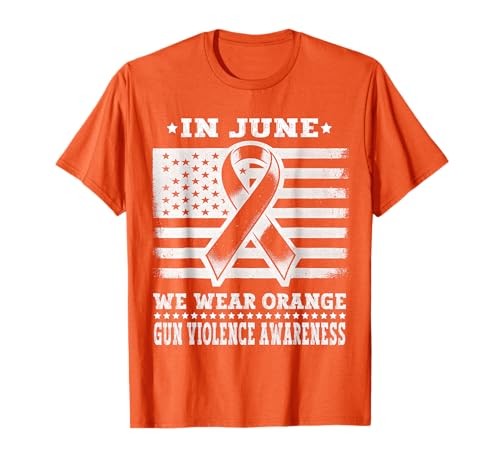
The shirt is tailored in a standard fit, designed to provide a balanced silhouette that avoids excessive tightness while preventing an overly loose drape. This specific product listing corresponds to a size Small in black, tailored for standard mens sizing. The graphic design incorporates the Wear Orange awareness messaging and flag-themed artwork, making its visual intent straightforward.
In terms of construction, the shirt features technical performance fabric engineered for active use. The material is moisture-wicking to assist in temperature and sweat regulation during outdoor events in warmer months. Additionally, the garment includes built-in UPF 50 solar protection, which offers ultraviolet coverage during daytime rallies and marches, alongside snag-resistant fabric technology to minimize pulls from contact with rough surfaces or accessories.
For practical ownership, care routines for synthetic performance fabrics generally involve washing with like colors in cold water and avoiding high heat drying or fabric softeners that could degrade moisture-wicking treatments or graphic prints. As with any outdoor athletic apparel, users should evaluate how the standard cut pairs with their personal layering preferences and regional weather conditions.
Prospective buyers should take note of a few missing technical details in the supplied listing. The exact fiber blend, such as the specific ratio of polyester, nylon, or elastane, is not stated in the product data. Furthermore, detailed chest, shoulder, and length measurements are absent, meaning buyers should confirm standard sizing practices or check sizing guides prior to ordering to ensure proper torso and shoulder fit.
Overall, this performance shirt represents a functional choice for buyers specifically seeking commemorative or awareness attire with activewear features. If you need a lightweight, sun-protective top for summer rallies, outdoor awareness days, or casual athletic wear, its documented UPF 50 rating and moisture-wicking construction meet those needs directly without requiring specialized care.
This garment is classified under mens apparel and is listed in a size Small with a black base color. It features a standard fit profile designed to offer a balanced silhouette that falls naturally between loose athletic cuts and fitted compression garments.
Because exact garment measurements such as chest circumference, sleeve opening, and torso length are not supplied in the listing data, prospective buyers should consult standard apparel sizing charts or verify sizing recommendations before purchasing.

Pros
- Lightweight design suited for June outdoor gatherings and awareness walks
- Double-needle stitching at the hem and sleeves helps maintain garment structure
- Stated classic fit offers a traditional, non-restrictive cut
Cons
- Specific fabric blend details such as cotton or polyester percentages are not listed
- Specific dimensional measurements like chest width and garment length are omitted
This product is an apparel item classified under casual clothing, designed specifically to mark Gun Violence Awareness Month in June. The garment is intended for advocates, community participants, and individuals who want to show support for the national orange ribbon campaign during organized events, community walks, or everyday activities.
According to the manufacturer listing, the t-shirt is built with a classic fit profile in a size Small and features a black colorway. The construction utilizes double-needle stitching across the sleeve cuffs and the bottom hem, which is a standard finishing technique used to reduce fraying and keep edges flat during normal wear.
The visual design features graphic text and a rainbow leopard pattern centered on the June awareness theme. The manufacturer positions this graphic as a way for family members, survivors, and supporters to visibly participate in awareness efforts throughout the month.
Practical wear considerations center on personal comfort and sizing. Because exact garment dimensions such as sleeve length, chest circumference, and total body length are not specified in the product record, buyers should consult general t-shirt sizing charts before making a purchase. In addition, checking the sewn-in label upon receipt is advisable to confirm appropriate laundering instructions.
A notable limitation of the supplied listing data is the absence of material composition details, leaving it unverified whether the garment is 100 percent cotton, a synthetic blend, or pre-shrunk fabric. Buyers seeking an event-ready graphic tee for June will find the design matches stated awareness themes, though those with specific fabric preferences will need to verify the material makeup directly with the seller.
The supplied product information identifies this shirt as a size Small with a standard classic fit cut. The base fabric color is black, providing contrast for the front graphic print.
Documented physical attributes include lightweight fabric handling and double-needle hem reinforcement. Specific sizing tolerances and fabric stretch characteristics are not detailed in the product specifications, making it important to confirm standard apparel measurements prior to selection.


Pros
- Double-needle sleeve and bottom hem provide dependable seam construction
- Lightweight design supports breathability during summer awareness activities
- Stated classic fit offers standard casual apparel styling
Cons
- Specific fabric composition and material percentages are not stated in the product data
- Detailed sizing chart measurements and shrinkage expectations are not provided
- Care and laundering instructions are omitted from the supplied specifications
This apparel item is a graphic t-shirt designed for individuals observing National Gun Violence Awareness Month in June. The garment serves as visual support for community prevention efforts, advocacy gatherings, and public awareness campaigns. Because it falls squarely into the casual apparel category rather than tactical gear or shooting apparel, it is intended strictly for everyday wear and community participation rather than range utility.
The product record specifies a lightweight build cut in a standard classic fit. In this specific configuration, the shirt comes in black and size small. The lightweight designation suggests it is suitable for warm summer weather, aligning with June awareness events. The classic fit generally indicates a relaxed cut through the torso rather than an athletic or compression profile, offering ease of movement for general activities.
Regarding construction, the t-shirt incorporates double-needle stitching along the sleeves and bottom hem. Double-needle hems are an industry standard for casual knitwear, reinforcing high-stress points to help prevent fraying and unravelling through standard wear and laundering cycles. The supplied data does not detail specific fiber percentages, such as whether the shirt consists of all-cotton jersey, a cotton-polyester blend, or tri-blend fabric.
For practical ownership, standard apparel upkeep applies. Buyers should evaluate garment fit upon arrival, ensuring the chest and shoulder dimensions match personal comfort preferences. Because printed graphic tees can be sensitive to high heat, standard laundering practices typically involve washing inside-out in cold water and drying on low heat to maintain the print and fabric integrity, though specific care instructions are not detailed in the manufacturer listing.
A significant unknown for prospective buyers is the exact fabric composition and corresponding shrinkage behavior. Without documented fabric percentages or a dimensional size chart, purchasers cannot confirm whether the garment will shrink under standard washing or how soft the material feels against the skin. Buyers should verify exact sizing measurements and material details before ordering, particularly if they fall between conventional shirt sizes.
This shirt provides a straightforward option for individuals seeking casual apparel centered on gun violence awareness and community prevention messaging. While it lacks detailed textile specifications and specific wash guidelines, the double-needle construction and lightweight design match typical needs for outdoor rallies and seasonal wear. Checking individual sizing requirements beforehand will help ensure the best fit for your intended use.
The garment is classified as casual apparel in a classic fit silhouette. Documented specifications list the color as black, the size as small, and the construction as lightweight fabric with double-needle hems. Prospective buyers should confirm chest, length, and shoulder measurements with standard sizing standards before purchase.
A Detailed Examination of Gun Violence Survival and Awareness in the United States
Understanding the scope of survival requires examining emergency medicine, public health reporting, and community aftermath across the United States. Direct answers to this inquiry depend on whether one examines direct physical injury statistics or the wider umbrella of personal trauma. Reliable public health tracking suggests that millions of Americans live with the physical and psychological aftermath of firearm violence today. Examining both clinical definitions and community responses provides a thorough framework for understanding these numbers.
Defining Survivor Status: Direct Physical Trauma Versus Secondary Impact
Public health researchers generally distinguish between primary survivors and secondary survivors when evaluating violence data. Primary survivors include individuals who experienced direct gunshot wounds and survived their physical injuries through medical intervention. Secondary survivors encompass immediate family members, close friends, eyewitnesses, and neighbors who endure severe psychological aftermath following an incident. Distinguishing between these two categories helps researchers establish clear epidemiological baselines while validating the emotional grief of affected communities.
Advocacy organizations often adopt broader, more inclusive frameworks that recognize emotional and social trauma as valid forms of survival. A person who loses a child, spouse, sibling, or parent to a firearm incident experiences lifelong disruption that alters their daily trajectory. Research surveys often show that over half of American adults report having a personal connection to gun violence, either directly or through a loved one. Both statistical precision and compassionate understanding are necessary when evaluating what it means to survive an event.
Annual Nonfatal Gunshot Injuries and Emergency Department Trends
Hospital emergency departments provide the most direct baseline for tracking nonfatal gunshot injuries in the United States. Federal tracking systems and healthcare databases indicate that between seventy thousand and one hundred thousand nonfatal firearm injuries occur in a typical year. These figures fluctuate based on demographic shifts, regional law enforcement reporting, and changes in hospital coding practices. Advances in emergency trauma medicine mean that a higher percentage of victims survive severe injuries today compared to past decades.
Physical survival marks only the beginning of an extensive, multifaceted recovery process for these patients. Survivors often navigate prolonged surgical interventions, physical therapy, chronic nerve pain, and permanent mobility impairments. Brain injuries, organ damage, and amputations represent common long-term outcomes for patients who survive high-velocity or close-range trauma. The ongoing medical costs and rehabilitation needs place immense strain on both family finances and regional healthcare systems.
Cumulative National Estimates: How Many Living Survivors Exist Today?
Calculating the total number of living direct survivors requires aggregating decades of emergency department admissions and discharge records. Because annual nonfatal injury counts regularly exceed eighty thousand, epidemiologists estimate that well over one million living Americans have survived a physical gunshot wound. This cumulative population spans multiple generations, from young adults injured in urban disputes to older individuals surviving accidental discharges or self-harm attempts. The medical and support needs of this population evolve over time, requiring specialized community health resources.
Expanding the calculation to include indirect survivors increases the estimate into tens of millions of individuals across the country. Social science surveys repeatedly demonstrate that roughly one in five Americans personally knows someone who died from a firearm-related injury. Adding those who witnessed shootings in schools, workplaces, shopping centers, or places of worship further enlarges the scope of affected individuals. Understanding the scale of this demographic explains why survivor-led advocacy has become such a prominent cultural force across the country.
Psychological Trauma and the Path Toward Long-Term Emotional Healing
Emotional recovery often proves just as challenging as physical healing for individuals recovering from violent incidents. Post-traumatic stress, anxiety disorders, severe depression, and sleep disruptions frequently affect direct survivors and their household members. Survivors often report hypervigilance in public spaces, recurring flashbacks, and difficulties maintaining employment or continuing education. Mental healthcare professionals emphasize that specialized trauma therapy is essential for restoring stability and personal self-efficacy.
Peer support groups establish critical social environments where survivors can share their experiences without fear of judgment or misunderstanding. Connecting with others who have navigated similar emotional turmoil helps reduce the isolation that often accompanies violent trauma. Community organizations frequently pair newly injured individuals with long-term survivors who provide practical guidance on navigating disability, legal processes, and medical bills. These relational networks reinforce resilience and empower survivors to reclaim agency in their daily lives.
Data Collection Methodologies, Surveillance Systems, and Reporting Gaps
Tracking firearm injuries across the nation involves significant methodological challenges and data fragmentation. The Centers for Disease Control and Prevention maintains injury surveillance databases, but reporting participation varies among state and municipal hospitals. Some jurisdictions classify assault injuries differently from unintentional discharges or self-inflicted wounds, complicating national comparisons. Incomplete reporting in rural healthcare facilities can also lead to undercounting of nonfatal incidents in certain geographic areas.
Independent research organizations like the Gun Violence Archive work to verify incidents through police reports, media accounts, and public records. While these initiatives improve real-time situational awareness, discrepancies between public health estimates and law enforcement metrics remain common. Educational researchers and recreational target shooters examining training gear, such as realistic CO2 airgun platforms, also highlight the necessity of clear categorizations between true firearms and recreational airguns in statistical surveys. Accurate categorization ensures that public health policies reflect verifiable data rather than ambiguous classifications.
The Origins and Significance of the Wear Orange Movement
The modern movement to recognize gun violence survivors gained national momentum following the tragic death of Hadiya Pendleton in Chicago. Her classmates chose to wear blaze orange, the color hunters wear to signal safety and warn others of their presence, to honor her life and demand greater community safety. This grassroots tribute evolved into National Gun Violence Awareness Day, observed annually on the first Friday in June, alongside Gun Violence Awareness Month. Today, community members, survivors, civic buildings, and grassroots organizations wear orange to amplify survivor voices and demand actionable safety solutions.
Awareness campaigns serve multiple public purposes by providing visible solidarity, reducing stigma, and promoting evidence-based safety dialogue. Wearing bright orange creates an immediate visual statement during marches, community forums, and memorial walks across the country. These events foster environments where survivors can publicly share their stories and educate their neighbors on local violence intervention programs. Public visibility helps transform private grief into collective determination, urging communities to address root causes collaboratively.
Evaluating Awareness Apparel and Fabric Considerations for Public Events
Participants in community rallies and awareness walks often choose specialized apparel to identify with the movement. When selecting t-shirts and apparel items, evaluating fabric composition, breathability, and stitch quality ensures comfortable wear during warm summer events. Garments constructed from pure cotton or high-performance polyester blends provide distinct trade-offs regarding moisture absorption, softness, and durability through repeated washings. Apparel featuring clear iconography, such as orange awareness ribbons, heart motifs, or butterflies, allows participants to communicate their message clearly.
Sizing and print durability represent practical factors when purchasing commemorative shirts for large community groups. Reviewing manufacturer sizing charts helps organizers ensure an appropriate fit across diverse body types and age groups. Screen-printed graphics and heat-transferred vinyl designs handle laundering differently, with higher-quality inks resisting cracking and fading over extended wear cycles. Investing in well-constructed garments ensures that awareness messages remain sharp and readable throughout multiple awareness campaigns and public gatherings.
Responsible Firearm Ownership, Secure Storage, and Preventative Measures
Discussions surrounding survivor experiences inevitably intersect with practical measures for safe and responsible firearm handling. Safety advocates and responsible firearm owners agree that secure storage practices substantially lower the risk of unauthorized access and tragic household accidents. Utilizing heavy-gauge steel gun safes, biometric lockboxes, and sturdy trigger locks ensures that firearms remain inaccessible to curious children or unauthorized users. Keeping firearms unloaded and storing ammunition in a separate locked compartment creates redundant safety barriers within any household.
Formal safety training and ongoing education provide firearm owners with the skills needed to handle equipment safely under various conditions. Qualified instructors emphasize muzzle discipline, target identification, and continuous situational awareness as fundamental tenets of responsible ownership. Regular maintenance, proper cleaning, and thorough familiarity with manufacturer specifications prevent mechanical malfunctions and accidental discharges. Safe ownership habits directly contribute to reducing the frequency of preventable injuries across every community.
Community-Level Interventions and Practical Support for Survivor Networks
Supporting survivor networks requires sustained commitment that extends far beyond seasonal awareness months. Community violence intervention programs deploy trained street outreach workers to mediate disputes before conflicts escalate into physical violence. Hospital-based intervention initiatives connect bedside social workers with trauma victims immediately following an injury to break cycles of retaliatory violence. These evidence-informed strategies have demonstrated measurable success in lowering local injury rates across diverse metropolitan centers.
Individuals wishing to support survivors can contribute through volunteer advocacy, legislative engagement, and grassroots community organizing. Assisting local trauma recovery centers provides tangible relief to families dealing with sudden medical debt, physical rehabilitation, and funeral expenses. Sharing educational resources on safe storage and suicide prevention within local neighborhood associations strengthens community safety standards. Every proactive intervention helps build a safer environment where future generations face fewer risks of traumatic injury.
Educational Resources, Crisis Helplines, and Victim Assistance Programs
Connecting survivors to reliable mental health resources and victim compensation funds is a critical component of post-incident recovery. Most states maintain crime victim compensation programs that help cover medical bills, mental health therapy, and lost wages resulting from violent crimes. Navigating application paperwork can prove overwhelming for families in crisis, making victim advocates stationed in hospitals and community centers indispensable. Timely financial and logistical support prevents temporary emergencies from turning into chronic household instability.
National helplines and specialized crisis lines offer immediate counseling for survivors experiencing acute post-traumatic distress or intrusive thoughts. Many organizations now offer text-based support services specifically designed for younger demographics seeking confidential assistance. Connecting with local peer-led recovery circles provides continuing validation as survivors work through complex emotional milestones over several years. Knowing where to locate reliable crisis support empowers both survivors and their caregivers during critical moments of need.
Summary of Survivor Realities and Ongoing Public Awareness
Evaluating the true scope of gun violence survival requires balancing precise clinical metrics with an appreciation of broad social impacts. While hospital statistics identify tens of thousands of newly injured physical survivors annually, the broader community of affected individuals numbers in the millions. Awareness campaigns like Wear Orange provide vital platforms for remembering victims and supporting those navigating long-term physical and emotional recovery. Combining compassionate survivor support with rigorous storage safety and community-based intervention creates the most balanced path toward lasting harm reduction.


Write Your Review
No reviews yet. Be the first to share your experience!