


A precharged pneumatic (PCP) air rifle needs compressed air, so charging it means transferring air from a compatible source into its reservoir. The exact connection and filling requirements depend on the rifle, not on a universal air-gun fitting. If you’re asking how do you charge a pcp air rifle, the safe starting point is the rifle maker’s manual: confirm the specified pressure limit, connector, and approved air source before attaching anything.
PCP owners may use a hand pump, a high-pressure tank, or a compressor, but a source must be designed for the rifle’s pressure and compatible with its fill system. That equipment affects the practical cost and convenience of owning a PCP, and adapters are not automatically interchangeable. Our PCP filling guide and air-rifle refill overview cover related setup questions; this article explains the charging process and the equipment distinctions behind it.
Top Products

Pros
- Solid build quality from a trusted brand in airguns
- Portable enough to take on hunting trips or range days
- Oil-free design means less hassle and cleaner operation
Cons
- Higher price point compared to manual pumps or smaller compressors
- May require a deep-cycle battery when using 12V DC for extended fills
- No built-in moisture filter (some users may want to add one for extra protection)
The Umarex ReadyAIR Gen 2 is a portable high-pressure air compressor built specifically for PCP air rifle and airgun owners. This second-generation model improves on the original with a smaller footprint, lighter weight, an oil-free pump, and an upgraded programmable digital display. It accepts both 12V DC power (direct to a vehicle’s battery) and standard 110V AC household power, giving shooters the freedom to fill tanks at home or in the field.
This compressor is best suited for hunters, target shooters, and outdoor enthusiasts who use PCP air rifles and need a reliable way to top off tanks without relying on a dive shop or hand pump. According to the product description, it can fill a 24-cubic-inch tank from empty to 4,500 PSI in about 18 minutes. Refills on partially depleted tanks take much less time, which means less downtime between shots.
Build quality looks solid. The oil-free design eliminates the need for frequent oil changes and reduces mess during transport and storage. The digital interface lets you set a precise cutoff pressure, so the compressor stops automatically once your tank reaches the desired pressure. This is a nice safety and convenience feature that many users appreciate.
One realistic limitation is power consumption. When using the 12V DC mode, you’ll want a strong battery (like a deep-cycle marine battery) to avoid draining your vehicle’s starter battery. Also, while the compressor is quieter than many larger units, it’s still not silent. Some users may want to add an inline moisture filter for humid environments, though the unit itself is designed to run clean.
Overall, the ReadyAIR Gen 2 is a practical investment for serious PCP airgun enthusiasts who value portability, ease of use, and consistent performance. It’s not a budget option, but for those who shoot frequently, it can save time and hassle compared to other filling methods.
This section typically covers blade performance, but the ReadyAIR Gen 2 is not a cutting tool. Instead, think of its “cutting” capability in terms of how efficiently it fills PCP air tanks. Based on the product specs, the compressor delivers up to 4,500 PSI and fills a 24-cubic-inch tank from empty in roughly 18 minutes. That’s a solid fill rate for a portable unit.
The oil-free pump operates smoothly and the programmable cutoff helps prevent over-pressurization. The dual-voltage flexibility means you can use it on a workbench with 110V AC or in the field with 12V DC, so you’re not limited to one power source. According to the features, hooking up the fill hose and setting the desired pressure is straightforward, making it easy to get back to shooting quickly.
For precision, the digital readout lets you monitor pressure in real time, so you can stop exactly where you want. The compressor is designed for PCP airguns specifically, so it’s optimized for that task rather than for general high-pressure needs. Users will find it reliable for repeated fills during a day at the range or a hunting trip.
The ReadyAIR Gen 2 has a noticeably smaller footprint than the first generation, making it easier to pack in a vehicle or carry to a shooting spot. The oil-free pump is a key improvement—no oil changes, no messy spills, and less overall maintenance. The case appears durable and built to withstand transport and regular use.
Weight is lighter than many comparable units, though it’s still a substantial piece of gear. Portability is enhanced by the dual-power capability: you can run it off a car battery or a wall outlet without needing an inverter. The digital interface is clear and intuitive, with a programmable cutoff that simplifies operation.
Ergonomics are good for a compressor—the handles and controls are accessible, and the fill hose is long enough to reach most airgun tanks comfortably. Storage is straightforward, and the unit packs away without taking up too much bench or truck space. Corrosion resistance isn’t a major concern since the pump is oil-free and the exterior is built for outdoor use.
Overall, the design balances ruggedness with practicality. It’s not a tool you’ll carry in your pocket, but for shooters who need mobile high-pressure air, it’s a well-thought-out solution.


Pros
- High-pressure rating matches modern PCP airgun requirements
- Threaded connections fit Hatsan Long BullBoss without modifications
- Compact 17.3 inch length fits inside most rifle stocks or bags
Cons
- Compatibility is limited to Hatsan Long BullBoss and similar models with identical threads
- No pressure gauge included (must rely on external fill system or rifle's own gauge)
- 4500psi requires a compatible high-pressure compressor or tank for refilling
This air tube from airmega is a drop-in replacement or spare fill cylinder specifically designed for the Hatsan Long BullBoss PCP air rifle. It is ideal for airgunners who hunt small game or spend long days at the range and want to maximize their shot count without stopping to refill.
Constructed from black anodized aluminum, the tube holds 200cc of air at up to 4500psi. Users report that the built-in valve and standard threading (M18x1.5 and M30x1.5) allow straightforward installation. The protective cap adds security during storage or in a pack.
While not a cutting tool, this cylinder directly impacts the performance of a hunting airgun. A reliable air supply means more shots and consistent velocity, which is critical for ethical hunting. The lightweight design (0.95 lbs) won't weigh down your rifle, and the length is manageable for transportation in a gun case or backpack.
A realistic drawback is the reliance on a high-pressure fill source. Without a compressor or tank rated to 4500psi, you may need to seek a dive shop or specialized setup. Also, there is no built-in gauge, so you must monitor fill pressure externally.
Overall, this is a practical upgrade for owners of the Hatsan Long BullBoss who need extra air capacity for extended field use. It offers good value for the price and should serve well for hunting, pest control, or target shooting.
This air tube does not directly cut, but it enables the cutting performance of the Hatsan Long BullBoss air rifle. More air capacity means you can sustain higher shot counts without velocity drop, which translates to consistent pellet energy for clean kills and humane game processing.
For hunters, that means reliable performance when field dressing small game after a successful shot. The tube's 4500psi rating supports high power for accurate shots on squirrels, rabbits, and birds. While not a blade, its role in delivering consistent air pressure is critical for the cutting effectiveness of the projectile.
Target shooters also benefit from uninterrupted sessions, allowing more practice on precision shots. The tube's capacity directly influences how many shots you can fire before needing to refill, which is especially valuable in field or competition settings.
The air tube is machined from aluminum with a black anodized finish that resists scratches and corrosion. The threading (M18x1.5 on one end, M30x1.5 on the other) is precisely cut for a snug fit with the Hatsan Long BullBoss fill port. The built-in valve appears to be brass or stainless steel, providing reliable sealing at high pressure.
Weighing just 0.95 lbs and measuring 17.3 inches long, it is easy to carry as a spare. The protective cap is plastic but snug, shielding the threads and valve from dirt and impact during transport. The tube feels solid with no sharp edges. However, the lack of a pressure gauge means you must rely on your rifle's gauge or an external fill station to monitor air level.
Ergonomically, the tube is not a handheld item; it mounts inside the gun's air cylinder slot or replaces the original cylinder. Installation requires basic tools and knowledge of PCP airgun maintenance. Overall, the build quality appears adequate for its price point, and the black finish matches most airgun aesthetics.

Pros
- Resilient stainless steel fabrication prevents corrosion and thread damage
- Integrated check valve prevents unwanted backflow during disconnect
- Standard Foster quick-coupling interface allows swift operation
- Cost-effective replacement part for maintaining PCP charging stations
Cons
- Buyers must carefully verify their specific port thread pitch before installation
- Does not include replacement sealing washers, O-rings, or thread sealant tape
- Specific maximum operating pressure rating is not listed in the manufacturer data
The heyous Stainless Steel One-Way Foster Fill Nipple Adapter is a specialized pneumatic charging fitting intended for pre-charged pneumatic (PCP) air rifles, paintball markers, and high-pressure charging cylinders. In the airgun community, maintaining reliable air delivery from an external compressor, hand pump, or SCBA tank to a rifle reservoir is essential for consistent shooting sessions. This component functions as a male quick-disconnect terminal that links high-pressure supply hoses directly to the air reservoir interface.
This adapter is best suited for recreational air rifle plinkers, target shooters, and airgun competitors who frequently replenish onboard air cylinders. Enthusiasts managing multiple charging accessories or looking for a durable replacement for brass fittings will appreciate the mechanical stability of stainless steel. It also serves as a practical, low-cost spare for an airgun maintenance bench or range pack, preventing a downed rifle during an extended afternoon of target practice.
From a construction standpoint, the fitting utilizes stainless steel to achieve solid durability, rust prevention, and resistance against mechanical abrasion. High-pressure air fittings undergo substantial stress during filling and venting cycles. The integrated one-way check valve is designed to close under backpressure, helping retain air within the system and enabling a smooth, controlled disconnect process once the charging line is depressurized. The smooth surface finish also minimizes wear on the mating female Foster coupler locking collars.
Operation and integration remain straightforward, as the quick-plug profile interfaces directly with standard quick-disconnect sleeves common on airgun fill whips. However, prospective buyers should exercise caution regarding thread compatibility. The listing references both M8x1 and 1/8 NPT threading, making it crucial for users to measure and confirm their hose or cylinder receiver port before tightening. Because pneumatic threads require appropriate sealing, proper installation with suitable thread sealant or bonded seal washers is necessary to ensure an airtight lockup.
While this adapter provides a robust, wear-resistant solution for airgun hobbyists, it does lack explicit documentation regarding peak operating pressure (PSI/bar limits) and does not come bundled with spare sealing components. For PCP air rifle shooters and recreational target sports enthusiasts needing a dependable, rust-free connection point for routine bench recharging, the heyous Foster fill nipple represents a practical and economical hardware upgrade.
The heyous fill nipple features a male Foster quick-disconnect profile on one end and male threads on the connection base. This setup is engineered to pair with standard pneumatic female quick-release couplers typically attached to high-pressure hand pumps, electronic air compressors, or SCBA fill whips.
Because the product specifications cite M8x1 and 1/8 NPT threads, shooters must verify whether their receiving block requires a straight metric thread with an O-ring or a tapered pipe thread. Ensuring thread pitch match is essential to prevent cross-threading and to maintain a secure, leak-free high-pressure seal during every cylinder recharge.
Manufactured from stainless steel, this fill adapter resists atmospheric corrosion, moisture, and galling far better than softer brass counterparts. This resilience is especially advantageous for shooters who fill reservoirs outdoors or transport their gear in humid field environments.
Routine maintenance involves inspecting the outer sealing surface and internal check valve for dust, grit, or lint that could compromise the internal seat. Keeping the male quick-connect clean and applying a thin wipe of pure silicone grease designed for high-pressure air systems will help prolong seal longevity and ensure smooth disconnect action.

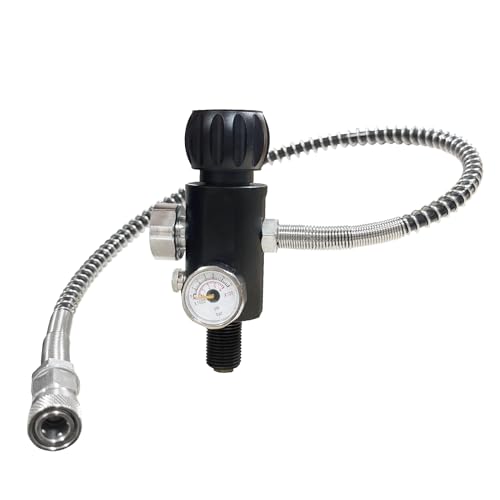
Pros
- Dual pressure gauges simplify tracking bottle reserve and target fill pressure simultaneously
- Standard 8mm quick-disconnect fitting connects easily to common PCP rifle fill probes
- Integrated 6000 PSI burst disc and manual bleed valve enhance user safety
- Flexible 50cm hose provides convenient reach during bench or tailgate refills
Cons
- Specific to 5/8-18UNF threads and will not fit metric M18x1.5 cylinders without an adapter
- Compact gauge faces require close visual inspection in bright outdoor sunlight
- Requires careful familiarity with high-pressure air safety protocols prior to use
The Pautaca 5/8-18UNF 4500 PSI Charging Valve is a dedicated high-pressure air fill station designed for pre-charged pneumatic airgunners and paintball players. Whether you are topping off a precision air rifle for small game hunting or running drills at the shooting range, having a reliable mechanism to transfer compressed air from a supply cylinder is essential. This valve assembly caters to target shooters, outdoor enthusiasts, and airgun hunters who demand steady control over their air supply without relying on commercial fill shops every session.
Operating high-pressure air equipment requires accurate monitoring to ensure equipment safety and shot consistency. Based on product specifications, this charging station features a dual-gauge layout that delivers clear feedback at a glance. One gauge tracks the pressure remaining inside your main supply cylinder, while the second gauge shows the real-time filling pressure entering your air rifle reservoir. This setup helps marksmen hit their exact target pressure up to 4500 PSI, protecting delicate air rifle seals and helping maintain consistent muzzle velocities across long strings of fire.
Build quality and hardware convenience are critical when working under extreme pressure. The valve includes a 50cm high-pressure microbore hose that offers enough reach to position your air rifle comfortably on a shooting bench or truck tailgate without placing stress on the valve neck. Terminating in a standard 8mm female quick-disconnect foster fitting, the line connects smoothly to most PCP fill probes and paintball tank nipples, making field refills rapid and tool-free during active shooting sessions.
Safety remains paramount in high-pressure air handling, and the system incorporates several protective measures. A dedicated 6000 PSI burst disc is integrated directly into the assembly, providing overpressure relief to safeguard against overfilling past the 4500 PSI working threshold. Additionally, a built-in bleed valve allows users to depressurize the transfer hose completely before disconnecting. This controlled release eliminates violent hose whip and protects the internal O-rings on your rifle fill probe from getting damaged by trapped air.
Before buying, verify your storage cylinder matches the 5/8-18UNF thread pattern, as air cylinders with metric M18x1.5 or DIN valves will require adapters. While the dual gauges are compact and require a steady look in direct sun, the overall unit provides a dependable, budget-conscious charging solution. For sport shooters and hunters seeking an accessible, safety-equipped charging station for their PCP air rifles, this fill valve offers practical utility for home fill stations and mobile range kits alike.
Managing air at 4500 PSI requires dependable failsafes, and this fill station includes built-in safeguards to protect both the shooter and the firearm. The integrated burst disc is rated for 6000 PSI, providing an emergency mechanical pressure release if a fill cylinder accidentally exceeds safe working parameters.
Safe disconnection is handled via a dedicated release valve knob. Depressurizing the line before unplugging the 8mm quick-release coupler prevents dangerous line discharge and prevents seal degradation on fill probes. Keeping the threads clean and periodically inspecting the seals ensures safe operation across seasons of target practice and hunting outings.
This charging station is engineered with 5/8-18UNF male threads, making it suitable for high-pressure air cylinders configured with this specific neck size. Shooters should verify their tank neck specifications prior to installation to confirm a secure, airtight seal.
On the output side, the 50cm flexible line terminates in an industry-standard 8mm female quick-disconnect foster socket. This design easily locks onto standard male quick-fill studs commonly found on PCP air rifles, paintball marker tanks, and universal fill adapters, ensuring broad compatibility across typical airgun platforms.

Pros
- Stainless steel construction resists corrosion and handles high pressure well.
- Compatible with a broad range of popular PCP air rifle models.
- Comes with spare O-rings, adding value and convenience for maintenance.
- Arc-shaped tip aids in quick and accurate port alignment.
- Affordable price point makes it an easy upgrade for any PCP shooter.
Cons
- No customer reviews yet, so real-world longevity is not verified.
- May not fit all PCP models; users should confirm compatibility with their specific rifle.
- Requires a separate high-pressure air source (hand pump or tank) to function.
The Aopkeo HP Air Charging Probe Fill Adapter is a specialized accessory for PCP (pre-charged pneumatic) air rifle owners. It acts as the interface between your high-pressure air source and your rifle's fill port, allowing quick and secure refills. Based on the product specifications, this stainless steel probe handles up to 4500psi, which covers the majority of PCP air rifles on the market today.
This adapter is best suited for air rifle enthusiasts, pest control shooters, field target competitors, and hunters who rely on PCP platforms. Its arc-shaped bottom is designed to simplify insertion into the rifle's fill port, which can be a small convenience during repeated fills. The included six spare O-rings are a thoughtful addition, as O-rings are a common wear item in high-pressure systems.
In terms of real-world performance, the precise dimensions should help maintain a tight seal, reducing air loss during filling. That matters for consistent shot-to-shot pressure and overall efficiency at the range. The stainless steel body is a plus for durability and corrosion resistance, especially when used in outdoor or humid conditions.
One potential drawback is that compatibility isn't universal. While the adapter lists many models from Artemis, Diana, SPA, SMK, and others, users with less common rifles should verify fitment. Also, because there are no user reviews yet, we can't confirm long-term reliability or leakage behavior over many fill cycles.
Overall, this is a practical, budget-friendly accessory for PCP shooters who want a dedicated probe for faster fills. If it matches your rifle's fill port, it's a solid addition to your airgun gear.
While the charging probe itself doesn't directly affect accuracy, it plays a critical role in maintaining consistent fill pressure, which is essential for shot-to-shot repeatability in PCP air rifles. A reliable seal from the probe helps avoid pressure drops during filling, allowing you to reach your desired fill level quickly and consistently.
The quick charge valve design is meant to reduce the time spent connecting and disconnecting your air source. At the range, this means less downtime between strings of shots. The arc-shaped probe tip helps align with the fill port accurately, which can be a small but noticeable improvement over straight probes.
Based on the specifications, the 4500psi rating covers most high-pressure air tank outputs. The included O-rings are a nice backup, as a worn O-ring can cause slow leaks or make filling difficult. For hunters or field target shooters who do multiple refills during a session, a dependable probe like this supports a smoother workflow.
Compatibility with many popular models (Artemis, Diana, SPA, SMK, P15, PP700, etc.) means a large number of shooters can use it without needing an adapter. However, users should still double-check their rifle's fill port size and type.
The Aopkeo HP Air Charging Probe is built from stainless steel, which gives it good corrosion resistance and the ability to handle high pressure without deforming. The machining appears precise, with the product description noting 'exquisite workmanship and precise dimensions.' That matters for creating a proper seal inside the fill port.
Weight is minimal, so it won't add noticeable bulk to your gear bag. Its small size means you can toss it in a shooting pouch or pocket without fuss. The arc-shaped bottom is a design choice aimed at easier insertion, which should help reduce fumbling when connecting under field conditions.
The six spare O-rings are a smart inclusion. O-rings are the most likely part to wear out over time, especially if you fill frequently. Having spares on hand extends the life of the probe without needing to buy a new one. The silver finish is clean and standard.
Overall, the build quality seems appropriate for the price point. While we can't vouch for long-term durability from personal testing, the material choices and included accessories suggest a product designed for regular use by PCP air rifle owners.
Charging a PCP Air Rifle: Sources, Connections, and Checks
To charge a PCP air rifle, connect an air source that the rifle manufacturer approves, transfer air only within the rifle’s stated limit, then disconnect as directed by the manual. The source may be a purpose-built high-pressure hand pump, a suitable air cylinder or tank, or a PCP compressor. No one method suits every rifle, and a fitting that physically connects is not proof that the source, pressure, or procedure is suitable.
Start with the model’s manual and identify its fill pressure, fill connector or probe, and any instructions for the rifle’s pressure gauge. Do not infer these details from another model, a generic adapter listing, or the maximum rating printed on a hose. If the manual is missing, ask the rifle manufacturer or an authorized service provider for the correct documentation before filling.
What charging means for a PCP rifle
A PCP stores compressed air in a reservoir, often called an air cylinder, tube, or bottle depending on the rifle’s design. Charging replenishes that stored air; it is different from cocking the action, loading a pellet, or operating a spring-piston rifle. The reservoir’s approved pressure and fill connection are model-specific, so treat the rifle’s own markings and manual as the controlling references.
Spring-piston and gas-piston rifles generally do not use a PCP fill port. Their powerplant works differently, and an external compressed-air filling assembly is not a substitute for the rifle’s approved operation. A break-barrel, underlever, or bullpup describes action or layout rather than automatically identifying the powerplant, so check the model specifications instead of guessing from appearance.
Shot capacity is another separate specification. A rifle’s action may be single-shot or multi-shot, but that does not tell you how much air it holds or how many usable shots it provides per charge. Use the manufacturer information for those figures, and do not treat a filling accessory’s pressure rating as evidence of a rifle’s capacity or performance.
Choose an air source that matches the rifle
A hand pump can avoid dependence on a powered compressor or refill station, but manual pumping takes effort and the pump must be intended for the pressure the rifle requires. The rifle’s manual should specify whether a hand pump is appropriate. Avoid ordinary bicycle pumps and general-purpose compressors unless the rifle maker explicitly identifies them as suitable; a typical low-pressure air tool is not the same as a PCP charging system.
A high-pressure storage tank can provide a relatively quick refill when its outlet, regulator or fill assembly, hose, and rifle connection are compatible. The tank itself must be intended for the service and maintained according to its maker’s instructions. Buyers should verify the complete path from tank to rifle rather than assuming that a tank thread or paintball fitting will connect directly to a particular airgun.
A dedicated PCP compressor offers an at-home or portable alternative, but its maximum output alone does not establish compatibility. For example, the supplied product information describes the Umarex ReadyAIR Gen 2 Portable High Pressure Air as a compressor rated up to 4,500 PSI, with 12-volt DC and 110-volt AC power options. That rating is a compressor specification, not permission to fill every rifle to that pressure; the rifle’s own stated limit remains decisive.
Also consider what the equipment listing actually includes. A compressor, tank valve, hose, quick connector, and rifle-specific probe perform different roles, and a listing may cover only one component. Check the connection type, rated working pressure, power requirements, and included parts against the rifle manual and source manufacturer’s instructions before purchasing.
Several products in the supplied listings are adapters or replacement components rather than complete air sources. The heyous stainless-steel quick plug is described as a one-way fill nipple with specified threads, while the Air Filling Quick Charging Probe listing identifies compatibility with named Artemis and Snowpeak models. Those descriptions are useful starting points, not a universal compatibility guarantee; confirm the exact rifle model, thread, seals, and working-pressure rating.
The listed Pcp Airgun Barrel Air Tube Compatible for Hatsan is described as a 200 cc tube with a maximum working pressure of 4,500 PSI and specified thread sizes. It is a rifle component, not a pump or standalone charging solution. A replacement reservoir should be considered only when the rifle’s manufacturer or qualified service source confirms the exact part and installation requirements.
Identify the fill connection before attaching equipment
PCP systems can use a fill probe or a quick-disconnect fitting, and models may differ in shape, thread, and sealing arrangement. Find the fill point identified in the manual, then compare the required connection with the adapter documentation. A connector that resembles the right style can still have a different thread or be intended for a different model.
The supplied product data illustrates why model identification matters. The generic Air Filling Quick Charging Probe listing names a set of Artemis and Snowpeak models, while the Aopkeo probe listing gives a different set of model names and states a maximum working pressure of 4,500 PSI. Neither listing establishes that the probe fits every PCP rifle, and a pressure rating does not confirm thread or seal compatibility.
Check whether the adapter’s stated thread matches both the air source assembly and the rifle-side fitting. Some product listings describe 1/8-inch NPT, M8, M18, or other threads; these designations are not interchangeable. Do not force a connector, improvise a seal, or use a part simply because it can be threaded into place.
Replacement O-rings and seals also need to match the part and be installed as directed by its maker. A listing may include spare seals, but that does not establish the correct size or service method for another probe. If a seal is missing, damaged, or leaking, stop and obtain the specified replacement or service guidance rather than continuing to fill.
Follow the manual’s filling sequence, not a generic one
There is no responsible universal sequence that can replace the rifle and filling-equipment manuals. Before filling, verify that the rifle is unloaded and handled in the manner its manufacturer specifies, that the air source is suitable, and that the connection is clean and undamaged. Keep people clear of the equipment and use the protective measures required by the manufacturers.
Attach the correct connector and operate the source only as its instructions direct. Monitor the rifle’s pressure indication if the manufacturer directs you to do so, and stop at the rifle’s specified limit. Do not use the compressor’s maximum pressure, the tank’s maximum rating, or an adapter’s printed rating as the rifle’s target pressure.
After reaching the specified fill condition, follow the equipment maker’s instructions for shutting off the source, releasing pressure from the hose if required, and disconnecting the fitting. Do not loosen a pressurized connection or invent a venting method. Some filling assemblies have a bleed or release control, but its operation must come from that particular assembly’s instructions.
Once disconnected, check the rifle and connection only in the way the manual describes. If you hear a persistent leak, see a damaged seal, notice an unexpected gauge reading, or cannot release the connector as directed, stop using the setup. Consult the equipment maker or a qualified service provider instead of repeatedly reconnecting or attempting an improvised repair.
Pressure ratings, gauges, and common misunderstandings
A rating is meaningful only when you know which component it describes and whether it is a maximum working pressure, a gauge scale, or another limit. A 3,000 PSI gauge, for example, cannot establish the rifle’s correct fill pressure. Likewise, a hose or adapter described as rated for a higher pressure does not raise the safe operating limit of the rifle.
The Pautaca tank charging valve listing describes two gauges, a stated 4,500 PSI working pressure, a 6000 PSI burst disc, a hose, and a quick-release coupling. These are details of that listed assembly, not universal PCP requirements or a substitute for checking the tank, rifle, and every connection. A safety component’s stated rating should not be interpreted as a target pressure for filling.
Do not confuse gauge readings from different locations in a system. A tank gauge and a rifle reservoir gauge may represent different pressures, especially while air is moving, and a display can be difficult to interpret without the equipment instructions. If readings conflict or a gauge appears damaged, pause and seek manufacturer guidance rather than estimating by feel or sound.
Never exceed the rifle’s published limit to try to gain extra shots or power. Do not alter the regulator, reservoir, valve, or safety features to change performance. Such modifications can create hazards and may invalidate manufacturer guidance or support; this article does not provide instructions for them.
What can make charging inconvenient or unsuitable
A hand pump may be less convenient for a rifle that requires frequent refills or a higher volume of air, while a compressor or storage tank adds equipment, connection, and maintenance considerations. The supplied ReadyAIR Gen 2 listing states that it can fill a 24 cubic inch tank from empty to 4,500 PSI in 18 minutes, but that is a product-specific description, not a promise for another rifle or a typical refill time. Actual suitability depends on the rifle and the source’s instructions.
A product may be intended for a different gas or rifle system than the reader owns. The VaVoger adapter listing describes adaptation of paintball CO2 tanks for Benjamin Discovery series PCP rifles and refers to CO2 use. That narrow listing should not be generalized to ordinary compressed-air PCP rifles, other models, or other tanks; verify the rifle maker’s approved gas and the adapter’s exact use before considering it.
Air supply is part of the total ownership setup, not an afterthought. A lower-cost connector does not provide air by itself, and a compressor or tank may need compatible hoses, fittings, and power. Compare the full documented setup and replacement or service requirements rather than choosing an accessory from its headline alone.
These products are listed in an online marketplace context, and availability, included components, and configuration can vary by location and over time. The supplied information does not establish which products are available in every market or which local requirements apply. Verify the listing, manufacturer documentation, currency, and applicable rules for your location before buying or using filling equipment.
Care, safe handling, and the point to stop
Follow manufacturer-approved care instructions for the rifle, compressor, pump, tank, hose, and fittings. High-pressure components should not be disassembled or repaired based on generic online advice; consult the relevant manufacturer or a qualified service provider if a component is damaged or its service status is uncertain. Keep equipment stored and handled as its maker directs.
Use the rifle only in a controlled setting with a suitable backstop and protective equipment appropriate to the activity. Keep the muzzle directed safely and follow the rifle’s handling instructions while charging or disconnecting equipment. Check current local rules for air rifles, compressed-gas cylinders, transport, and storage because requirements differ by jurisdiction.
For general rifle care, use the maker’s approved methods and parts, not improvised substances or procedures. Our air-rifle cleaning pellet guide discusses a related care topic, but cleaning pellets are not a charging tool and should only be used if the rifle manufacturer permits them. The same principle applies to filling: a product listing does not supersede the rifle manual.
Make the setup decision from the rifle outward
First identify the rifle model and its manufacturer-stated fill requirements. Then identify the approved source, the rifle-side probe or connector, the source-side fittings, and any pressure indicators or release controls. This sequence reduces the chance of buying a fitting that matches one end but not the complete system.
If you are comparing PCP and spring-powered rifles, include air supply in the ownership equation. A PCP may suit a buyer willing to manage a pump, tank, or compressor, while a spring-powered model does not use the same external charging system. These are general ownership distinctions, not a judgment about accuracy, power, or suitability for a particular activity.
Intended use still matters when choosing a rifle, but charging hardware does not establish that a rifle is suitable for target competition, hunting, or pest control. Check caliber, approved projectile type, action, sight provisions, and manufacturer specifications independently. A pellet, BB, and slug are not interchangeable, and neither a matching caliber label nor a compatible fill connector proves suitability for a given purpose.
Product listings can help identify possible components, but they are not a substitute for a verified compatibility check. Manufacturer specifications and instructions are the most relevant basis for the rifle’s fill limit and approved equipment; no independent performance testing is supplied for the listed accessories. Treat advertised figures as component descriptions, not proof that a complete combination has been tested together.
The practical answer is straightforward: use only the source and connector approved for the exact PCP model, observe its stated filling limit, and follow the manuals for both the rifle and the equipment. If any thread, seal, pressure rating, or operating step is unclear, do not guess. Resolve that uncertainty with the manufacturer or qualified service support before charging the rifle.


Write Your Review
No reviews yet. Be the first to share your experience!