


Spotting subtle heat signatures through dense brush or thick fog exposes every limitation in traditional nocturnal glass. Standard optical devices struggle without ambient light, so serious night observation demands sensitive thermal sensors that register micro-level temperature differences. Many outdoor observers quickly learn that identifying distant targets cleanly comes down to sensor pixel pitch, optical magnification, and refresh stability. Finding the best pulsar thermal monocular means prioritizing Lynred or XP microbolometers, durable sub-zero displays, and rugged magnesium alloy housings built for harsh weather. While scanning vast fields with a handheld thermal scanner handles long-range reconnaissance, pairing your observation setup alongside reliable daytime reflex optics ensures complete situational awareness across all lighting conditions.
Battery longevity and accurate ranging add immense practical value during extended nocturnal operations. Pulsar units such as the Telos and Axion series utilize quick-detach APS or LPS rechargeable power packs alongside optional integrated laser rangefinders capable of reading targets past 1,000 yards. Integrated Stream Vision Wi-Fi connectivity lets you stream thermal footage directly to a mobile device without managing loose cables in freezing conditions. Evaluating the manufacturer specifications across the current lineup helps you choose the right balance of detection reach, pocket-sized portability, and thermal clarity for your adventures in 2026.
Pros
- High-detail 640x480 thermal sensor resolution with a 12-micrometer pixel pitch.
- Durable, lightweight magnesium alloy body weighing only 0.8 pounds.
- Seven-hour manufacturer-claimed battery life with quick-change APS5 cells and USB-C charging.
- Stream Vision 2 mobile app integration for wireless viewing and firmware updates.
Cons
- Configuration is without an integrated laser rangefinder (LRF).
- Handheld monocular design is not configured for direct firearm mounting or weapon-sight use.
- Controlled for export and transfer under U.S. Export Administration Regulations (EAR).
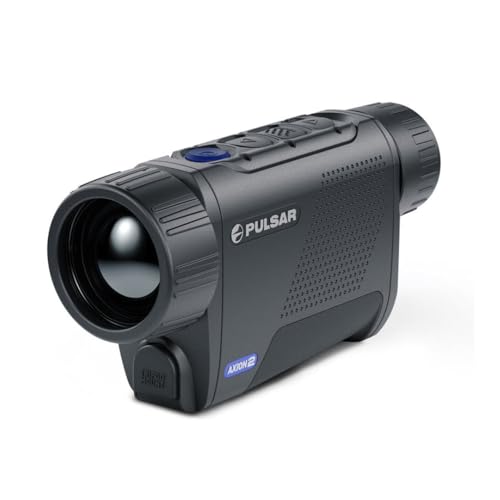
The Pulsar Axion 2 XG35 is a dedicated handheld thermal imaging monocular designed for scouting, game tracking, and outdoor terrain observation. Built around a 640x480 thermal core with a 12-micrometer pixel pitch, this device delivers high-contrast thermal signatures to help observers identify heat sources across complex landscapes. Unlike weapon-mounted thermal scopes or reflex sights, the Axion 2 XG35 is engineered purely as a portable optical observation tool, making it an excellent standalone asset for hunters, wildlife watchers, and sporting optics enthusiasts needing reliable identification in total darkness or adverse weather.
Portability and structural durability are immediate highlights of the Axion 2 platform. Encased in a reinforced magnesium alloy chassis, the unit weighs only 0.8 pounds and measures a compact 6.6 by 1.9 by 2.9 inches. This lightweight metal housing provides structural rigidity against drops, mechanical shock, and environmental moisture, while simultaneously acting as a heat sink to dissipate internal thermal buildup. The compact, contoured profile fits comfortably in one hand and slides easily into a field vest or backpack pocket, ensuring observers can carry it on long excursions without excessive fatigue.
Thermal processing on the XG35 is enhanced by three selectable sensitivity amplification levels paired with specialized digital filters and manual brightness and contrast adjustments. These software controls allow users to optimize target rendering according to ambient humidity, ground fog, and temperature differentials. Whether scanning open pastures or heavy timber, the internal processor balances subject heat signatures against background terrain. Additionally, the device features built-in Wi-Fi that interfaces directly with the Stream Vision 2 application for Android and iOS, enabling real-time video streaming to a paired mobile screen, remote digital adjustments, and straightforward over-the-air firmware updates.
Power management is centered around Pulsar's APS5 rechargeable lithium-ion battery, which provides up to seven hours of continuous operation under manufacturer-specified conditions. The battery compartment allows for rapid battery swapping in the field, and the system can be recharged through a dedicated charging dock, a PC, standard household power, or a portable USB-C power bank. The device can also run continuously on external USB power sources during stationary observation sessions. Routine care is straightforward: users should keep the Germanium objective lens free of dust using dedicated lens brushes or microfiber cloths, store the unit in its protective pouch when traveling, and keep electrical contacts clean and dry.
When evaluating the Axion 2 XG35, buyers should keep specific application boundaries in mind. This configuration is the non-LRF model, meaning it does not feature an onboard laser rangefinder module, nor does it include firearm mounting brackets, rail clamps, or aiming reticles. Furthermore, prospective owners should note that this thermal unit is controlled under the U.S. Export Administration Regulations (EAR), restricting unauthorized foreign export. For hunters and outdoor enthusiasts seeking an exceptionally compact, high-resolution thermal monocular with proven battery life and durable metal construction, the Pulsar Axion 2 XG35 offers a practical, high-performance scouting solution.
The housing of the Pulsar Axion 2 XG35 is manufactured from a reinforced magnesium alloy, offering superior strength-to-weight balance compared to standard plastic housings. This metal enclosure effectively shields delicate internal sensor electronics from mechanical shock, accidental drops, and moisture ingress during adverse field conditions.
In addition to structural defense, the magnesium alloy construction acts as a passive heat sink. It draws operational heat away from the thermal sensor and internal circuit boards, keeping the imaging system stable and minimizing thermal noise during extended viewing sessions in warm or fluctuating environments.
The Axion 2 XG35 operates on a quick-change APS5 rechargeable battery, delivering up to seven hours of continuous runtime on a full charge. The modular battery design allows users to swap cells quickly in the field without requiring specialized tools.
Charging versatility is supported through a modern USB-C connection, allowing replenishment via wall outlets, vehicle adapters, computers, or portable battery power banks. The unit can also draw power directly from an external power pack during prolonged scouting or surveillance setups.

Pros
- Integrated 1,100-yard laser rangefinder provides rapid, accurate distance data directly through the monocular
- Lynred 384x288 thermal sensor with 17 µm pixel size offers reliable heat signatures in fog, rain, and darkness
- Extremely compact 0.8-pound profile makes it easy to carry in a hunting pocket or field pack
- Built-in Wi-Fi integration allows seamless app connectivity, remote operation, and over-the-air firmware updates
Cons
- Designed solely as a handheld observation monocular, not as a firearm-mounted thermal rifle scope
- Subject to strict U.S. Export Administration Regulations (EAR) prohibiting unauthorized international export
- Requires periodic battery management and deliberate care of specialized thermal optical lenses
The Pulsar Axion 2 XQ35 Pro with LRF is a dedicated handheld thermal observation monocular designed specifically for outdoor reconnaissance, game spotting, and sporting observation. In the wider hunting and sighting optics category, it serves as a specialized handheld scanning companion rather than a weapon-mounted sight. Firearm owners and hunters frequently pair a standalone thermal monocular like this with traditional rifle scopes or daytime sighting systems to quickly locate heat signatures without having to raise or maneuver a firearm. It is best suited for big-game hunters, wildlife watchers, and outdoor enthusiasts who require high-sensitivity thermal scanning and rapid distance estimation in a portable format.
Core thermal performance centers on a French-made Lynred 384x288 sensor featuring a 17 µm pixel pitch. Combined with a variable 2-8x magnification range, the monocular gives observers the flexibility to scan broad fields of view at 2x before stepping into higher magnification for closer animal identification. Pulsar integrates three distinct sensitivity amplification levels alongside digital contrast and brightness filtration. These software adjustments help isolate temperature differentials across targets, foliage, and damp background cover, allowing hunters to maintain detection capability even through mist, fog, light brush, or precipitation.
A standout operational asset of this specific model configuration is its built-in long-distance laser rangefinder (LRF). Operating out to a manufacturer-rated 1,100 yards with ±1 meter accuracy, the LRF provides essential situational data that thermal imagery alone cannot communicate. Because thermal images display contrast without natural optical depth cues, judging target distances at night can be notoriously difficult. The rangefinder solves this by offering both single-measurement and continuous-scanning modes, allowing users to track moving game or assess changing terrain distances on the fly.
Portability and digital integration are well executed within the Axion 2 architecture. Measuring 6.6 x 1.9 x 2.9 inches and weighing just 0.8 pounds, the unit slides naturally into a field coat pocket or chest pack. It features built-in 2.4 GHz Wi-Fi connectivity that pairs with the Stream Vision 2 application for Android and iOS smartphones. Through this interface, users can stream thermal footage live to an external screen, adjust digital device functions remotely, and install wireless firmware updates directly from the manufacturer to maintain device reliability over long-term ownership.
Buyers should remain aware of important practical and legal parameters surrounding this optic. This unit is strictly a handheld spotter and lacks a mounting rail interface, reticle adjustment system, or recoil rating for firearm attachment. Additionally, the Axion 2 XQ35 Pro is strictly regulated under the U.S. Export Administration Regulations (EAR), meaning in-country transfers and international travel require strict adherence to U.S. export control laws. For hunters seeking a dependable, lightweight handheld thermal scanning tool with integrated ranging capabilities to support lawful sporting pursuits, this monocular delivers an exceptionally well-rounded observational package.
The Axion 2 XQ35 Pro utilizes a European Lynred uncooled thermal sensor operating at a resolution of 384x288 pixels with a 17 µm pixel size. This pixel pitch provides balanced resolution and image smoothness for mid- to long-range detection of thermal heat signatures in open fields and timber.
Optical magnification spans from 2x base magnification up to 8x digital zoom. The base 2x setting maintains a wider scanning window to help hunters sweep large areas efficiently, while the higher digital zoom levels allow closer inspection of detected animal silhouettes.
To counteract image degradation in humid or adverse weather, the system incorporates three distinct sensitivity levels alongside digital image smoothing filters. These user-adjustable settings optimize contrast rendering across fluctuating atmospheric temperatures.
The integrated laser rangefinder module is built directly into the monocular housing, eliminating the need to pack and manage a separate handheld rangefinder during field observation. The LRF provides active distance readings out to an impressive 1,100 yards.
Users can select between single-point measurement mode for stationary objects or dynamic continuous-scanning mode. Continuous scanning allows rapid distance updates as moving animals change positions across uneven terrain, delivering accuracy within ±1 meter.
Wireless connectivity is handled via onboard Wi-Fi communicating through the Pulsar Stream Vision 2 app. This connection allows real-time viewing on paired Android or iOS devices, simple file management, and over-the-air firmware updates that keep the internal software current without cables.
Engineered for all-day field carry, the Pulsar Axion 2 XQ35 Pro features external dimensions of 6.6 inches in length, 1.9 inches in width, and 2.9 inches in height. This slim profile ensures it fits securely in one hand and stores easily in jacket pockets.
With a listed weight of approximately 0.8 pounds, the monocular introduces minimal weight penalty into a hunting setup. Its lightweight design reduces arm fatigue during sustained stationary observation sessions compared to larger, heavier thermal spotting units.
Routine care involves standard optical maintenance: clearing external lenses using soft optical cloths and non-abrasive cleaning solutions to protect delicate germanium coatings, and storing the unit in a padded protective pouch when not in active field use.

Pros
- High-sensitivity sub-18mK NETD sensor resolves clear details in difficult weather and low thermal contrast
- Integrated 1,000-yard laser rangefinder eliminates the need to carry a separate optical ranging device
- Durable magnesium alloy housing provides structural rigidity while keeping total weight near one pound
- Long battery life of over 8 hours supports uninterrupted night scanning and predator spotting
Cons
- Handheld monocular architecture means it cannot be mounted directly to a firearm as a primary weapon sight
- Export and domestic transfer are strictly regulated under U.S. Export Administration Regulations (EAR)
- High-end thermal sensor and integrated rangefinder position this optic in a premium investment tier
The Pulsar Telos LRF XP50 is a handheld thermal imaging monocular integrated with a precision 1,000-yard laser rangefinder (LRF). Built around a 640x480 uncooled thermal sensor with a 17µm pixel pitch and an ultra-sensitive sub-18mK NETD rating, this device delivers high-contrast thermal imaging through a vibrant 1024x768 AMOLED display. Unlike weapon-mounted thermal rifle scopes, the Telos LRF XP50 functions as a dedicated observation and scanning unit. It is best suited for hunters, recreational outdoorsmen, predator control spotters, and wildlife monitors seeking long-distance target acquisition and accurate ranging before employing standard firearm systems.
Optical and digital performance centers on long-distance detection and environmental adaptability. Pulsar lists a detection range reaching out to 1,900 yards, paired with variable magnification to inspect heat signatures across changing terrain. The integrated laser rangefinder measures distances out to 1,000 yards, providing crucial distance data that traditional standalone thermal imagers lack. To accommodate fluctuating weather, foliage density, and thermal backgrounds, the monocular provides eight adaptable color palettes, allowing viewers to optimize image contrast for specific field conditions.
Durability and physical usability are tailored for challenging outdoor environments. The Telos LRF XP50 is built inside a magnesium alloy chassis that maintains rugged structural integrity while keeping the listed weight to approximately one pound (0.998 pounds). Measuring 9.3 x 2.8 x 3.5 inches, it is balanced for comfortable handheld use or pack carry. Weather resistance is rated at IPX7, ensuring protection against heavy rain, snow, and brief moisture immersion, while the operating temperature range extends from -13°F to 104°F. Continuous field scouting is supported by an internal power system that Pulsar rates for over eight hours of runtime on a single charge.
Digital integration expands the utility of the monocular beyond real-time scouting. The unit features built-in photo and video recording capabilities, enabling users to document sightings, evaluate wildlife patterns, or store scouting footage. Integrated Wi-Fi allows direct pairing with iOS and Android devices through the Stream Vision 2 application. This app connection enables firmware updates, remote display sharing, and simplified media transfers to smartphones or tablets, making it easy to coordinate with hunting partners or archive field observations.
Prospective buyers must consider practical ownership parameters before purchasing. Because this is a dedicated observation monocular, it does not feature an aiming reticle or weapon mounting interface for direct firearm mounting; it operates strictly as an auxiliary detection and spotting tool. Additionally, the Telos LRF XP50 is subject to strict U.S. Export Administration Regulations (EAR), meaning export and diversion contrary to U.S. law are strictly prohibited. For hunters, wildlife observers, and land managers requiring industry-leading thermal sensitivity and an onboard laser rangefinder in a single handheld platform, the Telos LRF XP50 represents a top-tier field scouting solution.
The Pulsar Telos LRF XP50 features a 640x480 thermal sensor with a 17µm pixel pitch and a thermal sensitivity rating of less than 18mK NETD. This allows the unit to differentiate subtle temperature gradients even in heavy fog, rain, or low-contrast environments.
Visuals are projected onto a crisp 1024x768 pixel AMOLED display capable of displaying heat signatures across 8 distinct color palettes. Pulsar rates the detection range up to 1,900 yards with variable digital magnification for thorough target identification.
Equipped with an integrated laser rangefinder, the Telos XP50 measures target distances up to 1,000 yards with the press of a button, removing guesswork during night observation or field scouting.
Integrated Wi-Fi connectivity pairs with the Stream Vision 2 companion app on iOS and Android devices. Users can stream real-time footage to a connected mobile device, manage settings, update firmware, and record high-resolution photos and video directly to onboard storage.
Engineered for harsh environments, the housing is constructed from lightweight magnesium alloy, bringing the overall weight to roughly 0.998 pounds with dimensions of 9.3 x 2.8 x 3.5 inches.
The Telos LRF XP50 carries an IPX7 waterproof rating for protection against heavy rainfall and wet field conditions. It operates across extreme temperatures from -13°F to 104°F, powered by an internal power architecture rated for over 8 hours of continuous operation on a single charge.

Pros
- Compact, pocket-sized magnesium alloy body delivers rugged field durability under 300 grams
- Bundle includes a spare APS 3 battery for extended runtimes during remote field observation
- Versatile 1.5-6x magnification range paired with built-in photo and video recording
- High-sensitivity 384x288 sensor delivers reliable thermal detection up to 750 meters
Cons
- Designed primarily as a handheld observation monocular rather than a direct firearm-mounted optic
- The 750-meter detection figure reflects optimal conditions and may vary depending on ambient humidity and terrain
- Premium price point represents a significant investment for entry-level thermal users
The Pulsar Axion XQ19 Compact Thermal Imaging Monocular Bundle is a dedicated handheld thermal observation tool tailored for scouting, game tracking, and outdoor navigation. Built around an advanced 384x288 thermal sensor with a 17 µm pixel pitch, this device detects heat differentials across various lighting environments, including total darkness, fog, and light brush. For hunters, property managers, wildlife observers, and outdoor enthusiasts, having a capable thermal monocular simplifies locating game or monitoring terrain without requiring ambient illumination.
Optically, the Axion XQ19 features a 1.5-6x magnification range, allowing users to switch between broader situational scanning at baseline power and focused observation at higher digital steps. The manufacturer lists a maximum detection range of up to 750 meters under favorable environmental conditions. In addition to optical flexibility, the unit incorporates sensitivity amplification levels and specialized image processing algorithms designed to preserve edge definition. Onboard photo and video recording, alongside Wi-Fi connectivity, allow observers to document footage and stream viewing feeds directly to compatible smart devices.
The physical construction of the Axion XQ19 highlights compact portability and ruggedness. Built with a high-grade magnesium alloy housing, the monocular is rated for reliable operation in challenging weather conditions, including rain and freezing temperatures. Pulsar engineered the chassis for single-handed use, keeping the bare monocular weight under 300 grams. A symmetrical button layout along the top deck ensures intuitive, ambidextrous navigation of power, magnification, and recording controls, even when wearing cold-weather gloves.
Power management is a critical factor for any electronic optic, and this bundle addresses extended field use by including two Pulsar APS 3 rechargeable batteries. Having a swappable factory battery on hand ensures continuous scouting capability without waiting for an active recharge in the field. The package also provides a USB-C charging cable, power adapter, wrist strap, carrying case, microfiber lens cloth, and a pair of air-activated HotHands warmers designed to deliver supplemental warmth during extended stationary observation in freezing climates.
Buyers should understand that the Pulsar Axion XQ19 is an observation monocular rather than a weapon-mounted thermal rifle scope. It does not feature direct Picatinny mounting interfaces, integrated reticle adjustments, or mechanical recoil-mitigation systems required for firearm zeroing. Instead, it serves as an observation and detection companion for hunters and outdoor scouts before transitioning to a primary sporting setup. Before deploying thermal imaging equipment in the field, users should always verify current state and local wildlife regulations regarding the use of thermal or night-vision devices for game scouting.
Overall, the Pulsar Axion XQ19 bundle provides a well-rounded handheld thermal detection solution. The combination of a 384x288 sensor, weather-resistant magnesium construction, intuitive one-handed controls, and included spare power cells makes it a solid investment for experienced outdoor sporting enthusiasts seeking reliable thermal scanning performance in a pocketable format.
The Pulsar Axion XQ19 is powered by an uncooled 384x288 microbolometer sensor with a 17 µm pixel pitch, engineered to detect subtle temperature variations in outdoor environments. Its variable 1.5-6x magnification allows users to scan wide fields of view at 1.5x before increasing digital magnification to identify heat signatures up to a manufacturer-stated 750 meters.
To support visual clarity across dynamic environments, the monocular utilizes sensitivity amplification algorithms and multiple viewing palettes. Integrated recording hardware captures digital stills and video directly to internal storage, while built-in Wi-Fi enables wireless data sharing with connected mobile applications for live viewing and firmware maintenance.
This bundle is configured to support extended outdoor trips by including two rechargeable Pulsar APS 3 lithium-ion battery packs. The quick-change battery system allows observers to swap depleted cells in seconds without tools, maintaining observation uptime during long nighttime scouting sessions.
In addition to the primary optic and dual batteries, the package includes a USB-C charging cable, wall power adapter, wrist lanyard, protective zippered carry case, microfiber cleaning cloth, and a pair of single-use air-activated HotHands hand warmers capable of providing up to 10 hours of heat.
Constructed with a structural magnesium alloy housing, the Axion XQ19 is designed to handle physical impacts, rain, fog, and wide temperature swings without compromising internal sensor alignment. Weighing under 300 grams, it fits easily inside standard hunting jacket pockets or utility pouches.
For long-term maintenance, optical glass surfaces should be cleaned exclusively with the included microfiber cloth or specialized lens cleaning solutions to prevent scratching anti-reflective coatings. Keep battery contacts clean and dry, and store the unit in its protective travel case when not in active use.

Pros
- High-resolution 640x480 12-micron thermal sensor delivers excellent thermal contrast and detail
- Extremely lightweight at 0.68 pounds, making it easy to store in a jacket pocket or pack
- IPX7 waterproof rating and cold-weather resistance down to -13 degrees Fahrenheit
- Eight customizable color palettes tailored to diverse environmental conditions
Cons
- Handheld monocular configuration does not include a direct firearm mount, optic plate, or aiming reticle
- Specific battery type and manufacturer-listed runtime are not detailed in the provided specifications
- Subject to U.S. Export Administration Regulations (EAR), prohibiting unauthorized export or transfer
The Pulsar Axion XG30 is an ultra-compact thermal monocular designed specifically for handheld thermal observation, scouting, and target detection. Built around a sensitive 640x480 microbolometer with a 12-micron pixel pitch, this device delivers high-resolution thermal imaging in a pocketable chassis. It is primarily suited for hunters, predator callers, wildlife trackers, and outdoor recreationists who require a dedicated detection tool to scan terrain before deploying a primary sighting system. Because it is a handheld spotting device rather than a weapon-mounted sight, it provides hunters and observers with safe, flexible 360-degree situational awareness without needing to point a firearm.
At the heart of the Axion XG30 is its optical and thermal imaging core. The 12-micron sensor architecture allows for finer thermal detail, which works in conjunction with the 640x400 AMOLED display to render clear heat signatures against complex backgrounds. With a base magnification of 2x and a digital zoom reaching up to 16x, the unit accommodates both wide-angle field scanning and long-range confirmation. To assist users in varying atmospheric conditions, Pulsar integrates eight distinct color palettes. These modes allow observers to switch between classic white-hot, black-hot, and specialized color-contrast settings to highlight subtle temperature differences in dense brush, humidity, or heavy timber.
Portability is a defining strength of this unit. Measuring 5.7 inches long, 1.6 inches wide, and 2.7 inches high, the Axion XG30 weighs a minimal 0.68 pounds. Its slim, ergonomic housing fits naturally in the palm, enabling prolonged one-handed scanning during scouting sessions without causing user fatigue. Unlike bulky thermal weapon scopes or dual-sensor binoculars, this monocular slips easily into a pocket or chest harness. It is important to distinguish this monocular from rifle scopes or red dot sights: the Axion XG30 does not feature an aiming reticle, windage adjustments, or a Picatinny mounting base. It functions strictly as an observation optic to supplement your overall field gear.
Build quality and environmental protection reflect Pulsar's focus on all-weather sporting use. The device carries an IPX7 waterproof rating, signifying that it is fully sealed against heavy rain, snow, and brief accidental water submersion. It operates across an extensive temperature range from -13 degrees Fahrenheit to +104 degrees Fahrenheit, ensuring consistent internal electronic performance during freezing winter predator hunts or humid summer scouting. The physical controls are positioned along the top ridge of the unit for straightforward, tactile operation even when wearing winter gloves.
Ownership considerations include checking legal and regulatory requirements. The Pulsar Axion XG30 is controlled under the U.S. Export Administration Regulations (EAR), meaning export or unauthorized transfer outside the United States is strictly prohibited by federal law. Buyers should also observe that specific battery runtime details are absent from the provided listing data, so users should consult manufacturer documentation regarding spare battery systems and charging cables prior to extended outings. For hunters and outdoor enthusiasts seeking an exceptionally compact, high-resolution thermal monocular to boost their spotting capabilities, the Axion XG30 represents a robust, highly capable handheld detection solution.
The Pulsar Axion XG30 features a high-density 640x480 thermal microbolometer with a 12-micron pixel pitch. This fine sensor pitch enables enhanced thermal detail and improved clarity at extended distances compared to standard 17-micron sensors. The optical configuration provides a 2x optical base magnification with digital zoom capability up to 16x, supporting versatile scanning across open fields or close timber.
Visual output is delivered through a vibrant 640x400 AMOLED display. The monocular includes eight customizable color palettes, giving observers the flexibility to tailor display contrast to current environmental conditions, ambient humidity, and user preference.
Engineered for maximum portability, the Axion XG30 measures 5.7 inches in length, 1.6 inches in width, and 2.7 inches in height. It weighs approximately 0.68 pounds, making it one of the most compact 640-sensor thermal monoculars in its class. The ergonomic form factor facilitates balanced one-handed operation.
The housing is rated IPX7 waterproof, providing complete protection against severe rain, snow, and moisture intrusion. It is rated to function reliably in extreme ambient environments ranging from -13 degrees Fahrenheit to +104 degrees Fahrenheit.
This optic is subject to U.S. export control laws and is regulated under the Export Administration Regulations (EAR). Diversion, re-export, or transfer contrary to U.S. federal law is strictly prohibited. Prospective buyers must ensure adherence to applicable domestic and federal regulations.
Because the Axion XG30 is designed exclusively as an observation monocular, it does not include weapon-mounting hardware, optic plates, or sighting reticles. Users should practice safe handling, verify manufacturer guidance for optical lens cleaning, and store the unit in a protective case when not in use.

Pros
- High-sensitivity 384x288 sensor with sub-25mK NETD for detecting minute temperature variations.
- Substantial manufacturer-stated detection range extending out to 1,421 yards.
- Built-in multimedia suite records 1024x768 photos and videos without auxiliary gear.
- Handheld footprint weighing only 1.2 pounds facilitates portable field use.
Cons
- Designed strictly as a handheld observation monocular without a documented rifle-mounting interface or weapon recoil rating.
- Export Administration Regulations (EAR) prohibit unauthorized international export and in-country transfer.
- Listing omits specific battery type, runtime estimates, and standardized water-ingress ratings.
The Pulsar Telos XQ35 is a digital thermal monocular engineered specifically for nocturnal observation, wildlife scouting, and game recovery. Unlike firearm-mounted sights, reflex dots, or dedicated rifle scopes, the Telos XQ35 functions as a standalone handheld detection instrument. This optic is best suited for nighttime hunters, varmint controllers, and outdoor enthusiasts who need to locate heat sources and evaluate terrain before deploying sporting equipment.
At the center of the unit is an uncooled 384x288 thermal imaging sensor with a 17-micrometer pixel pitch and a thermal sensitivity rating under 25 millikelvins (NETD). The manufacturer lists a maximum detection range of up to 1,421 yards, providing substantial scanning reach across fields, pastures, and timber edges. Pulsar incorporates its Image Boost Technology, a software-driven processing algorithm intended to enhance edge definition and subject contrast when viewing targets through environmental interference such as fog, light brush, or precipitation.
For documentation, scouting logs, and visual recording, the monocular features an integrated multimedia suite. Users can capture both static photography and video files at a resolution of 1024x768 pixels directly on the device. Dimensionally, the monocular measures 8.8 inches in length, 2.5 inches in width, and 2.3 inches in height, yielding a cylindrical handheld configuration. With a listed weight of 1.2 pounds, the unit remains lightweight enough for prolonged glassing sessions without creating substantial fatigue.
Prospective buyers must recognize the physical boundaries of this optic. The listing does not include a Picatinny mount, Weaver clamp, or an internal aiming reticle, meaning this product cannot be zeroed or attached directly to a firearm slide or rail as an active gun sight. Additionally, the manufacturer description highlights a rugged build for demanding environments, but it does not specify formal IP ingress ratings, battery chemistry, or runtime figures in the provided data. Ownership also carries legal obligations: the Telos XQ35 is strictly regulated under the Export Administration Regulations (EAR), meaning international transport or unauthorized diversion outside the United States is illegal.
Overall, the Pulsar Telos XQ35 represents a capable, dedicated scanning tool for sportsmen who prioritize long-range thermal detection and onboard recording in a handheld configuration. Hunters and target shooters should treat this unit as an observation companion to pair alongside their primary sighting systems, while verifying local night-hunting regulations and federal export rules prior to purchase.
The thermal core of the Pulsar Telos XQ35 utilizes a 384x288 resolution sensor configured with a 17µm pixel architecture. Its thermal sensitivity rating of less than 25mK NETD enables the sensor to resolve minimal temperature differentials, which aids in distinguishing animal profiles from ambient backgrounds.
According to manufacturer data, the unit delivers a detection reach of up to 1,421 yards under suitable atmospheric conditions. The built-in Image Boost Technology processes incoming thermal data in real time to sharpen object boundaries and improve overall scene contrast during low-light and adverse weather observations.
The Telos XQ35 is designed with an exterior housing engineered to withstand rough outdoor conditions across varying hunting environments. The device measures 8.8 inches long, 2.5 inches wide, and 2.3 inches high, providing a compact handheld profile suitable for carrying in a field pack or coat pocket.
At a stated weight of 1.2 pounds, the unit balances portability with stability during one-handed scanning. Although the manufacturer indicates robust environmental durability, buyers should consult official documentation for detailed ingress protection codes against water immersion and dust exposure.
The Pulsar Telos XQ35 is subject to U.S. Export Administration Regulations (EAR). Under federal law, export, re-export, or in-country transfer of this thermal optic without appropriate government authorization is strictly prohibited.
In addition to export compliance, hunters and property owners must verify state and local game regulations regarding the possession and use of electronic thermal imaging devices during hunting and outdoor recreation in their specific jurisdictions.

Pros
- Compact, pocket-sized magnesium alloy body weighing only 0.7 pounds for easy one-handed carry
- High-sensitivity 384x288 17µm thermal sensor with 8 distinct viewing palettes
- IPX7 waterproof construction provides reliable protection against adverse weather
- Removable battery design paired with modern USB-C fast charging for field convenience
Cons
- Configured exclusively as a handheld monocular without firearm mounting hardware or reticle systems
- Export and domestic transfer are strictly controlled under U.S. Export Administration Regulations (EAR)
- Represents a significant investment compared to standard non-thermal optical spotting equipment
The Pulsar Axion XQ30 Pro is a specialized handheld thermal imaging monocular engineered for detection and observation. Built around a 384x288 thermal sensor with a 17µm pixel pitch, this device gives outdoor enthusiasts, hunters, and sporting-optics owners the ability to spot heat signatures regardless of ambient lighting or visual obstructions like light brush and fog. It is critical for buyers to distinguish this unit from direct-mount firearm optics; the Axion XQ30 Pro is intended strictly as a handheld detection tool rather than a rifle scope or rail-mounted sight.
This device is best suited for recreational hunters, wildlife observers, and land managers who require efficient area scanning before deciding on closer visual assessment. For firearm owners and sportsmen, utilizing a dedicated handheld thermal monocular provides a major safety advantage. It allows users to scan terrain, identify movement, and assess surroundings without the unsafe practice of pointing a firearm-mounted optic at unidentified targets. The device also suits outdoor gear enthusiasts who prioritize pocket portability and thermal scouting capability.
Optically and electronically, the Axion XQ30 Pro is configured to maximize scanning speed and target distinction. The thermal sensor features multiple sensitivity amplification levels to adapt to subtle temperature gradients across changing weather conditions. A wide field of view helps users scan expansive open areas quickly, while eight selectable color palettes allow the operator to optimize contrast based on specific environmental backgrounds. In addition, integrated photo and video recording functionality makes it easy to capture thermal footage for later analysis or documentation.
Build quality is centered on lightweight durability. The housing is machined from a magnesium alloy that delivers structural rigidity while keeping total weight down to just 0.7 pounds. With exterior dimensions of 5.7 x 1.6 x 2.7 inches, the unit fits comfortably inside a jacket pocket or standard gear pouch. An IPX7 waterproof rating protects the internal electronics against heavy rain, snow, and temporary submersion in water. Power is supplied by a removable battery system compatible with USB Type-C fast charging, facilitating easy recharging between outings.
Ownership and maintenance considerations are straightforward but require attention to regulatory guidelines. The manufacturer listing highlights that this product is controlled under U.S. Export Administration Regulations (EAR), meaning international export or unauthorized domestic transfer is prohibited by law. Routine care involves keeping the optical lenses clean using specialized lens brushes or microfiber cloths, keeping the USB-C port dry, and storing the removable battery properly when not in use. Prospective buyers must remember that this unit does not feature an aiming reticle or rail interface, so it will not serve as a primary sighting solution.
Ultimately, the Pulsar Axion XQ30 Pro earns a solid recommendation for outdoor observers and hunters who want reliable thermal scanning performance in an exceptionally compact package. Its rugged magnesium housing, IPX7 weather protection, and crisp 384x288 sensor make it a dependable scouting companion. As long as users understand its handheld role and do not expect rail mounting or reticle functionality, this monocular delivers high utility for lawful sporting and recreational observation.
The Axion XQ30 Pro utilizes a 384x288 thermal imaging sensor with a 17µm pixel architecture, engineered to detect subtle heat differences across challenging terrains. Multiple sensitivity amplification levels allow users to fine-tune image clarity depending on atmospheric humidity, temperature contrast, and background foliage.
To assist in scanning broad landscapes, the device offers a generous field of view and eight color palettes, including standard hot-white and hot-black options. Built-in video and photo recording gives operators a direct method for documenting observations directly to onboard storage.
Constructed with a rugged magnesium alloy body, the Pulsar Axion XQ30 Pro balances structural durability with minimal carry fatigue. Measuring 5.7 x 1.6 x 2.7 inches and weighing just 0.7 pounds, the monocular can easily be carried in a pocket, chest rig, or daypack.
The unit is backed by an IPX7 waterproof rating, ensuring it remains fully operational through wet weather, downpours, or brief immersion. Its removable battery configuration supports modern USB Type-C fast charging, enabling convenient replenishment in vehicles or via portable power banks.

Pros
- High-resolution 640x480 thermal core with exceptional sub-18mK thermal sensitivity
- Long manufacturer-stated detection distance of over 1,900 yards via fast F50/1.0 germanium optics
- Submersible IPX7 waterproof housing wrapped in durable rubber armor
- Generous continuous runtime of up to 8.5 hours using the LPS 7i battery pack
- Integrated multimedia capabilities including video capture and wireless app support
Cons
- Designed strictly as a handheld observation monocular without integral Picatinny mounts or aiming reticles
- Subject to U.S. Export Administration Regulations (EAR) prohibiting unauthorized international export or transfer
- Substantial investment profile compared to standard recreational observation optics
The Pulsar Telos XP50 is a specialized handheld thermal imaging monocular engineered for detection, observation, and situational awareness in low-light and adverse weather conditions. Unlike direct-mount firearm optics, rifle scopes, or slide-ride red dots, the Telos XP50 is configured purely as an observation monocular. This makes it an ideal spotting companion for recreational target shooters scanning backstops, hunters surveying terrain before committing to a setup, and outdoor enthusiasts seeking high-definition thermal imaging without attaching an optic directly to a firearm platform.
At the center of the optical system is a European-designed 640x480 thermal imaging sensor with a 17-micrometer pixel pitch and a noise-equivalent temperature difference (NETD) rating of under 18 millikelvins. In practical terms, this sensitivity level allows the unit to differentiate subtle temperature gradients even during rain, fog, or humid evenings when environmental contrast is degraded. The sensor is paired with a fast F50/1.0 germanium objective lens, yielding a manufacturer-claimed detection range of over 1,900 yards. Users can cycle through eight selectable color palettes, adjusting display contrast based on target distance, ambient temperatures, and individual eye comfort.
Physical construction emphasizes field resilience and ergonomic handling. The monocular utilizes a reinforced plastic housing finished with protective rubber armoring, providing a secure grip in cold, wet, or gloved conditions. With an ingress protection rating of IPX7, the device is fully waterproof and capable of withstanding heavy precipitation or brief accidental submersion. At 1.58 pounds and measuring 9.3 by 2.8 by 3.5 inches, it offers a solid handheld presence that packs easily into a standard daypack or gear bag without demanding specialized transport cases.
Field endurance and digital integration are managed through Pulsar's LPS 7i rechargeable lithium-ion battery and internal processing architecture. The manufacturer lists up to 8.5 hours of continuous runtime on a single charge, which significantly reduces the need to carry multiple spare power banks during long observation sessions. The unit also includes onboard video recording and integrated Wi-Fi connectivity, allowing users to stream real-time footage, adjust settings, and download firmware updates using the compatible Stream Vision 2 application on iOS or Android devices.
Prospective buyers should note that the Telos XP50 is strictly a handheld spotting tool and does not feature aiming reticles, windage and elevation turrets, or firearm-mounting brackets. Additionally, this unit is regulated under U.S. Export Administration Regulations (EAR), meaning international export or transfer contrary to U.S. law is strictly prohibited. For hunters, wildlife observers, and shooting-sports spotters who require standalone, high-performance thermal scanning capabilities to supplement their primary sighting setups, the Pulsar Telos XP50 represents a capable, well-protected, and observation-focused choice.
Sensor Resolution: 640x480 pixels
Pixel Pitch: 17 µm
Thermal Sensitivity (NETD): <18 mK
Objective Lens: F50/1.0 Fast Germanium
Detection Range: 1,900+ Yards (Manufacturer Claim)
Display Color Modes: 8 Selectable Palettes
Housing Material: Rubber Armored Reinforced Plastic
Waterproof Rating: IPX7 (Submersion Protection)
Battery Model: Pulsar LPS 7i Rechargeable Li-Ion
Operational Runtime: Up to 8.5 Hours Continuous
Dimensions: 9.3 x 2.8 x 3.5 Inches
Weight: 1.58 Pounds
Connectivity: Built-in Wi-Fi & Stream Vision 2 App Compatible

Pros
- Integrated 1500-meter laser rangefinder removes the requirement to carry an independent rangefinding device.
- Magnesium alloy body offers robust structural protection at a portable 1.15-pound total weight.
- High-magnification range from 2.5x to 20x supports both wide scanning and extended target identification.
- High-resolution 1024x768 AMOLED screen ensures sharp contrast in adverse weather conditions.
Cons
- Designed as a handheld observation monocular rather than a weapon-mounted sighting optic with an aiming reticle.
- The supplied manufacturer listing does not specify battery chemistry, runtime, or charging hardware details.
- Subject to strict U.S. Export Administration Regulations (EAR), prohibiting unauthorized foreign transfer.
The Pulsar Oryx LRF XG35 is an advanced thermal imaging monocular built with an integrated laser rangefinder, designed specifically for handheld observation, scouting, and distance calculation. Within the broader sporting optics and shooting ecosystem, this device serves as a detection and reconnaissance asset rather than a direct-mount rifle optic. Firearm owners, hunters, and tracking personnel frequently pair handheld thermal monoculars alongside traditional daytime rifle scopes or red dot sights to scan surroundings, identify heat signatures, and confirm distances before taking any sporting action.
Optically, the Oryx LRF XG35 centers on a 35mm objective lens assembly delivering a baseline magnification of 2.5x with digital scaling up to 20x. Visuals are processed through an internal 1024x768 AMOLED display, backed by a 12.5-degree angular field of view. According to manufacturer specifications, this optical configuration allows users to detect heat signatures at distances up to 1969 yards, maintaining visual tracking capability through environmental obstacles such as fog, precipitation, and sparse tree cover.
A standout functional attribute of the unit is its integrated laser rangefinder module. Capable of measuring distances out to 1500 meters with an accuracy rating of plus-or-minus 1 meter, the LRF addresses one of the primary challenges of thermal observation: loss of depth perception. Because thermal imagery flattens terrain perspective, having a dedicated on-board rangefinder allows sportsmen and search teams to immediately establish true target distance without fumbling between separate optical tools.
The physical housing is manufactured from magnesium alloy, which provides impact resistance and structural rigidity without excessive mass. The monocular measures 7 inches long, 2 inches wide, and 3 inches tall, with an overall weight of approximately 1.15 pounds (18.3 ounces). This compact footprint allows for comfortable single-handed operation in the field, as well as easy transport in a chest harness, jacket pocket, or field pack. Proper lens maintenance involves using soft optical microfiber cloths to protect the specialized Germanium front objective coating from abrasion.
Prospective buyers should review a few practical ownership considerations before purchasing. Because the listing does not detail battery chemistry, cell capacity, or expected operating hours, buyers will need to consult the manufacturer manual regarding charging cables and backup power accessories. Additionally, this unit is classified under the U.S. Export Administration Regulations (EAR), meaning it is restricted from international export or unauthorized transfer outside the United States. It does not feature Picatinny rail mounting clamps or internal zeroable reticles, meaning it is purely an observation monocular.
Overall, the Pulsar Oryx LRF XG35 represents a capable, premium observation instrument for hunters, ranchers, wildlife observers, and search-and-rescue personnel who require dependable thermal scanning combined with accurate laser distance measurement. When used to complement an established field setup, it provides substantial situational awareness and target confirmation across extended sporting ranges.
The optical system of the Pulsar Oryx LRF XG35 utilizes a 35mm front objective lens designed for thermal infrared transmission. It provides an optical-to-digital magnification span ranging from 2.5x for broad observation up to 20x for closer examination of distant thermal signatures.
Internal imagery is presented via an AMOLED display with a 1024x768 resolution, providing high contrast and defined edges across varying thermal differentials. The unit delivers a 12.5-degree field of view and carries a manufacturer-rated detection distance reaching up to 1969 yards under favorable thermal conditions.
The built-in laser rangefinder is integrated directly into the monocular chassis, eliminating the need to pack secondary rangefinding gear into the field. It provides real-time distance readings out to a maximum range of 1500 meters.
With a documented accuracy rating of plus-or-minus 1 meter, this subsystem assists hunters and navigators in overcoming standard thermal optical distortion, verifying precise terrain gaps and target ranges with digital certainty.
Constructed with a magnesium alloy chassis, the Oryx LRF XG35 balances external durability with pack-friendly weight, registering at 1.146 pounds (approximately 18.3 ounces) with exterior dimensions of 7 x 2 x 3 inches. The housing is engineered for reliable operation in wet weather environments including fog and rain.
This thermal device is subject to United States Export Administration Regulations (EAR). Domestic ownership is lawful within the U.S., but export, re-export, or transfer contrary to U.S. export laws is strictly prohibited, requiring adherence to all federal compliance standards.

Pros
- High-definition 1024x768 thermal sensor with 12-micron pixel architecture
- Built-in 1000-meter laser rangefinder for accurate distance estimation
- Submersion-rated IPX7 waterproof housing with ambidextrous rubber grip
- Generous 64GB onboard video storage and dual-band Wi-Fi connectivity
Cons
- Handheld monocular configuration does not attach directly to firearm rails or optic plates
- Substantial 1.5-pound weight and 9.7-inch length require dedicated pack or harness transport
- Subject to U.S. Export Administration Regulations (EAR) restricting international export and transfer
The Pulsar Telos LRF XL50 is an advanced handheld thermal imaging monocular engineered with an integrated laser rangefinder, designed primarily for hunters, wildlife observers, and outdoor sporting enthusiasts. Unlike direct-mount weapon sights, rifle scopes, or slide-mounted red dot optics, this device operates as a dedicated handheld spotting and detection instrument. It serves experienced outdoor optics buyers who require dependable heat-signature detection and spatial awareness in low-light or zero-light environments before transitioning to primary sighting systems.
At the core of the Telos LRF XL50 is an expansive 1024x768 thermal sensor boasting a fine 12-micron pixel pitch, paired with a fast aperture F/1.0 germanium objective lens. This optical architecture provides clear thermal rendition across extreme environmental temperatures spanning from -25 to +40 degrees Celsius. In addition to thermal imaging, the unit features an integrated laser rangefinder capable of measuring target distances up to 1000 meters. The objective ring zoom control offers intuitive magnification adjustments directly on the lens barrel, allowing users to scan broad fields or inspect localized points of interest with equal ease.
Pulsar constructed the Telos LRF XL50 with an ergonomic, nonslip rubber-armored housing that accommodates both right-handed and left-handed handling comfortably during prolonged scanning sessions. The chassis is rated to IPX7 submersion waterproof standards, providing reliable protection against heavy rain, snow, and accidental water exposure. Weighing 1.5 pounds and measuring 9.7 by 2.8 by 3.5 inches, the monocular maintains a balanced form factor that balances solid build quality with portable field handling, though it carries more heft than compact pocket-sized observation tools.
For documentation and digital management, the unit integrates a built-in video recorder supported by 64GB of internal memory, eliminating the immediate need for external memory cards. Wireless functionality is managed through dual-band 2.4 GHz and 5 GHz Wi-Fi integration via the Stream Vision 2 application, facilitating straightforward image streaming and firmware management with iOS and Android mobile devices. Potential purchasers must take note that the Telos LRF XL50 is controlled for export and in-country transfer under the U.S. Export Administration Regulations (EAR), making lawful domestic compliance an essential part of ownership.
Maintaining the Telos LRF XL50 involves standard optical lens care, ensuring the germanium glass is cleaned only with specialized optical wipes to protect surface coatings, alongside secure storage in a padded case when not deployed. Because this monocular is an observation device rather than a rail-mounted rifle optic, it pairs naturally alongside primary firearm sighting setups for pre-shot scanning and distance verification. For sporting hunters and serious recreational observers needing top-tier thermal resolution, integrated rangefinding, and proven weather resistance, the Pulsar Telos LRF XL50 represents an exceptional, purpose-built scanning investment.
The optical system features a premium F/1.0 germanium lens designed for maximum thermal light gathering and transmission in demanding outdoor environments. Coupled with an XL50 1024x768 thermal sensor featuring a 12-micron pixel pitch, the monocular resolves subtle heat differentials across varied landscapes.
Zoom adjustments are managed mechanically via the objective ring, giving the user tactile and precise control over magnification levels. The integrated laser rangefinder complements the thermal optics by measuring target distances up to 1000 meters, delivering accurate distance data directly within the observation interface.
The Telos LRF XL50 housing is finished with a non-slip, rubberized coating that ensures a secure grip in wet, freezing, or muddy field conditions. The symmetrical chassis geometry allows natural operation for both right-handed and left-handed users.
Rated IPX7 for submersion waterproofing, the housing resists prolonged water ingress during downpours or accidental water drops. The internal electronics and optics are rated to operate reliably across a broad temperature range from -25 to +40 degrees Celsius, providing consistent readiness across varied seasonal conditions.
The device includes a built-in digital video recorder equipped with 64GB of internal storage, providing ample space for high-resolution video and photo documentation during field trips without requiring third-party SD cards.
Connectivity is handled through the Stream Vision 2 application, utilizing dual-band Wi-Fi operating on 2.4 GHz and 5 GHz frequencies. This allows smooth wireless media transfer, live viewing, and firmware updates on compatible iOS and Android devices.
Essential Thermal Monocular Questions Answered
What sensor resolution should you look for in a thermal monocular?
A 640×480 thermal sensor provides the highest image fidelity, though a 384×288 sensor delivers reliable target detection for general scouting. High-resolution sensors, found on units like the Pulsar Axion 2 XG35 or Telos XP50, maintain sharper edges and target detail when you dial into higher digital zoom levels. Models featuring 384×288 microbolometers offer adequate detection ranges while keeping gear accessible for budget-conscious users.
How does a built-in laser rangefinder benefit night observation?
A built-in laser rangefinder provides exact target distance readings in total darkness where standard depth perception is ineffective. Because thermal imaging displays flat heat signatures on an AMOLED screen, estimating distance over open fields can be misleading. Monoculars like the Pulsar Axion 2 XQ35 Pro resolve this guesswork by measuring yardage accurately up to 1,100 yards with single or continuous scanning modes.
What does the NETD rating indicate on Pulsar thermal sensors?
The Noise Equivalent Temperature Difference (NETD) rating measures how sensitive the sensor is to tiny temperature variations, with lower millikelvin numbers representing superior sensitivity. A thermal sensor rated under 18mK NETD detects minute contrast gradations even during cold rain, dense fog, or high humidity. This ensures target outlines remain clear even when ambient surroundings match the target surface temperature.
How long do removable Pulsar battery packs last in the field?
Most Pulsar thermal monoculars deliver between 7 and 8.5 hours of continuous operation on a single charge. Units utilizing swappable APS5 or LPS 7i battery systems allow users to swap fresh packs in the dark without waiting on external chargers. You can also power these devices using standard external power banks through a USB Type-C port during long observation sessions.
What is the safest way to store and transport high-end thermal optics?
Storing your thermal monocular inside a protective, moisture-resistant case kept in a temperature-regulated cabinet protects the delicate germanium objective lens and internal sensors. High-value gear deserves dependable physical protection, and keeping sensitive optics stored alongside secure storage picks prevents accidental drops or unauthorized handling. Always keep protective lens covers installed during transit to prevent abrasions on optical coatings.


Write Your Review
No reviews yet. Be the first to share your experience!