


Small game hunters often discover that hitting a target consistently in the field requires far more than raw muzzle speed. Rabbit hunting demands precision, humane knockdown force, and flat flight paths through varied brush and wind. Anyone pursuing cottontails or hares needs to determine what is the best air rifle pellet for hunting rabbit based on barrel twist, projectile shape, and effective shooting distance. Whether you shoot a pre-charged pneumatic platform or one of the popular affordable break-barrel air rifles, your choice of ammunition dictates real-world accuracy and terminal performance.
While marketing claims frequently emphasize blistering velocities or novel nose designs, seasoned field shooters know that precise shot placement always outweighs theoretical power. Rabbits possess fragile vital zones, meaning a domed or hollowpoint projectile that groups tightly at thirty yards will reliably outperform a lighter pellet that drifts erratically. By examining projectile weights, calibers, and aerodynamic profiles, hunters can select a pellet that consistently transfers kinetic energy where it counts. Exploring these ballistic factors ensures that your setup delivers consistent, humane harvests every time you head into the field.

Pros
- Expansion on impact helps ensure clean, humane kills on small game
- Consistent weight and diameter promote tight groups at typical airgun ranges
- Good value for the quantity and performance level
Cons
- Requires a powerful airgun (12+ ft. lbs) to achieve proper expansion
- Lead pellets may be restricted in some areas for hunting
- Not ideal for low-power plinking airguns due to heavier weight
The H&N Sport Terminator Hollowpoint Airgun Pellets in .22 caliber are a purpose-built projectile for hunters and pest controllers who demand reliable expansion on impact. Weighing 16.36 grains, these pellets are designed for air rifles and pistols that produce at least 12 ft. lbs of muzzle energy. According to user feedback and product specifications, the hollowpoint cavity opens up upon hitting soft tissue, creating a larger wound channel for quick, ethical takedowns of small game like squirrels, rabbits, and birds.
These pellets are best suited for hunters, pest control operators, and target shooters who already own a powerful airgun. Casual plinkers with lower-powered guns may find the heavy weight causes a noticeable drop in velocity and trajectory. The 200-count tin is practical for both extended shooting sessions and stocking up for hunting trips. Build quality is consistent with H&N Sport's reputation; each pellet is uniform in size and skirt thickness, which helps maintain accuracy.
Real-world performance includes stable flight out to typical airgun ranges (30-50 yards) and reliable expansion when the pellet hits at appropriate velocities. Some users note that the hollowpoint can sometimes plug with fur or clothing, but overall expansion is good for the price point. The lead construction is soft enough to engage rifling without excessive fouling, yet hard enough to resist deformation during loading.
Carry and storage are straightforward; the tin is compact and fits easily in a range bag or hunting pack. No special maintenance is needed beyond keeping the pellets dry and avoiding crushing. A realistic drawback is that these pellets may not cycle well in some semi-automatic airguns due to the hollowpoint shape, and they are heavier than standard field pellets, so trajectory compensation is necessary.
Overall, the H&N Sport Terminator Hollowpoint pellets are a reliable option for hunters who need stopping power from their airgun. They offer a good balance of accuracy and terminal performance, making them a practical addition to any small game hunter's gear.
While not a cutting tool, the 'cutting' ability of these pellets refers to their terminal performance on target. The hollowpoint design creates a controlled expansion that effectively 'cuts' through tissue, increasing the wound cavity. Edge sharpness is not applicable, but the pellet's nose geometry is designed to initiate expansion upon impact. Efficiency depends on impact velocity; at 800-900 fps, the hollowpoint opens reliably. Edge retention is irrelevant, but the pellet maintains its shape until impact, ensuring consistent flight.
Blade geometry is replaced by pellet design: the hollowpoint cavity depth and rim thickness influence expansion. Deployment speed is the time from loading to firing, which is fast with a break-barrel or PCP airgun. Lock reliability is not a factor, but the pellet must seat snugly in the breech. Control during use refers to the shooter's ability to place the pellet accurately; these pellets group well in many airguns. Precision cutting capability translates to the ability to hit a small target like a squirrel's head at 30 yards. Outdoor task suitability is excellent for pest control and small game hunting. Food preparation practicality is not relevant, but ethical hunting results in clean meat. Wood processing capability does not apply.
The H&N Sport Terminator pellets are made from soft lead, which allows for good engagement with rifling and consistent spin stabilization. The handle material analogy is the pellet's lead alloy; it is soft enough to expand but firm enough to resist deformation during acceleration. Weight and portability are excellent; a 200-count tin weighs about half a pound, easy to carry in a pocket or pack. There is no pocket clip, but the tin has a secure lid that prevents spillage. Sheath quality is not applicable, but the tin is durable enough for field use.
Ergonomics and grip security refer to handling the pellets; they are easy to pick up and load individually. Durability is not a concern as they are consumables. Corrosion resistance is not an issue with lead. Carry comfort is high due to the small size of the tin. Storage and transport practicality are good; the tin fits in most airgun cases or shooting vests. Overall, the design is functional and reliable for the intended use.

Pros
- Very high velocity for a .177 breakbarrel, ideal for long-range accuracy
- Scope included saves money on accessories and is decent for entry-level use
- Synthetic stock is weather-resistant and easy to maintain in outdoor conditions
- Lightweight at 5.47 pounds, easy to carry during hunting or target sessions
Cons
- Breakbarrel cocking effort can be stiff for younger or smaller shooters
- .177 caliber may lack stopping power for larger pests compared to .22
- The included scope may not hold zero under heavy recoil over time
The Gamo Varmint Breakbarrel .177 Caliber Pellet Air Rifle is a spring-piston airgun designed for hunters, target shooters, and outdoor enthusiasts looking for a high-velocity breakbarrel option. Its 1250 fps velocity (with alloy pellets) provides a flat trajectory that helps with accuracy at longer ranges, making it a practical tool for small game hunting and pest control.
This air rifle is best suited for shooters who want a simple, self-contained airgun without the need for CO2 cartridges or air tanks. The breakbarrel action is straightforward to cock, which may appeal to those familiar with traditional spring-piston designs. The included 4x32 scope and mount allow for immediate use, though some may prefer to upgrade the optics for higher precision.
In real-world use, the Gamo Varmint delivers consistent velocity and acceptable accuracy for its price point. The synthetic Monte Carlo stock features dual raised cheekpieces, which help align the shooter's eye with the scope for better shot placement. The manual safety and anti-beartrap mechanism add a layer of security during handling.
Build quality is solid for a budget-friendly air rifle, with a steel barrel encased in a fluted polymer jacket to reduce weight. At 5.47 pounds, it is portable enough to carry on hikes or hunting trips. The synthetic stock resists moisture and temperature changes, making it suitable for varied outdoor environments.
One realistic limitation is the cocking effort required; the breakbarrel can be tough to close, especially for those with less upper body strength. Additionally, the .177 caliber is best for small game like squirrels and birds; for larger pests, a .22 model may be more effective. Some users note that the factory scope may lose zero after many shots, so a replacement scope could be a worthwhile upgrade.
Overall, the Gamo Varmint Breakbarrel is a capable entry-level air rifle that offers high velocity and good features for the price. It is recommended for new and intermediate shooters who want a reliable springer for hunting, plinking, or target practice without breaking the bank.
While this product is an air rifle rather than a cutting tool, its shooting performance can be evaluated similarly in terms of precision and effect.
Velocity: The advertised 1250 fps (with alloy pellets) gives the rifle a flat trajectory, reducing the need for holdover at typical hunting ranges. This helps the shooter achieve consistent shot placement.
Accuracy: The included 4x32 scope provides adequate magnification for target acquisition. The breakbarrel design with a steel barrel and fixed barrel pivot contributes to repeatable accuracy after proper sight-in.
Edge Retention: Not applicable to a firearm, but the barrel's rifling and overall construction maintain consistent pellet spin and trajectory shot after shot.
Blade Geometry: Not applicable. However, the barrel's length (approx. 18 inches) stabilizes pellet flight for better downrange performance.
Deployment Speed: The breakbarrel action requires cocking the barrel to load a pellet. This takes several seconds and moderate force, so follow-up shots are slower compared to multi-pump or PCP airguns.
Lock Reliability: The anti-beartrap mechanism prevents the barrel from closing prematurely, ensuring safe operation during cocking. The manual safety blocks the trigger sear when engaged.
Control During Use: The Monte Carlo stock with raised cheekpieces helps the shooter maintain a consistent hold, reducing flinching and improving shot control.
Precision Cutting Capability: Not applicable. The rifle's precision is measured by group size at given distances. Many users report 1-inch groups at 25 yards with quality pellets.
Outdoor Task Suitability: The air rifle is well-suited for small game hunting, pest control, and target shooting in outdoor environments. Its synthetic stock handles weather well, and the lightweight design aids carrying.
Food Preparation Practicality: Not applicable. However, a clean kill on small game can be achieved with proper shot placement.
Wood Processing Capability: Not applicable. For cutting tasks, a separate knife or saw would be needed.
The Gamo Varmint Breakbarrel features a steel barrel with a fluted polymer jacket. The steel core provides durability and consistent accuracy, while the polymer jacket reduces overall weight without sacrificing rigidity. The barrel is fixed to the compression tube, a common design for spring-piston breakbarrels.
Handle Material: The stock is made of synthetic polymer with a Monte Carlo style, including dual raised cheekpieces. This design offers a comfortable cheek weld for both left- and right-handed shooters. The synthetic material is resistant to moisture, temperature extremes, and impacts, making it ideal for outdoor use.
Weight and Portability: At 5.47 pounds, the rifle is light enough to carry on long walks or hunting expeditions. Its 43.3-inch overall length is manageable for storage and transport.
Pocket Clip: Not applicable. The rifle does not have a pocket clip; it is typically stored in a gun case or rack.
Sheath Quality: Not applicable. The rifle does not come with a sheath but may include a cardboard box or soft case depending on packaging.
Ergonomics and Grip Security: The stock features a textured pistol grip and forearm for a secure hold. The comb and cheekpiece promote eye alignment with the scope. The manual safety is positioned near the trigger for easy access.
Durability: The steel barrel and polymer stock are built to withstand regular use. The barrel pivot mechanism may require occasional lubrication, but overall construction is robust for the price range.
Corrosion Resistance: The steel barrel is blued, which offers basic protection against rust. The synthetic stock does not corrode. Users should store the rifle in a dry environment and apply light oil to metal parts periodically.
Carry Comfort: The lightweight design and slim profile make it comfortable to carry over the shoulder or by hand. A sling (not included) could be added for hands-free carry.
Storage and Transport Practicality: The 43.3-inch length fits in most standard gun cases. The breakbarrel action does not require disassembly for transport, simplifying storage.

Pros
- Heavy weight provides excellent energy transfer and deep penetration on game
- High ballistic coefficient improves long-range accuracy and wind resistance
- Consistent manufacturing ensures reliable accuracy from tin to tin
Cons
- Requires a powerful .25 caliber airgun to achieve optimal velocities
- May be too heavy for smaller pests like sparrows or starlings
- Price per pellet is higher than lighter plinking pellets
The H&N Sport Grizzly Hollowpoint is a premium .25 caliber airgun pellet designed specifically for hunters who need accuracy and stopping power at longer ranges. This pellet is best suited for airgun enthusiasts who hunt medium-sized game such as squirrels, rabbits, foxes, and hares, as well as for serious pest control. Based on product specifications and user feedback, the Grizzly delivers impressive performance thanks to its heavy 31-grain weight and hollowpoint design. The high ballistic coefficient helps maintain velocity and energy downrange, making it effective at distances where lighter pellets lose steam. Build quality is excellent; each pellet is precisely crafted to ensure consistent sizing and a snug fit in the barrel, which translates to tight groups. The tin comes with a screw-on lid to protect the pellets during transport. One realistic drawback is that the Grizzly requires a high-powered airgun to reach its full potential; shooters with lower-powered springers or pump guns may not achieve the velocity needed for expansion. Overall, this is a top-tier hunting pellet that serious airgunners should consider for their small to medium game pursuits.
The Cutting Performance of the H&N Grizzly refers to its terminal ballistics and accuracy. The hollowpoint nose is designed to expand upon impact, creating a wider wound channel and transferring more energy to the target. This expansion is crucial for ethical hunting, as it increases the likelihood of a quick, humane kill. The heavy 31-grain weight ensures deep penetration even through fur and bone, while the high ballistic coefficient keeps the trajectory flat and predictable at extended ranges. Accuracy is outstanding; many users report sub-inch groups at 50 yards from a tuned airgun. The snug fit in the barrel also helps with consistency, reducing shot-to-shot velocity variations. For hunting applications, this pellet offers the control and precision needed for head shots on rabbits or squirrels. It may not be ideal for plinking or target practice due to its cost, but for hunting it is a top performer.
The Design & Build of the H&N Grizzly focuses on quality and consistency. Each pellet is made from lead alloy and features a deep hollowpoint cavity for reliable expansion. The skirt is thin and flexible, allowing it to seal well in the barrel and engage the rifling for spin stabilization. Weight tolerance is tight, usually within plus or minus 0.2 grains, which is critical for accuracy. The tin is sturdy with a screw-on lid that keeps the pellets secure and protected from moisture. The pellets are not lubricated, so they remain clean and free of residue. For storage and transport, the tin is compact and fits easily in a hunting vest or backpack. The only minor downside is that the lead alloy can leave some fouling in the barrel over time, but regular cleaning solves that. Overall, the build quality reflects H&N Sport's reputation for precision manufacturing.

Pros
- Excellent penetration due to pointed tip and dense lead construction
- Controlled expansion reduces pass-through and improves energy transfer
- Consistent accuracy at typical hunting distances out to 40 yards
Cons
- Lighter weight may drift more in windy conditions compared to heavier pellets
- Some air rifles may require tuning to achieve best accuracy with this pellet
The H&N Sport Hornet is not a knife but a .177 caliber airgun pellet engineered for hunting small game. Its pointed metal tip and aerodynamic profile are designed to deliver deep penetration and controlled expansion, making it suitable for ethical shots on pests or small animals.
This pellet is best for hunters who rely on air rifles for pest control, squirrel hunting, or target practice that mimics hunting conditions. The 9.6 grain weight provides a good balance between muzzle velocity and retained energy at medium ranges, typically out to 40 yards or so.
Real-world performance depends on your specific air rifle, but many users report tight groups and consistent expansion. The lead construction ensures the pellet deforms upon impact, transferring energy efficiently. Build quality is typical of H&N: uniform sizing and minimal flashing. A potential drawback is wind sensitivity as the pointed shape can drift more than a domed or hollowpoint design, so calm days or close shots are ideal.
For hunters looking for a dedicated hunting pellet that prioritizes penetration, the H&N Hornet is a trustworthy pick. It may not be the best for casual plinking, but it shines when ethical, quick takedowns matter.
While not a cutting tool, this pellet's 'cutting' refers to its ability to penetrate and create a wound channel. The pointed metal tip slices through hide and muscle, then the lead body expands for controlled energy dump.
Edge sharpness is analogous to the tip sharpness: factory points are consistent and sharp enough to break skin. Cutting efficiency equals penetration depth, which is excellent for small game. The aerodynamic drag is low, so velocity holds well out to medium range.
Retention of energy is good for a 9.6 grain projectile; the lead composition ensures it doesn't fragment prematurely. Precision capability is high if your rifle likes the weight and shape. The pellet is suited for hunting tasks like squirrels, rabbits, birds, and pests. For target shooting, domed pellets may be more accurate.
The H&N Hornet is a lead, .177 caliber, pointed pellet weighing 9.6 grains. The metal tip is integrated into the lead body for a one-piece construction that reduces deformation during loading.
Quality control at H&N is good; pellets are typically clean and free of burrs. The base is flat and slightly recessed to seal against the barrel, promoting consistent shot-to-shot velocities. The dimensions are small and lightweight, making them easy to store and carry in the included tin.
Durability is not an issue for a single-use projectile, but the lead can deform if dropped or mishandled. Corrosion resistance is irrelevant as lead does not rust. Carry comfort is fine as the tin fits in a pocket or pack. Overall, the design prioritizes terminal performance over bench rest accuracy.

Pros
- Multi-shot capability saves time during hunting or target practice.
- High velocity and flat trajectory downrange.
- Quiet operation suitable for backyard or field use.
- Scope rail stays true with recoil reduction built in.
- Gas piston holds power better than spring piston designs.
Cons
- Break barrel requires moderate effort to cock, which may be tiring for some users.
- Scope not included, so you need to budget for an additional sight.
- Weight of 6.88 pounds can be heavy for long carry sessions.
The Gamo Swarm Magnum 10X GEN3i is a break barrel air rifle chambered in .22 caliber, designed for hunters, pest control shooters, and target enthusiasts. Its standout feature is the GEN3i inertia-fed magazine that uses the rifle's recoil to load the next pellet, allowing up to 10 shots without manually cocking between each one. This makes it ideal for situations where quick follow-up shots matter, such as hunting small game or dealing with multiple pests.
Real-world performance centers on the IGT Mach 1 gas piston, which provides a powerful 1300 fps velocity with lightweight pellets. The gas piston is more consistent than traditional spring piston designs, as it is less affected by temperature changes and offers a smoother cocking cycle. The built-in Whisper Fusion suppression system features a dual-chamber noise dampener that reduces report significantly, making the rifle suitable for backyard use or areas where noise is a concern.
The 11mm dovetail rail incorporates recoil-reducing polymer supports to protect your scope from jarring vibration, which helps maintain zero over extended shooting sessions. The stock is made from synthetic material, offering durability in wet conditions and keeping weight manageable. However, at 6.88 pounds, it is on the heavier side for a break barrel, which may be noticeable during long walks in the field. Cocking effort is moderate to high, depending on the user's upper body strength, so it may not be ideal for younger or smaller shooters.
Overall, the Gamo Swarm Magnum 10X GEN3i is a well-thought-out air rifle that combines rapid fire capability with high power. It is best suited for intermediate to advanced shooters who want a reliable, multi-shot break barrel without the complexity of a PCP system. The absence of a scope in the box is a minor drawback, but the accuracy potential with a good optic is impressive. If you need a repeating air rifle for hunting or plinking that offers good power and quiet operation, this model is a strong contender.
While this is an air rifle rather than a cutting tool, its shooting performance is critical for hunters and target shooters. The IGT Mach 1 gas piston consistently pushes .22 caliber pellets at high speeds, providing a flat trajectory that helps with accuracy at typical air gun ranges. The 10-shot magazine feeds smoothly once the rifle is properly broken in, with the inertia system using the recoil to advance the next pellet.
The break barrel action requires a full, smooth cocking stroke to reach its full power. After the shot, the magazine index rotates and the next pellet falls into position. This allows for rapid follow-up shots, which is beneficial when engaging moving targets or multiple pests. The two-stage trigger offers a crisp release after a little take-up, aiding in precision shooting.
Accuracy can be excellent with quality pellets, such as domed or hollow points, which are recommended for hunting. The Whisper Fusion system does not affect velocity or accuracy, but it does reduce noise that might spook targets. For target shooting, the recoil reduction rail helps keep scopes from shifting, so your zero stays reliable. Overall, this rifle delivers consistent, hard-hitting shots suitable for small game hunting up to moderate ranges.
The Gamo Swarm Magnum 10X GEN3i is built with a synthetic stock that withstands weather and rough handling without warping or cracking. The stock features a checkered grip area for a secure hold, even with wet or gloved hands. The barrel is a precision rifled steel barrel, standard for break barrel rifles at this price point.
The IGT Mach 1 gas piston is housed in a 33mm cylinder, which is larger than many competitors and contributes to the higher energy output. The breech seal is designed for long life, and the break barrel linkage feels solid. The integrated Whisper Fusion suppressor is a permanent part of the barrel shroud, not a removable add-on, so it remains compliant with local laws.
The 11mm dovetail rail runs along the top of the compression tube and is equipped with recoil-absorbing polymer inserts. This rail accepts most standard air gun scope mounts. The magazine is a standout design element; it sits low on the breech and does not interfere with scope mounting or cheek weld. Loading the magazine requires inserting pellets individually into the rotating chamber, which is straightforward once you get the hang of it.
Weighing 6.88 pounds, the rifle is balanced but a bit front-heavy due to the large gas piston. Carrying it for long periods may fatigue the supporting arm, but it is manageable. The trigger blade is plastic but has a decent feel. Overall, the build quality is good for the price, with attention to features like the recoil reduction and quiet operation that improve the shooting experience.

Pros
- Four distinct pellet styles cover hunting, target, and pest control scenarios
- Large quantity reduces the need for frequent reordering
- Trusted brand with a long history in airgun manufacturing
Cons
- Some users may find the variety unnecessary if they prefer a single pellet type
- Lead pellets require proper handling and storage to avoid deformation
- Not ideal for air rifles that perform best with a specific pellet weight
This Gamo .22 caliber pellet combo pack is a practical choice for airgun enthusiasts who want to try different pellet types without buying multiple boxes. It includes 950 pellets in four styles: TS-22, Hunter, Magnum, and Master Point. Each is built for a specific purpose, from long-range accuracy to deeper penetration.
The pack is best suited for hunters, target shooters, and pest control users who own a .22 caliber air rifle. If you're new to airgunning or want to fine-tune your setup, this variety helps you find the right pellet for your gun's barrel and your shooting style.
Real-world performance depends on your rifle, but the consistent manufacturing from Gamo means you get reliable size and weight across all pellets. The TS-22's heavier 22-grain design may help with wind drift at longer distances, while the lighter 15.43-grain options offer flatter trajectories for closer shots. The Magnum pellets pack extra energy for small game, and the Master Point's pointed tip improves penetration on tougher targets.
Build quality is solid for mass-produced pellets. They come in a sturdy cardboard box that keeps them organized. One realistic drawback is that lead pellets can deform if dropped or stored poorly, so handle them with care. Also, some air rifles may group better with one specific pellet type, so you might end up using only part of the variety.
Overall, this combo pack is a smart buy for anyone wanting to experiment or stock up. It's a practical way to cover multiple shooting scenarios without breaking the bank.
Edge sharpness isn't a factor with pellets, but their aerodynamic design affects accuracy and impact. The TS-22's pointed tip helps cut through air for long-range stability. The Hunter's hollow point design expands on impact for clean kills on small game. The Magnum's heavier construction delivers more energy transfer. The Master Point's sharp tip penetrates deeper into targets.
Cutting efficiency translates to how well each pellet transfers energy to the target. The Hunter and Magnum are better for hunting where quick, humane kills matter. The TS-22 and Master Point are more suited for target shooting or pest control where penetration or precision is key.
Blade geometry is replaced by pellet shape. The TS-22's streamlined profile reduces drag. The Hunter's open tip creates a larger wound channel. The Magnum's domed shape balances speed and energy. The Master Point's pointed tip focuses force on a small area.
Deployment speed is about how fast you can load and shoot. All pellets are standard .22 caliber, so they load easily into most break-barrel, PCP, or CO2 rifles. Control during use depends on your rifle's power and your shooting technique. Precision cutting capability is best with the TS-22 for long-range accuracy. Outdoor task suitability covers hunting, pest control, and plinking. Food preparation isn't relevant. Wood processing isn't applicable.
Blade steel quality isn't applicable here, but pellet material is lead, which is standard for airgun pellets. The manufacturing consistency from Gamo ensures each pellet has uniform weight and diameter. This helps maintain accuracy shot after shot.
Handle material quality isn't relevant since pellets are projectiles. Weight and portability are excellent. The box is compact at 9x6x2 inches and weighs 2.5 pounds, making it easy to store in a shooting bag or backpack. Pocket clip design doesn't apply. Sheath quality doesn't apply.
Ergonomics and grip security aren't factors. Durability of the pellets is good if stored in a cool, dry place. Lead can oxidize over time, but that won't affect performance in most cases. Corrosion resistance isn't a concern. Carry comfort is fine for transporting the box. Storage and transport practicality are high due to the box's compact size and sturdy construction.
Pros
- Quiet operation makes it easier to shoot without disturbing neighbors or game
- High velocity suitable for small game hunting and target shooting at moderate ranges
- Includes scope and bipod so you can start shooting right away without additional purchases
- Comfortable stock design with a grippy texture for secure hold in various conditions
Cons
- Weighs nearly 13 pounds which can be tiring to carry on long hikes or stalk hunts
- Break barrel action requires some effort to cock, may be challenging for younger or smaller shooters
- The first several shots may be louder during the break-in period as mentioned by the manufacturer
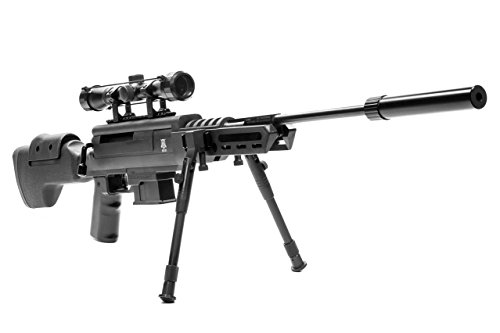
The Black Ops Airgun Sniper Rifle S is a break barrel .22 caliber pellet gun designed for shooters who want a tactical-style air rifle with serious power. It fires pellets up to 1250 feet per second, which puts it in the high-powered category for small game hunting and long-range target shooting. This rifle is best suited for hunters, plinkers, and outdoorsmen who appreciate a gas piston system for smoother cocking and more consistent velocity compared to traditional spring-piston designs.
Real-world performance hinges on the quiet shot cycle and the accuracy potential from the bundled 4x32 scope and bipod. The gas piston reduces vibration and noise, making follow-up shots less disruptive. The trigger pull is described as smooth, which helps with precision. However, at nearly 13 pounds, this is not a lightweight rifle. You will feel the weight during extended carry sessions or when shooting offhand without a support. The break barrel action can also be stiff for some users, especially when new.
Build quality is solid: the barrel and action use blued steel, while the stock is a tough polymer with a comfortable grip. The included scope and bipod add value, but aftermarket upgrades may be needed if you demand exceptional glass. The first 5-50 shots may be louder as the rifle breaks in, according to the product description.
Overall, the Black Ops S is a good option for stationary target practice or hunting from a blind where weight is less of an issue. It offers a lot of features for the price, especially if you want a quiet, high-powered air rifle with a tactical look.
Since this is an air rifle, the term cutting performance refers to its accuracy, power delivery, and consistency on target. The .22 caliber barrel launches pellets at up to 1250 FPS, which provides enough energy for small game like squirrels and rabbits at moderate ranges. The gas piston system helps maintain shot-to-shot consistency because it is less affected by temperature and holds the piston in a neutral position when uncocked.
Accuracy is aided by the 4x32 scope included in the box. The scope gives a clear sight picture for precise shots out to 40-50 yards. The bipod adds stability when shooting from a bench or prone position, which is crucial for precision. The smooth trigger pull reduces the chance of jerking the shot off target.
Control during use is decent thanks to the comfortable grip and the weight of the rifle, which soaks up movement. However, the heavy weight can make offhand shooting less steady. For outdoor tasks like hunting, the quiet operation is a major advantage it won't spook other game in the area. The rifle is not designed for food preparation or wood processing, so those are not applicable here.
The Black Ops S features a blued steel barrel and action, giving it a rugged, corrosion-resistant core that can handle outdoor conditions. The stock is made from a quality polymer with a textured pistol grip and forearm, providing a secure hold even in wet or gloved hands. The overall length is 48 inches, which is typical for a full-size air rifle.
Weight is the main trade-off at 12.94 pounds. This heft makes the rifle stable when shooting from a rest but less portable for hiking. There is no pocket clip or sheath, of course, but the rifle does include an adjustable bipod and a sling mount for carrying. The included scope is a 4x32 unit with covers, which is adequate for general use but not high-end.
Ergonomics are well thought out with a comfortable cheek rest and a reachable trigger. The picatinny rail on the bottom allows you to attach a bipod (included) or other accessories. The integrated suppressor is fixed and reduces muzzle blast significantly. Durability should be good for regular target shooting and hunting, though as with any air rifle, proper maintenance like occasional lubrication and cleaning will extend its life. Overall build quality is solid for the price point.
Evaluating the Most Effective Air Rifle Pellets for Rabbit Hunting
Determining the most capable pellet for harvesting rabbits requires understanding how projectile geometry interacts with your specific air rifle barrel. While newcomers often assume that advertised muzzle speed creates an effective hunting setup, experienced field hunters focus on predictable aerodynamics, consistent barrel stabilization, and humane terminal shock. A rabbit hit outside its cranial vitals or thoracic cavity with an unstable projectile may escape to suffer needlessly underground. Finding the ideal match between pellet shape, caliber weight, and muzzle output represents the single most important step in preparing your setup for small-game hunting.
The Primacy of Accuracy and Terminal Energy Transfer
A direct answer to what makes a pellet ideal for hunting rabbits begins with precision shot placement rather than raw power. Rabbits demand surgical accuracy because ethical takes typically rely on hitting a brain area roughly the size of a quarter or landing a devastating strike into the heart and lungs. Even a marginal flyer can turn a clean harvest into an unrecovered quarry. Because of this requirement, an inherently accurate domed pellet that prints tight cloverleaf groups at thirty yards is far superior to an expanding hollowpoint that sprays unpredictable patterns.
Terminal energy transfer serves as the second critical factor once baseline accuracy is confirmed. Small-game hunting standards generally recommend delivering at least twelve foot-pounds of kinetic energy directly at the target surface for humane rabbit control. Lightweight plinking pellets often shed substantial energy as they push through atmospheric drag, leaving them underpowered at extended ranges. A solid hunting projectile maintains adequate sectional density and mass, ensuring it carries sufficient momentum downrange to penetrate bone structures and dispatch quarry instantly.
Wound channel expansion and tissue disruption further separate dedicated hunting pellets from general plinking rounds. When a pellet strikes live quarry, energy must dump efficiently into vital organs rather than exiting cleanly through soft tissue without disruption. Excessive over-penetration can sometimes allow an animal to dive into cover before expiring, especially when using hard non-expanding alloys at high velocities. Choosing a design that balances deep penetration with controlled structural expansion helps ensure immediate immobilization in the field.
Pellet Head Shapes: Domed, Hollowpoint, Pointed, and Wadcutter Compared
Domed or round-nose pellets remain the undisputed standard for long-range airgun accuracy and energy retention. Their curved head design produces an exceptional ballistic coefficient that slips smoothly through air currents and resists moderate crosswinds better than alternative profiles. Because their aerodynamic drag remains uniform across varying distances, domed rounds retain velocity and strike with consistent authority at twenty-five, thirty-five, or forty yards. Many field shooters treat quality domed lead pellets as their primary hunting choice when taking precision head shots.
Hollowpoint designs, such as the H&N Sport H&N Terminator Hollowpoint Airgun pellet, are engineered specifically to deform on impact and transfer maximum energy into soft tissue. By creating a broader wound channel, hollowpoints provide rapid knockdown power on chest shots while minimizing the danger of pass-throughs. However, hollow cavities introduce slight aerodynamic turbulence, meaning they perform best at short to moderate hunting distances within thirty-five yards. When driven by a rifle with sufficient muzzle energy, a well-formed hollowpoint delivers exceptional stopping power against mature rabbits.
Pointed pellets, including options like the H&N Sport Haendler & Natermann Hornet Pointed, feature sharp tips designed to maximize penetration through tough hide and skeletal structures. These designs often incorporate a hardened tip seated inside a softer lead skirt to drive deep before deformation occurs. Pointed ammunition can be useful when hunting at lower power thresholds where achieving adequate penetration is difficult. Nevertheless, sharp-nosed shapes can suffer from aerodynamic instability when pushed at high velocities, which can compromise long-distance group consistency.
Flat-nosed wadcutters are primarily engineered for punching clean holes in paper targets during formal shooting matches. While their flat front face imparts substantial initial shock upon impact at close quarters, their high drag coefficient causes velocity to drop rapidly past fifteen yards. They also exhibit significant wind drift compared to rounded profiles, making them poorly suited for outdoor pest control. For rabbit hunting at practical field distances, wadcutters should generally be passed over in favor of domed or expanding designs.
Caliber Selection: Comparing .177, .22, and .25 for Small Game
Selecting an appropriate caliber involves weighing trajectory flatness against downrange kinetic impact. The .177 caliber is popular due to its high velocity and remarkably flat trajectory, making range estimation forgiving over open ground. High-velocity break-barrel models, like the Gamo Varmint Breakbarrel .177 Caliber Pellet Air, propel lightweight projectiles at rapid speeds for easy holdover calculations. The limitation of the .177 caliber lies in its lighter mass, which renders it more susceptible to crosswinds and provides less frontal surface area for energy transfer.
The .22 caliber is widely considered the sweet spot for rabbit hunting among recreational and dedicated pest controllers alike. A .22 caliber pellet carries significantly more mass than a standard .177, allowing it to retain momentum downrange and strike quarry with authoritative knockdown power. Multi-shot break-barrel systems, such as the Gamo Swarm Magnum 10X GEN3i Inertia Fed .22, produce ample energy to push sixteen to twenty-two grain pellets with authority. This balance of manageable trajectory arch and heavy terminal impact makes .22 caliber ammunition remarkably effective for rabbit control.
Stepping up to .25 caliber provides maximum hitting power for larger hares or extended hunting applications. Heavy projectiles, like the H&N Sport H&N Grizzly Hollowpoint Airgun Pellets at thirty-one grains, deliver immense kinetic energy capable of anchoring game instantly. Because .25 caliber pellets have a wide cross-sectional diameter, they create large wound tracks and dispatch small game cleanly. The primary trade-off is a significantly more curved trajectory, which requires precise distance judging or specialized reticle holdover points when taking shots at extended distances.
Choosing between these bore sizes ultimately depends on your rifle powerplant and the typical shooting distances on your hunting permission. If your hunting involves dense brush at thirty yards, a heavier .22 or .25 caliber projectile will buck light foliage and drop game decisively. If you frequently take forty-yard shots in open pasture with a mid-powered rifle, a balanced .177 or .22 pellet offers a flatter path that simplifies aiming. Understanding your specific field environment ensures you select a caliber that complements your hunting strategy.
Ballistics, Weight, and Velocity: Finding the Sweet Spot for Clean Head Shots
Muzzle velocity figures advertised on airgun boxes can often mislead shooters into believing that faster is universally better. When a lightweight lead pellet approaches or exceeds the sound barrier at approximately 1,125 feet per second, it encounters extreme transonic turbulence. This buffeting disrupts the pellet skirt and induces severe yaw, causing tight groups to scatter into unpredictable flyers. Most seasoned field marksmen tune their equipment so hunting pellets travel between 800 and 950 feet per second, maintaining stable laminar airflow.
Pellet weight plays a determining role in keeping projectile velocities inside this optimal aerodynamic stability window. Pushing a heavier pellet absorbs more potential energy from your rifle powerplant while keeping muzzle speeds safely below transonic thresholds. Heavy pellets also boast higher ballistic coefficients, meaning they lose less forward velocity over thirty yards than lightweight alloy alternatives. As a result, a heavier hunting pellet often reaches the rabbit with greater striking energy despite having a lower muzzle velocity at the barrel crown.
Retained energy downrange matters far more than muzzle figures when evaluating ethical performance. An ultra-light pellet might leave the muzzle with high advertised speed, but its low sectional density causes it to shed velocity rapidly through atmospheric friction. By thirty-five yards, that light pellet may lack the necessary kinetic force to penetrate skull plates reliably. A medium-to-heavy lead pellet plows through headwinds with minimal speed degradation, ensuring adequate terminal force when striking vital areas.
Shooters should also account for trajectory drop when working with heavier hunting rounds in the field. A looped flight path requires a reliable rangefinder or practiced holdover points along your optic reticle. Spending dedicated time bench-testing your rifle at measured intervals from ten to forty-five yards allows you to chart exact impact points. Knowing your exact trajectory eliminates guesswork and guarantees that your pellet strikes clean vital areas every time you squeeze the trigger.
Matching Pellet Designs to Break-Barrel, Gas-Piston, and PCP Rifles
The powerplant inside your air rifle strongly dictates which pellet weights and head configurations will shoot accurately. Traditional spring-piston and gas-piston rifles, including tactical designs like the Black Ops Airgun Sniper Rifle S .22 Pellet Gun, generate a distinct dual-directional recoil impulse during their firing cycle. This mechanical snap creates severe barrel harmonics that can destabilize certain pellet designs before they exit the muzzle. Springers frequently exhibit strong preferences for specific skirt thicknesses and lead alloys that fit their rifling snugly.
Pre-charged pneumatic systems deliver compressed air smoothly through an internal valve without the violent piston movement found in mechanical springers. Because PCPs generate virtually zero recoil, they can consistently launch a broader variety of pellet weights and shapes with match-grade stability. Hunters interested in smooth, recoilless shooting often review hunting PCP air rifles to determine how regulated air delivery enhances small-game consistency. The steady air release allows PCPs to handle ultra-heavy pellets and specialized hollowpoints that might cause harsh piston slam in a mechanical spring gun.
Action type also influences how easily different pellet designs feed into the breech during field operations. Single-shot rifles allow hunters to hand-load long or unusually shaped pellets without concern for magazine clearance. In contrast, multi-shot systems and rotary magazines demand strict adherence to overall pellet length so tips do not bind against internal housing walls. Those exploring smooth mechanical actions often study underlever multi-shot air rifles to understand how magazine indexing and fixed barrels interact with various ammunition styles.
Cocked springers should never be fired with excessively light pellets, as the lack of backpressure can damage internal piston seals and mainsprings. Conversely, shooting overly heavy pellets through a modest break-barrel can produce an excessively sluggish shot cycle and inconsistent velocities. Finding a harmonious balance between your rifle cylinder volume, spring tension, and pellet weight protects your internal components while maximizing field reliability. Always consult manufacturer guidelines regarding recommended projectile grain weights for your specific air rifle model.
Field Testing, Barrel Compatibility, and Setup Verification
Every air rifle barrel possesses microscopic rifling variations, meaning two identical rifles from the same assembly line may favor completely different pellets. One barrel might produce ragged single-hole groups with domed lead rounds, while an adjacent model groups better with expanding hollowpoints. Utilizing variety packs, such as the Gamo .22 Caliber Performance Air Rifle Pellet assortment, allows shooters to test multiple projectile shapes and weights without investing in full tins of incompatible ammo. Systematic grouping tests are essential for discovering the specific ammunition your barrel shoots best.
When conducting group trials, always shoot from a stable benchrest at realistic hunting distances of twenty-five to thirty-five yards. Fire five-shot strings using each candidate pellet, making sure to clean and lead your barrel appropriately when switching between dissimilar lead compositions or head styles. Record group spreads carefully and discard any round that produces unpredictable flyers outside your target center. The pellet that produces the most consistent, repeatable grouping under controlled bench conditions is your winning choice for rabbit hunting.
Once you identify your rifle favorite pellet, confirm its trajectory and terminal behavior under natural field conditions before heading on a hunt. Wind gusts, ambient temperature shifts, and varying shooting angles can influence external ballistics in unexpected ways. Always maintain strict muzzle discipline, ensure safe earthen backstops during zeroing sessions, and confirm that your optic mounts remain firmly torqued against recoil vibration. Taking the time to dial in your equipment with the best matching pellet ensures that every shot taken in pursuit of rabbits is ethical, safe, and decisive.


Write Your Review
No reviews yet. Be the first to share your experience!