


A scope’s mil markings can look like ordinary dots or hash marks, but they represent a measurement system that helps describe angular distance in a sight picture. Understanding that system matters when you’re comparing reticles, estimating target size, or deciding whether a scope’s reticle and adjustment controls use compatible units. The question what does mil mean on a rifle scope has a straightforward answer, but the practical details depend on the reticle design and the scope’s specifications.
Product descriptions in this selection include several illuminated mil-dot reticles, while the listed adjustment turrets on some models use MOA clicks. Those are separate features, and buyers shouldn’t assume that a mil reticle means the turrets also adjust in mils. Before choosing an optic, check its reticle information, focal-plane details, adjustment units, intended platform, and mounting requirements. For broader context on air-rifle optics, see our air-rifle scope considerations, and consult our scope ring compatibility guide when checking a separate mounting setup.
Top Products

Pros
- Clear optics with good light transmission for the price point
- Integrated laser adds aiming flexibility without extra gear
- Sturdy build feels solid and holds zero well
- Easy to mount on standard Picatinny rails with included hardware
Cons
- Laser may require frequent battery changes with heavy use
- Reticle illumination could be brighter in full daylight
- Limited eye relief may not suit all rifle setups
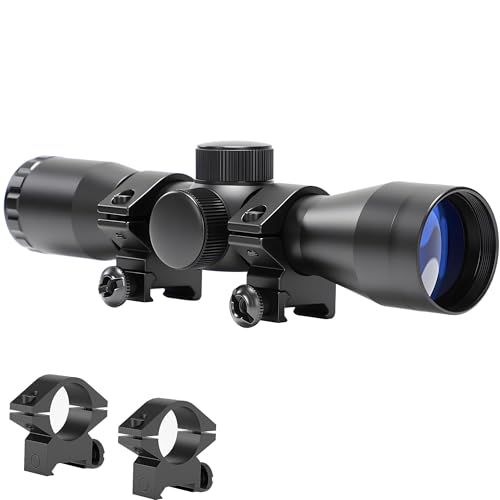
The UUQ 2.5-10x40 rifle scope is a budget-friendly optic designed for hunters, plinkers, and tactical shooters who want both magnification and a laser aiming aid in one package. This scope is best suited for air rifles, rimfire guns, and smaller-caliber hunting rifles used for varmint control or target practice. It may also appeal to survivalists and outdoor enthusiasts looking for a versatile sighting solution for their gear.
Real-world performance centers on the variable magnification, which lets you zoom from 2.5x for close brush to 10x for longer shots. The multi-coated green lens helps maintain a bright image even in low light, though some users note the reticle illumination could be stronger in direct sunlight. The built-in green laser adds a fast aiming option for close-range work, with a claimed range over 300 yards. However, the laser runs on small batteries that may need swapping after extended use.
Build quality is decent for the price, with an aircraft-grade aluminum body that feels rugged and resists moisture. The included 20mm Picatinny mounts make installation straightforward, but the eye relief is somewhat short, so mounting position matters for comfort. A realistic drawback is that the laser and scope share battery compartments, which can be fiddly to access in the field.
Overall, this combo is a practical choice for budget-conscious shooters who want a do-it-all optic for casual hunting or range days. It won't replace high-end scopes, but it offers good value for airgun and rimfire enthusiasts.
While this is a rifle scope and not a cutting tool, its optical performance directly impacts shooting accuracy. The 2.5-10x magnification provides a clear sight picture for engaging targets at varying distances. The illuminated Mil-Dot reticle aids in holdover and windage estimation, which is useful for hunters and tactical shooters.
The green laser offers a secondary aiming method for quick shots without shouldering the rifle. Its beam is visible in low light but may wash out in bright conditions. The multi-coated lens reduces glare and improves contrast, helping you spot game or targets more easily.
For precision shooting, the scope's adjustments are tactile and repeatable, though some users may prefer finer click values. The combination of scope and laser gives you flexibility for different scenarios, from stationary target practice to moving game.
The UUQ scope is built from aircraft-grade aluminum, which keeps weight manageable while providing good durability. The body is sealed and nitrogen-purged to resist fogging and water ingress, making it suitable for wet or humid conditions. The green lens coating helps protect against scratches and reduces reflections.
The included 20mm Picatinny mounts are made of metal and feel secure once tightened. The scope's finish is matte black, which minimizes glare. The laser module is integrated into the front of the scope body, adding a bit of length but not excessive bulk.
Ergonomics are straightforward: the magnification ring turns smoothly, and the illumination dial is easy to reach. The battery compartments for the reticle and laser are separate, which is convenient but requires small coin cells and a 14250 battery. Overall, the design prioritizes function over frills, and the build quality should hold up to regular use on air rifles or low-recoil firearms.
Pros
- Wide 6-24x magnification range supports extended-range target acquisition on the range
- Adjustable objective lens provides straightforward parallax correction for crisper sight pictures
- Complete starter package includes 1-inch scope rings and protective flip-up lens covers
- Dual red and green reticle illumination retains a clear black etched aiming point when unpowered
Cons
- Substantial 16-inch overall length and 1.44-pound listed weight add noticeable bulk to compact rifles
- Second focal plane design means reticle rangefinding subtensions are only strictly calibrated at a specific magnification setting
- Eye box and eye relief become tighter and more sensitive at maximum 24x magnification
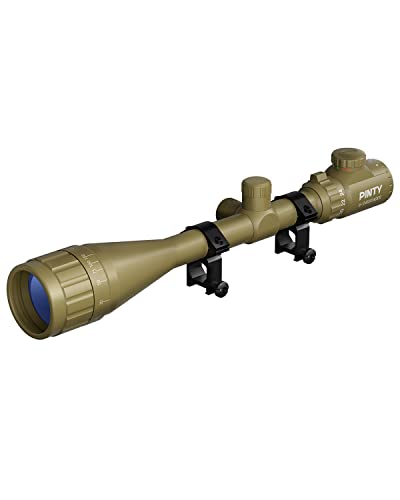
The Pinty 6-24x50 AO Rifle Scope is a full-sized, variable-magnification optic engineered for target shooters, plinkers, and budget-conscious hunters. Built around a 1-inch aluminum main tube with an anodized sand Flat Dark Earth (FDE) finish, this optic delivers high-magnification capability from 6x up to 24x. It is best suited for recreational range enthusiasts, rimfire or centerfire bench shooters, varmint hunters, and beginners looking to practice mid-range to long-range marksmanship without committing to high-end competition glass. The bundled accessory package makes it an accessible choice for first-time rifle scope buyers outfitting a rifle with a standard rail.
Optical performance is driven by a large 50mm objective lens combined with fully multi-coated glass elements designed to maximize light transmission during morning and late evening shooting sessions. The etched-glass second focal plane (SFP) reticle features an integrated rangefinder Mil-Dot pattern, providing reference points for windage holds and bullet drop. Shooters can choose between five brightness levels of red or green illumination, which aids reticle contrast against dark targets or dim foliage, while remaining entirely functional as a standard black reticle if battery power is depleted. Turret adjustments operate in standard 1/4 MOA click values, allowing fine windage and elevation tuning at the bench.
A key mechanical feature of this optic is the adjustable objective (AO) lens located on the front bell, which allows shooters to manually correct for parallax and sharpen image clarity at various target distances. Structurally, the scope measures approximately 16 inches in length and weighs 1.4375 pounds. The main tube is manufactured from lightweight aluminum alloy and is hermetically sealed and nitrogen-filled to provide water-resistant, fog-proof, and shockproof integrity against routine field conditions and recreational recoil impulses.
Mounting the optic is straightforward thanks to the included pair of 1-inch scope rings compatible with standard 20mm Picatinny rail bases. Flip-up protective covers are included to shield the objective and ocular lenses from dust and scratches during transport or gun safe storage. While the bundled rings simplify initial bench setup, shooters should ensure proper ring torque and eye-relief spacing during installation to maintain mounting stability. Diopter adjustments on the fast-focus ocular bell let marksmen tune the reticle focus directly to their individual eyesight.
As with many entry-level, high-magnification optics, there are practical trade-offs to keep in mind. The 16-inch physical profile and 1.44-pound listed weight make this scope relatively long and front-heavy, which may feel awkward on compact carbines or lightweight field stalking rifles. Additionally, high magnification at 24x naturally narrows the exit pupil, requiring more precise cheek weld and consistent eye placement behind the ocular lens. For weekend plinkers, bench rest target shooters, and hunters operating from fixed stands, the Pinty 6-24x50 AO scope offers a practical, high-value optical package with comprehensive out-of-the-box features.
The Pinty 6-24x50 AO scope comes packaged with a pair of 1-inch diameter scope rings designed to clamp directly to standard 20mm Picatinny or Weaver-style accessory rails. This makes the optic immediately compatible with a broad assortment of long guns, bolt-action platforms with pre-installed rail bases, modern sporting rifles, and recreational air guns featuring a matching rail configuration.
Because the objective lens outer bell measures over 50mm across, clearance above the rifle barrel or handguard is an essential installation consideration. Buyers should confirm that the included ring height provides sufficient clearance between the front bell and the rifle barrel, especially when using standard flip-up protective covers. Ensuring even screw torque across both ring caps helps preserve tube alignment and maintain zero across repeated range sessions.
Equipped with an adjustable objective (AO) mechanism on the front bell, this scope allows shooters to dial in precise focus for targets at varying distances. Correctly adjusting the AO ring aligns the target image with the reticle plane, reducing parallax error that could otherwise displace point of impact when shooting from the bench.
The fully multi-coated 50mm objective lens aids light gathering during transition hours such as dawn and dusk. At lower magnification settings like 6x to 12x, the sight picture remains wide and forgiving, while turning the magnification dial toward the 24x maximum increases magnification power for detailed target observation at the expense of a narrower field of view and smaller eye box.
Pros
- Clear glass with good light transmission for the price point
- Intuitive illuminated reticle with multiple brightness settings
- Solid construction feels robust and holds zero well on rimfire and mild-recoil rifles
- Included accessories reduce upfront cost and hassle
Cons
- Eye relief can be slightly finicky for shooters with high-magnification preferences
- Turret caps are plastic and may wear over time with frequent adjustments
- Not recommended for heavy-recoil magnum cartridges due to potential shift in zero
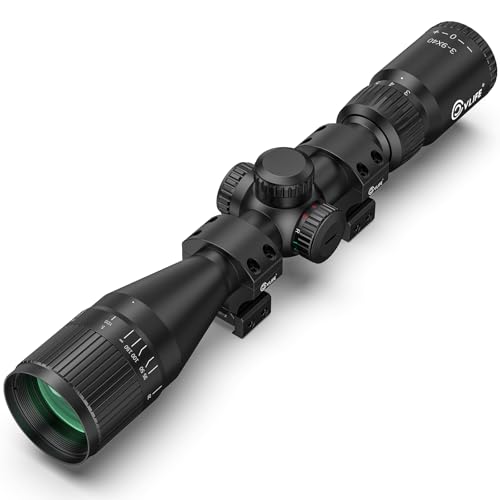
The CVLIFE EagleFeather 3-9x40 AO Rifle Scope is an entry-level to mid-range optic designed primarily for hunters, target shooters, and plinkers who value affordability without sacrificing essential features. This scope is best suited for rimfire rifles (.22 LR, .17 HMR), air rifles, and low-recoil centerfire calibers like .223 Remington. Its adjustable objective (AO) allows parallax correction from 10 yards to infinity, which is handy for close-range pest control or longer-range varmint hunting.
In real-world use, the fully multi-coated glass provides a bright, clear image even in dim morning or evening light. The red and green illumination (5 levels each) helps the Mil-Dot reticle stand out against dark backgrounds, though the reticle itself is etched and remains visible without illumination. The resettable turrets feature audible clicks that are easy to dial without tools, and the zero-reset function lets you return to your baseline quickly. The moderate eye relief (around 3.5 inches) works well with most standard rifle stocks.
Build quality is respectable for the price: a one-piece aircraft-grade aluminum tube, nitrogen-purged and O-ring sealed to resist fog and water. The included flip-up lens caps and Picatinny rings are functional but utilitarian. Some users report that the turret caps feel light; they are plastic but work fine for occasional adjustments. The scope is not intended for heavy-recoil rifles like .308 or magnum cartridges, as the internal components may shift under repeated hard recoil. For someone building a budget hunting setup or outfitting a .22 for squirrel or rabbit hunting, this scope offers great value. The lightweight design (1.24 lbs) keeps your rifle balanced and easy to carry in the field.
If you are a new hunter or a shooter looking for an affordable scope with illumination and AO, the EagleFeather is a dependable choice. Experienced users may prefer a higher-end model with better low-light performance or more precise turrets, but for the price, this scope hits above its weight class.
The term 'cutting performance' here refers to the scope's optical ability to 'cut through' challenging light conditions and provide a crisp, clear sight picture. The fully multi-coated lenses effectively reduce glare and enhance contrast, which helps shooters acquire targets quickly in bright sun or overcast skies. The adjustable objective (AO) eliminates parallax error, ensuring the reticle stays on target without shift – crucial for precision shooting at varying distances.
The illuminated Mil-Dot reticle offers 5 brightness levels each for red and green, allowing you to 'cut' through low-light situations like dawn, dusk, or dense brush. The reticle itself is fine enough for precise aiming at small targets, yet bold enough for fast target acquisition. The 3-9x magnification range is versatile: at 3x, you have a wide field of view for tracking moving game; at 9x, you can dial in on distant targets. The fast focus eyepiece lets you sharpen the reticle instantly without taking your eye off the target. Overall, this scope provides a clean, unobstructed view that enhances your ability to shoot accurately in varied conditions.
The CVLIFE EagleFeather is built around a single-piece 1-inch tube made from 6061 aircraft-grade aluminum. This construction ensures strength and shock resistance, while the matte black anodized finish reduces reflections and resists scratches. O-ring seals and nitrogen purging make the scope both waterproof and fogproof, so you can hunt in rain or snow without worries.
Weight is a modest 1.24 pounds, making it light enough for a hunting rifle without adding unnecessary heft. The included 20mm low-profile Picatinny rings are made of aluminum and work well for standard mount setups. The turrets are capped (plastic caps) to prevent accidental adjustment, and the audible clicks are positive enough to count without looking. The parallax adjustment ring on the objective lens turns smoothly with moderate resistance, allowing precise focus.
The reticle is etched on glass, which is more durable than wire reticles and remains visible even if the illumination battery dies. The illumination dial is located on the eyepiece, easy to reach, and has a positive click between settings. The lens caps are flip-up style with spring tension to stay open – practical but a bit stiff out of the box. The overall feel is that of a well-thought-out budget scope that emphasizes durability and functionality over luxury. It will hold up to years of casual use on rimfires and light-recoil centerfires, and its construction inspires confidence for field use.

Pros
- Affordable all-in-one scope and laser combo saves money and setup time.
- Clear optics with multi-coated green lens improve visibility in low light.
- Durable aluminum build with waterproof/fog-proof protection for outdoor use.
- Includes necessary mounts and tools for quick attachment to Picatinny rails.
Cons
- Laser is Class IIIA 2mW, which may have limited visibility in very bright daylight.
- Package does not include a 11mm dovetail mount, so airgun users may need an adapter.
- Zero reviews at time of writing, so long-term reliability is unverified by users.
The UUQ 2.5-10x40 Rifle Scope with Red/Green Laser Combo is a budget-friendly optic designed for hunters, airgun shooters, and tactical enthusiasts who want both magnification and a built-in laser for quick aiming. This scope is best suited for small game hunting, plinking, and target practice at moderate distances, typically under 200 yards. It may also appeal to airsoft players or those using air rifles.
Real-world performance, based on product specifications, includes a variable 2.5-10x magnification that allows users to zoom in for precision shots or dial back for a wider field of view. The multi-coated green lens is said to reduce glare and improve image clarity in various lighting, from bright sun to dusk. The illuminated mil-dot reticle offers five levels each of red and green brightness, helping with aiming in low light without washing out the target.
Build quality features an aircraft-grade aluminum alloy body that is both lightweight and durable. The scope is nitrogen-filled for waterproof and fog-proof performance, so it should hold up in rain or humid conditions. The included Picatinny mounts make installation straightforward on most rifles with a 20mm rail, though airgun users with 11mm dovetails may need to purchase an adapter separately.
The integrated red laser is rated at 2mW and Class IIIA, with a claimed range over 300 yards. In practice, the laser is most visible in low light or indoor settings; bright daylight may wash it out. The laser runs on three LR44 batteries (included), while the scope reticle uses a CR2032 battery (also included).
Realistic drawbacks include the lack of user reviews to confirm long-term durability and the laser's limited daytime visibility. Some users may find the scope adjustments less precise than higher-end models. However, for the price, this combo offers good value for casual shooters who want a simple, all-in-one sighting system.
Final recommendation: This scope is a practical choice for budget-minded hunters, airgun enthusiasts, and plinkers who need a functional optic with laser capability. It may not satisfy serious long-range shooters or those demanding premium glass, but for light to moderate use, it's a solid entry-level option.
While this is an optic and not a cutting tool, evaluating its 'cutting performance' in terms of aiming precision and target acquisition is appropriate. The scope's variable 2.5-10x magnification helps shooters quickly acquire and engage targets at varying distances. At 2.5x, the field of view is wider for close-range shots, while at 10x, users can zoom in for more precise aiming at longer ranges.
The illuminated mil-dot reticle provides aiming points for holdover and windage, which can improve accuracy in field conditions. The five-level red and green brightness settings allow users to adjust reticle visibility based on ambient light, reducing eye strain during low-light hunts.
The integrated red laser offers a secondary aiming method for fast, reflexive shooting at close distances. In low light, the laser can be highly effective for quick target engagement. However, its 2mW power means it may struggle in bright sunlight, limiting its utility in midday hunting scenarios.
Overall, the scope's optical clarity and reticle design contribute to reliable target acquisition and shot placement for small game, varmints, or paper targets. It is not designed for extreme long-range precision but works well within its intended range.
The UUQ 2.5-10x40 scope is constructed from aircraft-grade aluminum alloy, which provides a balance of strength and light weight (1.23 pounds). The body is finished in a matte black coating that resists glare and blends well with most rifle setups.
The scope is nitrogen-filled and O-ring sealed, making it waterproof and fog-proof. This ensures reliable performance in wet or humid conditions, which is important for hunters and outdoor shooters who may face rain or temperature changes.
The multi-coated green lens is designed to increase light transmission and reduce reflections, giving a brighter image compared to uncoated lenses. The lens covers included in the package help protect the glass during transport and storage.
Ergonomics are straightforward: the scope features large, easy-to-grip adjustment turrets for windage and elevation, with audible clicks for precise adjustments. The included 20mm Picatinny mounts are made of metal and provide a secure attachment to the rifle. However, users with 11mm dovetail rails (common on many air rifles) will need to purchase an adapter or different mounts.
The laser unit is integrated into the scope body, keeping the setup compact. It runs on three LR44 batteries, which are included and easy to replace. The scope's reticle illumination uses a CR2032 battery, also included. Overall, the design is practical for a budget optic, with enough durability for regular field use.

Pros
- Affordable price point for a variable magnification scope
- Clear optics with multi-coated lenses for low light use
- Rugged aluminum construction resists fog, water, and shock
- Includes scope rings for quick installation
Cons
- Limited to airgun and airsoft use, not rated for high-recoil firearms
- Eye relief may be tight for some users at higher magnification
- Tan color may not suit all rifle or gear color schemes
The Lancer Tactical 3-9x40 Airgun Airsoft Scope is a budget-friendly optic designed for airsoft and airgun enthusiasts. It offers adjustable magnification from 3x to 9x, making it suitable for engaging targets at mid to long ranges. The multi-coated lenses help provide a bright, clear sight picture even in lower light conditions, which is a plus for outdoor games or plinking sessions.
This scope is built with a durable aluminum housing that is fog, water, and shock proof, so it can handle the bumps and weather typical of airsoft skirmishes or backyard shooting. It comes with scope rings for immediate attachment to 20mm Picatinny rails, simplifying setup. Windage and elevation adjustments allow shooters to dial in their accuracy.
Best suited for airsoft players and airgun owners who want a variable power scope without breaking the bank. It may not be ideal for high-recoil firearms, as it is specifically designed for lower-recoil platforms. Some users might find the eye relief a bit short at higher magnification, but for the price, it offers solid performance for its intended use.
Overall, this is a practical choice for those looking to upgrade their airsoft or airgun setup with a reliable, adjustable scope. It delivers good value for recreational shooting and tactical games.
As an optic, this scope does not have cutting performance in the traditional knife sense. Instead, its optical performance is key. The multi-coated lenses help deliver a clear sight picture, which aids in target acquisition and shot placement. The adjustable magnification from 3x to 9x allows shooters to zoom in for precision shots at longer distances or zoom out for a wider field of view at closer ranges.
The mil-dot reticle assists with holdover and windage estimation, which can improve accuracy for experienced users. Windage and elevation adjustments are click-adjustable, allowing for fine-tuning. The fast focus eyepiece helps quickly bring the reticle into sharp focus.
For airsoft and airgun use, this scope provides adequate clarity and functionality. It may not compete with high-end optics, but for its price point, it offers reliable performance for recreational shooting.
The Lancer Tactical 3-9x40 scope features a one-piece aluminum tube construction that is designed to be fog, water, and shock proof. This makes it suitable for outdoor use in varying weather conditions. The exterior has a sleek tan finish that matches many tactical and outdoor gear setups.
The scope comes with integrated scope rings that fit 20mm Picatinny rails, so you can mount it directly out of the box without needing additional hardware. The turrets are capped and provide tactile clicks for windage and elevation adjustments. The fast focus eyepiece allows for quick reticle focusing.
Weighing in at a moderate weight, it adds some heft to your rifle but remains manageable. The build quality feels solid for its price range, though it is not designed for high-recoil firearms. Overall, it is a well-constructed optic for airsoft and airgun applications.

Pros
- High magnification range suitable for long-range precision shooting
- Bright and clear glass with effective parallax adjustment
- Rugged, waterproof, and fogproof build for reliable use in harsh conditions
- Easy zero-reset turrets for quick field adjustments
Cons
- Weight of 7 pounds adds significant heft to your rifle setup
- Limited to users needing extreme magnification; may be overkill for shorter ranges
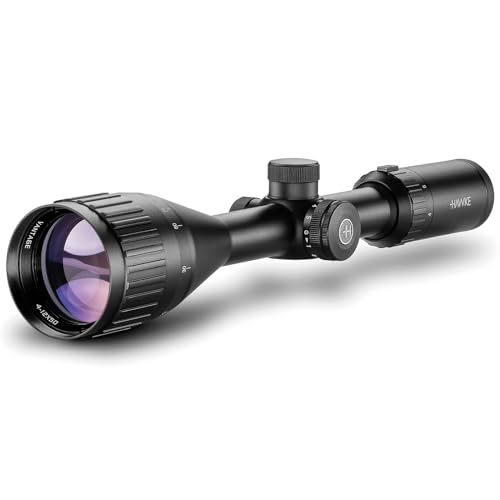
The Sniper KT12-60X60SAL is a long-range rifle scope designed for shooters who demand precision at extended distances. With a 12-60x magnification range and a 60mm objective lens, this scope delivers bright, clear images that help you acquire targets with confidence. The 35mm tube provides ample light transmission and a wide field of view, while the side parallax adjustment lets you fine-tune focus from close to far ranges without moving your shooting position.
This scope is best suited for hunters, tactical shooters, and target enthusiasts who engage targets beyond typical rifle ranges. The illuminated reticle in red and green with multiple brightness levels ensures visibility in changing light conditions, from dawn to dusk or against varied backgrounds. The glass etched reticle is durable and stays clear even after recoil.
In real-world use, the scope offers excellent clarity and precision. The capped reset turrets with 1/8 MOA clicks allow for precise windage and elevation adjustments, and the zero-reset feature makes returning to your original zero simple after sighting in. The nitrogen purged and O-ring sealed body ensures the scope remains waterproof and fogproof, so you can rely on it in wet or humid conditions.
Build quality is solid, with a black finish that resists scratches and corrosion. The package includes scope rings, a sunshade, lens caps, a cleaning cloth, and a battery, so you have everything needed for mounting and maintenance. However, the scope weighs 7 pounds, which can be noticeable on lighter rifles and may affect balance during carry or offhand shooting.
Some users may find the 12-60x magnification range excessive for typical hunting scenarios, where lower magnification is often preferred for quicker target acquisition. The scope is best suited for benchrest shooting, varmint hunting, or long-range target practice where high magnification is an asset.
Overall, the Sniper KT12-60X60SAL is a capable long-range scope for shooters who prioritize precision and clarity. It may not be ideal for all-around hunting or tactical use due to its weight and high magnification, but for dedicated long-range work, it offers good value and performance.
As a rifle scope, the Sniper KT12-60X60SAL does not involve cutting performance in the traditional knife sense. However, its optical performance is critical for precision shooting. The scope provides sharp, clear images at high magnification, allowing shooters to see targets with clarity and make precise adjustments. The side parallax adjustment helps eliminate parallax error, ensuring the reticle stays on target at varying distances. The illuminated reticle aids in quick target acquisition in low light, while the 1/8 MOA turret clicks allow for fine windage and elevation adjustments. This scope is designed for accuracy and reliability in long-range shooting scenarios.
The Sniper KT12-60X60SAL features a robust construction with a 35mm tube and 60mm objective lens. The scope body is nitrogen purged and O-ring sealed, making it waterproof and fogproof for use in harsh environments. The black finish is durable and resistant to wear. The turrets are capped and finger adjustable with 1/8 MOA clicks, and they can be reset to zero after sighting in. The illuminated reticle is glass etched for durability and clarity. The package includes scope rings, a sunshade, lens caps, a cleaning cloth, and a battery. Weighing 7 pounds, the scope is heavy but built to withstand recoil and rough handling. The design prioritizes long-range precision and durability over portability.

Pros
- Affordable price point for an optic with illuminated reticle and laser combo
- Reticle illumination with 5 brightness levels works well in varying light conditions
- Waterproof and fog proof sealing adds reliability in wet or humid environments
- Easy to mount on standard Picatinny or Weaver rails with included hardware
Cons
- Laser range limited to 100 yards, which may not suit long-range shooters
- Build quality and glass clarity may not match higher-end brands due to budget price
- Zero reviews available, making real-world performance difficult to assess
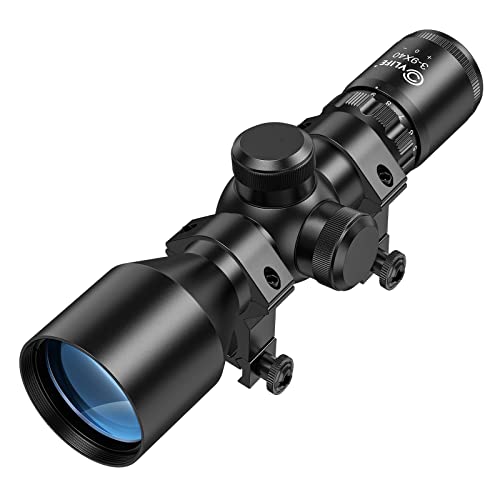
The Pinty 2.5-10x40 is a compact tactical rifle scope with an integrated red laser, aimed at hunters, plinkers, and tactical shooters on a budget. Based on its specifications, it offers a red/green illuminated mil-dot reticle with five brightness levels, a multi-coated green objective lens, and a nitrogen-filled, O-ring-sealed body for waterproof and fog proof performance. The 40mm objective and 2.5-10x magnification make it suitable for close to medium-range shooting, such as varmint control or target practice.
This scope is best suited for entry-level shooters or those who want an all-in-one optic without spending hundreds of dollars. The included red laser, with a claimed range of 100 yards, can assist in quick target acquisition. However, users should keep realistic expectations regarding glass clarity and durability at this price point. The solid aluminum alloy construction and standard Picatinny/Weaver mount should provide a secure attachment.
Realistically, the optical performance will likely be adequate for daytime use, though low-light edge-to-edge sharpness may be limited. The illuminated reticle helps in dim conditions, and the mil-dot markings allow for basic range estimation. A common drawback with budget scopes is inconsistent tracking and less refined adjustments, so buyers should verify zero retention after mounting.
Overall, this Pinty combo is a practical option for someone needing a functional optic for casual shooting or hunting trips where precision isn't critical. It may also serve as a backup scope or a starter optic for a new shooter. Given the lack of reviews, consider purchasing from a seller with a good return policy.
While this is an optic rather than a cutting tool, its performance directly affects a hunter's ability to make clean shots, which ties to ethical game harvesting and subsequent processing. The 2.5-10x magnification range allows shooters to acquire targets quickly at varying distances. The illuminated mil-dot reticle offers aim points for holdover, useful for ranging and compensating for bullet drop in the field.
The red/green illumination with five brightness levels helps during low-light conditions like dawn or dusk when many animals are active. A clear sight picture leads to precise shot placement, reducing the need for follow-up shots and making field dressing easier. The 40mm objective gathers moderate light, but the green lens coating may improve contrast in bright conditions.
For bushcraft or hunting where a cutting tool is used after the shot, this scope aids in ensuring the target is downed efficiently. The integrated laser can be a fast aiming aid when time is critical. However, the laser's 100-yard maximum range limits its use for longer shots. Overall, the scope's ability to help place an accurate shot contributes to a successful hunt.
The Pinty scope features a solid aluminum alloy main tube, which is standard for budget optics. The black matte finish helps reduce glare. The scope is 11.5 inches long and weighs around 1.2 pounds, making it a manageable addition to a rifle. The included rings allow quick installation on Picatinny or Weaver rails.
The windage and elevation turrets have low-profile caps, and adjustments are typically 1/4 MOA per click. The ocular lens has a fast-focus eyepiece for reticle focus. The objective lens is multi-coated with a green tint, which the manufacturer claims improves light transmission compared to blue coatings. The body is nitrogen filled and O-ring sealed for waterproof and fog proof performance, a useful feature for wet hunting environments.
Durability at this price point is a common concern; the scope may not withstand heavy recoil from magnum calibers as well as higher-end models. The reticle is wire-based, and illumination is powered by a single CR2032 battery. The laser module is integrated into the underside of the scope body and has windage and elevation adjustments. The on/off switch is a pressure pad or button, depending on the model.
For carrying in the field, the scope's compact size and light weight are advantages. The included flip-up lens caps protect the glass. Overall, the design is functional and user-friendly for beginners, but experienced shooters may prefer more robust construction.
Mil Reticles, Measurements, and Scope Choices
Mil is short for milliradian, an angular unit used to express how large an object appears in a scope’s sight picture. A mil is one-thousandth of a radian. In practical scope use, mil spacing can help estimate target dimensions or describe the apparent distance between points in the reticle, provided the shooter knows the reticle’s subtensions and uses the correct magnification where required.
A mil is not a physical dot size on the target. It describes an angle, so the corresponding span at the target grows as distance increases. At 100 yards, one mil spans about 3.6 inches; at 200 yards, it spans about 7.2 inches. Those are geometric conversions, not a promise of a particular scope’s accuracy, and small measurement or range-estimation errors can affect any calculation based on them.
On a mil-dot reticle, the dots and spaces provide reference points for judging angular size. The exact spacing, dot shape, and subtension are design-specific, so the scope manual or manufacturer’s reticle diagram is the authority for a particular model. Some products use a mil-dot pattern for holdover or range estimation, but descriptions may use “mil-dot” broadly; verify the actual reticle layout rather than assuming every design has identical marks.
What the mil scale tells you in the sight picture
A reticle’s mil scale lets a shooter state how many mils an object spans from one reference point to another. If the target’s real size is known, that apparent size can be combined with a formula to estimate distance. The result depends on accurate target-size information, correct reticle subtension, and a suitable view of the target; the reticle alone does not measure distance automatically.
For example, a shooter might use a known target dimension and count how many mils it covers. The general relationship is distance equals target size divided by angular size, with units kept consistent and an appropriate conversion applied. Because a mistaken size estimate or an unclear reticle reading can produce a poor distance estimate, treat the method as a calculation requiring care, not as a built-in rangefinder.
Mil markings can also provide aiming references. A shooter may use a reticle mark to hold above or beside a point of aim rather than changing a turret setting, but the correct hold depends on the firearm or air rifle, ammunition or pellet, distance, and observed trajectory. Product descriptions alone do not establish a particular holdover value or confirm that a setup will perform as expected.
Mil reticles and MOA turrets are different systems
The reticle and turrets perform related but distinct jobs. A reticle gives visual reference marks, while turrets move the point of aim through adjustments specified by the manufacturer. A scope may therefore have a mil-based reticle and MOA adjustment clicks, or it may pair a mil reticle with mil adjustments. Check both specifications before choosing a method for making corrections.
Mixing units does not make an optic unusable, but it requires converting between the reticle’s mil scale and the turret’s MOA values when translating a correction into clicks. A consistent mil reticle and mil turret arrangement can simplify calculations for someone already working in mils. Conversely, a buyer who uses MOA references may prefer an MOA reticle and MOA turrets. The best match is the system the user can read and apply consistently.
Several products in the supplied selection illustrate why the distinction matters. The PINTY 6-24×50 listing specifies a rangefinder-style mil-dot reticle and 1/4 MOA clicks, while the Hawke Vantage IR 4-12×50 listing identifies an AO Mil Dot reticle and 1/4 MOA clicks. Those descriptions indicate mil reticles paired with MOA adjustments, not mil-adjustment turrets. Confirm current manufacturer documentation for the exact configuration before relying on these details.
The Sniper KT12-60X60SAL listing describes a MIL reticle and 1/8 MOA clicks. Its broad magnification range and stated reticle type may interest someone looking for a high-magnification optic, but magnification alone does not establish suitability for a particular rifle, distance, or use. The listing does not provide all details a buyer may need, such as reticle subtension behavior across the zoom range, so consult the manufacturer’s documentation.
Focal plane changes how reticle spacing behaves
Focal-plane location matters because it determines whether the reticle appears to change size with magnification. In a first-focal-plane scope, the reticle scales with the image, so its angular spacing generally stays valid across the magnification range when the design is specified that way. In a second-focal-plane scope, the reticle stays visually similar in size as magnification changes, and its stated subtensions are typically accurate at a designated magnification.
That distinction affects ranging and hold references. A second-focal-plane reticle may require the user to set the scope to the manufacturer’s specified magnification before treating the marks as their stated mil values. Don’t assume the correct setting based on a common convention; check the manual for the specific optic. The supplied product information identifies the CVLIFE EagleFeather 3-9×40 as second focal plane, but does not provide a mil-calibration magnification.
Other listed products state mil-dot reticle features without identifying the focal plane or the magnification at which subtensions are calibrated. That missing detail is worth checking before purchase if the buyer intends to use reticle marks for ranging or holdovers. A reticle can remain visible and useful as an aiming reference even when a specification is unknown, but precise calculations require confirmed subtensions.
Illumination is a separate feature. Red or green illumination can make a reticle easier to distinguish against some backgrounds, but it does not change the mil scale or make the reticle a laser rangefinder. Compare illumination levels, battery requirements, and reticle details in the exact product documentation. Keep the reticle visible without assuming illumination improves measurement precision.
Mil-dot markings do not automatically mean a rangefinder
A mil reticle can support a manual distance estimate when the target’s size is known and the user can measure its apparent angular size. That is different from an electronic or laser rangefinder, which actively provides a distance reading when used within its stated limits. Product wording such as “rangefinder reticle” may describe a reticle pattern intended to assist with estimation, not an integrated ranging device.
The UUQ 2.5-10×40 listings describe an illuminated mil-dot reticle and a separate laser combination. The laser is a listed feature of that configuration, but its presence should not be confused with the reticle’s mil measurement or treated as proof of ranging precision for every intended use. Check the specific variant, included components, operating instructions, and applicable rules before deciding whether the laser meets a need.
The Pinty 2.5-10×40 listing also describes a laser combination and an illuminated mil-dot reticle. Its listed field of view varies with magnification, a reminder that a higher setting narrows the visible area. A reticle, an illuminated reticle, and a laser are three distinct features; verify which one addresses the actual task rather than treating the words as interchangeable.
By contrast, the Lancer Tactical Airgun Airsoft Scope is described as having a mil-dot reticle, but the supplied details do not identify an integrated rangefinder. The same evidence gap applies to other listings unless their exact configuration specifically confirms such a feature. If ranging is essential, look for explicit manufacturer documentation for the exact model instead of inferring capability from “mil-dot” in a product title.
Matching mil features to a particular optic and use
Start by deciding what the mil marks need to do. A buyer interested mainly in an aiming reference may prioritize a clear reticle and usable magnification, while someone planning to estimate distance also needs known subtensions, a target of known dimensions, and the correct focal-plane or magnification information. Neither purpose automatically calls for the highest magnification available; field of view and a steady sight picture also matter.
The PINTY 6-24×50 model lists adjustable objective parallax, 6-24x magnification, a 50 mm objective, and 1/4 MOA clicks. Those specifications can help a buyer compare its configuration with a particular use, but they do not establish compatibility with every rifle or air rifle. Confirm the intended platform, mounting interface, eye relief, and manufacturer guidance before purchase, especially if the optic will be used on a specific airgun.
The CVLIFE EagleFeather 3-9×40 listing includes an adjustable objective and an illuminated mil-dot reticle, along with 1/4 MOA clicks. Its listed magnification differs substantially from the high-magnification Sniper scope, so the practical choice depends on the target, distance, shooting position, and user preference. Product descriptions do not supply a universal distance range at which either model is appropriate.
Air rifles deserve particular care in compatibility checks. A scope that fits a rail dimensionally is not automatically suitable for every air-rifle action or recoil pattern. The supplied listing for a model may state certain platform examples, but that does not prove suitability for a different model or configuration. Check the air-rifle and scope manufacturers’ instructions, and ask the manufacturer or a qualified gunsmith if the specified use is unclear.
Mounts and rings are accessories, not part of the mil measurement system. A compatible setup requires the scope tube diameter, ring dimensions, rail type, and firearm or air-rifle interface to match the exact equipment. Some listed scopes include rings or mounts, but inclusion alone does not confirm fit for every rail or receiver. Verify the supplied hardware and the platform requirements independently.
For mounting or sighting work, follow the optic, mount, and firearm or air-rifle manufacturers’ instructions and safe-handling practices. Keep the firearm verified unloaded and pointed in a safe direction when working on it, and open the action where applicable. Avoid improvising torque values or procedures; use the specifications provided for the exact equipment. If fit or installation remains uncertain, professional assistance is a prudent option.
What to verify before relying on mil markings
Check the manual for the reticle diagram, subtension values, focal-plane location, and any magnification condition. Then identify whether the turrets adjust in MOA or mils and note the click value. This basic review prevents a common confusion: reading a reticle in one angular unit while assuming the turrets use the same unit.
Also distinguish manufacturer specifications from marketing language. A product title may mention mil-dot, rangefinder, tactical, or long range, but each term should be verified against the detailed reticle information and feature list. If the documentation does not state a calibration magnification or exact reticle spacing, treat that information as unresolved rather than filling the gap with assumptions.
Eye relief and parallax are separate usability considerations. The supplied listings give parallax information for some models, such as adjustable objective or side parallax, but do not consistently provide exact eye-relief measurements or parallax ranges. People who wear glasses should check eye relief and sight-picture requirements in the manufacturer’s specifications, since a mil reticle cannot compensate for an uncomfortable or incomplete view.
A spotting scope is a different optic from a rifle scope. It may help observe targets or scenery, but it is not a substitute for a rifle scope’s mounting and aiming role, and mil reticle specifications should not be assumed to apply to a spotting scope unless its own documentation says so. Keep each optic’s intended function and mounting arrangement distinct when comparing equipment.
Mil markings are best understood as angular references, not as a guarantee of distance measurement, compatibility, or shooting results. Confirm the exact reticle subtensions, focal-plane behavior, turret units, and platform fit for the specific scope. Those checks turn the term “mil” from a product-title label into information a buyer can actually use.
For a useful related perspective on mounting choices, our scoped pellet-gun setup overview discusses a neighboring airgun equipment decision. The key takeaway remains specific to the optic in hand: mil describes angular spacing, while the reticle design and adjustment system determine how that measurement applies in practice. Follow manufacturer documentation rather than relying on a generic mil-dot assumption.



Write Your Review
No reviews yet. Be the first to share your experience!