


Rodent management around barns, outbuildings, and suburban properties often prompts homeowners and shooters to evaluate mechanical pest control. A common question among backyard property managers is will an air rifle pellet kill a rat cleanly and ethically. While modern airguns generate enough muzzle energy to dispatch small pests humanely, success depends on adequate velocity, pellet construction, and precise shot placement. Air rifles vary widely in powerplant design, ranging from multi-pump pneumatics to powerful spring and gas-piston systems.
Understanding terminal ballistics helps shooters select appropriate equipment rather than relying on underpowered backyard toys. Many shooters explore budget-friendly break-barrel air rifle options to manage rat activity without investing in complex support equipment. Evaluating projectile shape, foot-pounds of energy, and effective shooting distances ensures that pest control remains swift and humane.

Pros
- Expansion on impact helps ensure clean, humane kills on small game
- Consistent weight and diameter promote tight groups at typical airgun ranges
- Good value for the quantity and performance level
Cons
- Requires a powerful airgun (12+ ft. lbs) to achieve proper expansion
- Lead pellets may be restricted in some areas for hunting
- Not ideal for low-power plinking airguns due to heavier weight
The H&N Sport Terminator Hollowpoint Airgun Pellets in .22 caliber are a purpose-built projectile for hunters and pest controllers who demand reliable expansion on impact. Weighing 16.36 grains, these pellets are designed for air rifles and pistols that produce at least 12 ft. lbs of muzzle energy. According to user feedback and product specifications, the hollowpoint cavity opens up upon hitting soft tissue, creating a larger wound channel for quick, ethical takedowns of small game like squirrels, rabbits, and birds.
These pellets are best suited for hunters, pest control operators, and target shooters who already own a powerful airgun. Casual plinkers with lower-powered guns may find the heavy weight causes a noticeable drop in velocity and trajectory. The 200-count tin is practical for both extended shooting sessions and stocking up for hunting trips. Build quality is consistent with H&N Sport's reputation; each pellet is uniform in size and skirt thickness, which helps maintain accuracy.
Real-world performance includes stable flight out to typical airgun ranges (30-50 yards) and reliable expansion when the pellet hits at appropriate velocities. Some users note that the hollowpoint can sometimes plug with fur or clothing, but overall expansion is good for the price point. The lead construction is soft enough to engage rifling without excessive fouling, yet hard enough to resist deformation during loading.
Carry and storage are straightforward; the tin is compact and fits easily in a range bag or hunting pack. No special maintenance is needed beyond keeping the pellets dry and avoiding crushing. A realistic drawback is that these pellets may not cycle well in some semi-automatic airguns due to the hollowpoint shape, and they are heavier than standard field pellets, so trajectory compensation is necessary.
Overall, the H&N Sport Terminator Hollowpoint pellets are a reliable option for hunters who need stopping power from their airgun. They offer a good balance of accuracy and terminal performance, making them a practical addition to any small game hunter's gear.
While not a cutting tool, the 'cutting' ability of these pellets refers to their terminal performance on target. The hollowpoint design creates a controlled expansion that effectively 'cuts' through tissue, increasing the wound cavity. Edge sharpness is not applicable, but the pellet's nose geometry is designed to initiate expansion upon impact. Efficiency depends on impact velocity; at 800-900 fps, the hollowpoint opens reliably. Edge retention is irrelevant, but the pellet maintains its shape until impact, ensuring consistent flight.
Blade geometry is replaced by pellet design: the hollowpoint cavity depth and rim thickness influence expansion. Deployment speed is the time from loading to firing, which is fast with a break-barrel or PCP airgun. Lock reliability is not a factor, but the pellet must seat snugly in the breech. Control during use refers to the shooter's ability to place the pellet accurately; these pellets group well in many airguns. Precision cutting capability translates to the ability to hit a small target like a squirrel's head at 30 yards. Outdoor task suitability is excellent for pest control and small game hunting. Food preparation practicality is not relevant, but ethical hunting results in clean meat. Wood processing capability does not apply.
The H&N Sport Terminator pellets are made from soft lead, which allows for good engagement with rifling and consistent spin stabilization. The handle material analogy is the pellet's lead alloy; it is soft enough to expand but firm enough to resist deformation during acceleration. Weight and portability are excellent; a 200-count tin weighs about half a pound, easy to carry in a pocket or pack. There is no pocket clip, but the tin has a secure lid that prevents spillage. Sheath quality is not applicable, but the tin is durable enough for field use.
Ergonomics and grip security refer to handling the pellets; they are easy to pick up and load individually. Durability is not a concern as they are consumables. Corrosion resistance is not an issue with lead. Carry comfort is high due to the small size of the tin. Storage and transport practicality are good; the tin fits in most airgun cases or shooting vests. Overall, the design is functional and reliable for the intended use.
Pros
- Versatile power adjustment suits different shooting needs
- Comes with everything needed to start shooting right away
- Scope is fogproof and shockproof for reliable outdoor use
- Affordable price point for a complete air rifle setup
- Good accuracy with pellets for target practice
Cons
- Multi-pump action requires effort for higher power levels
- Scope may need adjustment for optimal accuracy out of the box
- Not suitable for high-power hunting applications
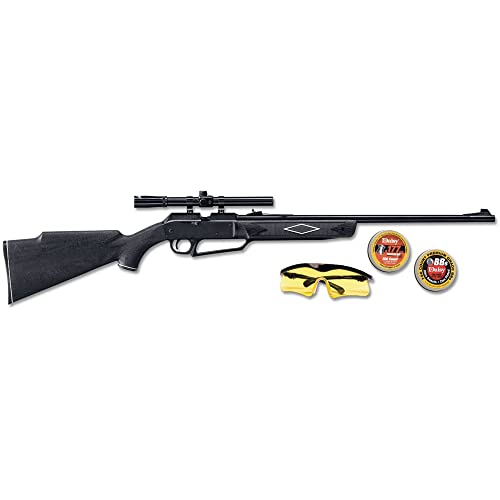
The Daisy Powerline Model 880 Shadow Air Rifle Kit is a multi-pump pneumatic air rifle designed for target shooting, plinking, and small game hunting. It's best suited for beginners, young shooters aged 16 and up, and casual plinkers who want a complete package without buying extras separately.
Real-world performance is solid for its class. The adjustable pump system lets you choose between 3 pumps for lower velocity indoor targets or up to 10 pumps for maximum 800 fps outdoor shooting. The bolt-action is smooth and easy to cycle, and the dual ammo capability allows quick BB shooting or more accurate pellet use. The included 4x15 scope is fogproof and shockproof, helping with precise aiming in various conditions.
Build quality is typical for Daisy air rifles: durable synthetic stock and metal barrel that can handle regular use. The rifle is lightweight at around 3 pounds, making it easy to carry to the range or field. However, the multi-pump action can be tiring for repeated shots, and the scope may need initial adjustment.
Drawbacks include the effort needed for multiple pumps and the scope's basic quality. Some users may prefer a single-pump or CO2 system for faster shooting.
Overall, this kit offers great value for anyone starting in airgunning or wanting a reliable plinker. It's a practical choice for backyard target practice or introducing new shooters to the sport.
As an air rifle, cutting performance is not directly applicable, but shooting accuracy and projectile speed are key. The .177 caliber pellets deliver consistent accuracy for target shooting, with the adjustable pump system allowing you to fine-tune power for different ranges. The 800 fps maximum velocity provides enough energy for small game hunting at close distances.
The included scope enhances precision, though it requires proper zeroing. The bolt-action system is reliable for cycling rounds without jams. For BB shooting, the 50-round magazine allows rapid fire, but accuracy is less than with pellets.
Overall, this rifle offers good control and precision for its price point, making it suitable for recreational shooting and pest control.
The Daisy Powerline 880 features a synthetic stock and metal barrel construction that balances durability with light weight. The black finish is practical for outdoor use and resists minor scratches. The rifle weighs approximately 3 pounds, making it easy to handle and carry.
The pump mechanism is robust, with a forearm that slides smoothly. The bolt-action is made of metal and cycles without issue. The included 4x15 scope is mounted on a dovetail rail and is fogproof and shockproof, though the optics are basic. The safety is manual and located near the trigger.
Ergonomics are decent for an entry-level air rifle, with a comfortable grip and shoulder stock. The overall design prioritizes function and affordability over premium materials. Storage and transport are easy due to its size and weight.

Pros
- Dual caliber capability offers flexibility for different game and distances.
- Gas piston system delivers consistent velocity and less maintenance than spring pistons.
- Included scope is decent for entry-level accuracy and saves on additional costs.
- Comfortable grip and balanced weight make it easy to handle for hours.
Cons
- Break barrel action requires some effort to cock, which may be tiring for smaller shooters.
- Scope included is basic; serious shooters may want to upgrade for precision.
- No open sights included, so you rely entirely on the scope or a separate optic.
The Barra Airguns 1200g is a dual-caliber break barrel air rifle designed for hunters, target shooters, and outdoor enthusiasts who want versatility without buying two guns. With interchangeable barrels, you can switch between .177 and .22 pellets using a simple Allen wrench. The gas piston powerplant provides smooth, consistent shots up to 1200 FPS in .177 and 1000 FPS in .22, making it effective for small game like squirrels, rabbits, and pests.
This rifle is best suited for hunters who need a reliable field gun, plinkers who enjoy variety, and survivalists looking for a lightweight, multi-caliber option for practice or pest control. The break barrel action is straightforward but requires moderate strength to cock. The included 4x32 scope mounts easily on the dovetail rail and offers decent clarity for distances up to 50 yards. Many users appreciate the accuracy out of the box, though some may want a higher-magnification optic for longer ranges.
Build quality is solid: the steel barrel is protected by a fluted polymer sleeve, and the synthetic stock has a textured grip that stays secure in wet conditions. At 7.75 pounds, it’s heavy enough to absorb recoil but still portable for hikes. One drawback is the lack of iron sights, so you’ll need a scope or red dot. Also, the break barrel effort can be tiring after many shots. Overall, the Barra 1200g offers excellent value for hunters and shooters who want a versatile, high-powered air rifle without a hefty price tag.
While not a cutting tool, the Barra 1200g delivers precision and power that translate directly to effective hunting and target shooting. The gas piston system provides consistent velocity shot after shot, which is critical for accurate pellet placement. In .177 caliber, the 1200 FPS velocity offers a flat trajectory for target work and small pest control. In .22 caliber, the 1000 FPS speed delivers more knockdown power for larger small game.
The break barrel design allows for quick follow-up shots once you’re accustomed to the cocking effort. The trigger is moderate but can be adjusted or smoothed with use. The included 4x32 scope is sufficient for most hunting scenarios, but upgrading to a better optic can improve precision at longer ranges. The dovetail rail is compatible with many aftermarket scopes and accessories.
For outdoor tasks like hunting, this rifle excels when paired with quality pellets. The .22 caliber is particularly effective for ethical takedowns of squirrels, rabbits, and similar game. The .177 is great for target practice, plinking, and small pests. Overall, the Barra 1200g offers reliable, accurate shooting that meets the needs of most hunters and shooters.
The Barra 1200g features a steel barrel with a fluted polymer sleeve that reduces weight while protecting the barrel. The break barrel mechanism is robust and locks up tight for consistent accuracy. The synthetic stock has a matte black finish that resists scratches and weather, with a textured pistol grip and forend for a secure hold.
Weighing 7.75 pounds, the rifle feels substantial but not overly heavy. The balance is good for off-hand shooting, and the included scope mounts easily. The dual-caliber system is a standout: swapping barrels takes less than a minute with the provided Allen wrench. The gas piston is sealed and requires no lubrication or maintenance, unlike spring-piston rifles.
Durability is a strong point. The materials are built to withstand field use, and the rifle comes with a one-year warranty. The only minor downside is the lack of open sights, which means you must rely on the scope or purchase an aftermarket red dot. Overall, the design is practical, functional, and built to last for years of hunting and target shooting.

Pros
- Variable pump power allows you to adjust velocity for different tasks from plinking to pest control
- Bolt action is easy to operate and provides reliable single-shot cycling
- Rifled barrel delivers good accuracy for an entry-level air pistol
- Adjustable rear sight helps fine-tune aim for various distances
Cons
- Pumping can be tiring after extended shooting sessions due to the number of strokes needed for high power
- Single-shot design limits follow-up speed compared to multi-shot models
- Plastic frame may feel less premium than all-metal alternatives
The Crosman P1377 American Classic is a variable-pump pneumatic air pistol that fires .177-caliber pellets. It is designed for target shooting, pest control, and skill development. This single-shot bolt-action pistol is best suited for shooters who want an affordable, reliable tool for backyard plinking, introductory marksmanship training, or small pest management.
Real-world performance depends on how many pumps you use. With up to 10 pumps, velocity reaches around 600 fps, which is enough for accurate target work at typical backyard distances. The bolt action is simple to cycle, though follow-up shots require manual reloading. Many users appreciate the adjustable rear sight for dialing in elevation and windage. The synthetic frame keeps weight low at 1.875 pounds, making it easy to handle during extended sessions.
Build quality is solid for the price point. The rifled steel barrel enhances accuracy over smoothbore alternatives. The crossbolt safety is intuitive and gives peace of mind. However, the plastic grip and frame may feel less premium than all-metal pistols. The pumping effort can become tiring after many rounds, especially at higher power levels.
For buyers seeking a straightforward, low-maintenance air pistol for casual target practice or pest control, the Crosman P1377 is a practical choice. It is not a high-speed repeater, but its reliability and adjustability make it a solid entry-level option.
The Crosman P1377 is not a cutting tool but a pellet air pistol, so cutting performance does not apply directly. However, its rifled steel barrel and adjustable sights contribute to accurate shot placement. The variable-pump system lets you control pellet velocity, which affects impact energy and penetration for pest control tasks. The single-shot bolt action promotes deliberate aiming, which can improve precision over rapid-fire designs. For target shooting, the pistol can group pellets consistently at 10 to 15 yards with practice. It is not suited for heavy-duty pest control but works well for small pests like rats or sparrows at close range.
The Crosman P1377 features a synthetic frame and grip that keep weight manageable at just under 2 pounds. The rifled steel barrel is a key upgrade over smoothbore models, improving accuracy. The adjustable rear sight and fixed blade front sight are functional and easy to use. The crossbolt safety is located at the rear of the frame for quick access. The bolt action handle is plastic but works reliably. The overall length is 14.5 inches, which is compact enough for storage in a range bag or backpack. The grip texture is moderate, providing adequate hold during pumping and shooting. While the plastic construction may not feel as robust as all-metal designs, it keeps costs low and reduces weight for easy transport. The pistol does not come with a holster or carry case, so you will need to source your own for storage. Corrosion resistance is good thanks to the synthetic materials and blued steel barrel.

Pros
- Excellent penetration due to pointed tip and dense lead construction
- Controlled expansion reduces pass-through and improves energy transfer
- Consistent accuracy at typical hunting distances out to 40 yards
Cons
- Lighter weight may drift more in windy conditions compared to heavier pellets
- Some air rifles may require tuning to achieve best accuracy with this pellet
The H&N Sport Hornet is not a knife but a .177 caliber airgun pellet engineered for hunting small game. Its pointed metal tip and aerodynamic profile are designed to deliver deep penetration and controlled expansion, making it suitable for ethical shots on pests or small animals.
This pellet is best for hunters who rely on air rifles for pest control, squirrel hunting, or target practice that mimics hunting conditions. The 9.6 grain weight provides a good balance between muzzle velocity and retained energy at medium ranges, typically out to 40 yards or so.
Real-world performance depends on your specific air rifle, but many users report tight groups and consistent expansion. The lead construction ensures the pellet deforms upon impact, transferring energy efficiently. Build quality is typical of H&N: uniform sizing and minimal flashing. A potential drawback is wind sensitivity as the pointed shape can drift more than a domed or hollowpoint design, so calm days or close shots are ideal.
For hunters looking for a dedicated hunting pellet that prioritizes penetration, the H&N Hornet is a trustworthy pick. It may not be the best for casual plinking, but it shines when ethical, quick takedowns matter.
While not a cutting tool, this pellet's 'cutting' refers to its ability to penetrate and create a wound channel. The pointed metal tip slices through hide and muscle, then the lead body expands for controlled energy dump.
Edge sharpness is analogous to the tip sharpness: factory points are consistent and sharp enough to break skin. Cutting efficiency equals penetration depth, which is excellent for small game. The aerodynamic drag is low, so velocity holds well out to medium range.
Retention of energy is good for a 9.6 grain projectile; the lead composition ensures it doesn't fragment prematurely. Precision capability is high if your rifle likes the weight and shape. The pellet is suited for hunting tasks like squirrels, rabbits, birds, and pests. For target shooting, domed pellets may be more accurate.
The H&N Hornet is a lead, .177 caliber, pointed pellet weighing 9.6 grains. The metal tip is integrated into the lead body for a one-piece construction that reduces deformation during loading.
Quality control at H&N is good; pellets are typically clean and free of burrs. The base is flat and slightly recessed to seal against the barrel, promoting consistent shot-to-shot velocities. The dimensions are small and lightweight, making them easy to store and carry in the included tin.
Durability is not an issue for a single-use projectile, but the lead can deform if dropped or mishandled. Corrosion resistance is irrelevant as lead does not rust. Carry comfort is fine as the tin fits in a pocket or pack. Overall, the design prioritizes terminal performance over bench rest accuracy.

Pros
- Impressive velocity for a .177 break barrel, offering flat trajectory and solid impact
- Quieter than many similar air rifles thanks to the integrated noise dampener
- Well-built stock that resists weather and feels comfortable for both left and right-handed shooters
Cons
- Break barrel design can be tiring to cock for repeated shooting sessions
- Scope quality may be basic, and some users may prefer an upgrade for serious precision work
The Gamo Wildcat Whisper is a .177 caliber break barrel pellet air rifle designed for hunters, campers, and outdoor enthusiasts who want a powerful yet quiet shooting experience. It uses Gamo's IGT gas piston system to deliver up to 1300 FPS with alloy pellets, making it suitable for small game hunting and target practice. The built-in Whisper noise dampener at the barrel tip cuts down on loud blasts, allowing you to shoot in your backyard without annoying neighbors. The ambidextrous stock is made from the same tough material used in luxury European cars, giving it excellent weather resistance and durability. It comes with a Gamo 4x32 scope and mounts that hold zero even with the gas piston's recoil. Weighing just 5.64 pounds, it's easy to carry on hikes or camping trips. Based on user feedback and product specs, the Wildcat Whisper offers a solid balance of speed, quiet operation, and reliability for its price range. However, the break barrel mechanism requires some effort to cock, and the included scope is basic but functional for plinking and hunting at typical airgun ranges. Overall, it's a great choice for someone wanting a versatile, low-maintenance air rifle that performs well in various weather conditions.
While not a cutting tool, the Gamo Wildcat Whisper delivers precision through its high-velocity shots that effectively 'cut' through the air and into targets. The .177 caliber alloy pellets travel at up to 1300 FPS, providing a flat trajectory and sufficient kinetic energy for clean shots on small game like squirrels and rabbits. The IGT gas piston ensures consistent power shot after shot, and the rifled barrel promotes accuracy. The included 4x32 scope helps you line up precise shots at moderate distances. For target shooting, it punches clean holes in paper targets with ease. The quiet report allows for discreet use, making it ideal for pest control or practice sessions where noise is a concern. Overall, the rifle's ballistic performance is reliable for its intended use, though it's not a substitute for a high-end PCP rifle for extreme long-range accuracy.
The Gamo Wildcat Whisper features a break barrel design with a synthetic ambidextrous stock that resists weather and impacts. The stock material is the same as that used in luxury European cars, so it's both lightweight and durable. The IGT gas piston system is housed in a steel receiver, contributing to the 5.64-pound weight. The built-in Whisper noise dampener is integrated into the barrel shroud, which helps reduce report without adding excessive length. The included Gamo 4x32 scope is mounted via dovetail rings and can handle the recoil of the gas piston. The overall fit and finish are typical of Gamo's mass-produced air rifles - functional but not premium. The cocking effort is moderate, and the safety mechanism is manual. For outdoor use, the weather-resistant stock is a plus, but the scope's optics are basic. Many buyers may upgrade the scope for better clarity. The design is straightforward and user-friendly, making it a good entry-level to mid-range air rifle for hunting and plinking.
Caliber: .177 | Velocity: Up to 1300 FPS with alloy pellets | Power Source: IGT Gas Piston | Action: Break Barrel | Scope: 4x32 with mounts | Stock: Synthetic ambidextrous | Weight: 5.64 pounds | Length: 48 inches | Noise Dampener: Whisper | Country of Origin: Spain
The Gamo Wildcat Whisper shines in small game hunting, target practice, and pest control. Its quiet operation makes it suitable for suburban backyards or rural settings where noise might attract unwanted attention. The lightweight build and included scope make it easy to carry on hikes for impromptu plinking sessions or to set up a shooting range at camp. The IGT gas piston performs well in cold weather compared to CO2 or spring-powered airguns, so it's a reliable companion for year-round outdoor activities. Hunters will appreciate the power for ethical shots on rabbits, squirrels, and other small game. Target shooters can use it to hone their marksmanship without the cost of firearm ammunition. Overall, it's a versatile tool for any outdoor enthusiast who enjoys shooting sports or needs to manage pests.

Pros
- Dual-action chemistry controls targeted rodent populations and their disease-carrying fleas simultaneously.
- Pre-portioned 2-ounce packs offer clean, convenient bait placement without measuring.
- Substantial 4-pound bulk quantity provides 32 individual bait packs for long-term property maintenance.
- Approved by the manufacturer for sale and legal application across 43 listed U.S. states.
Cons
- Not designed, sized, or safe for use in airguns, pellet rifles, or air pistols despite using the term pellets.
- Mandates the use of separate tamper-resistant bait stations per label instructions to prevent unintended exposure.
- Restricted from sale or use in states not explicitly included on the manufacturer distribution list.
Kaput Combo Bait Pellets represent an agricultural and household pest control solution rather than sporting airgun ammunition. While the product title features the word pellets, this product consists of ingestible rodenticide bait place packs produced by Kaput for managing rodent infestations and flea vectors. The package contains thirty-two pre-measured 2-ounce place packs totaling 4 pounds in the lawn and patio category. Airgun shoppers, target plinkers, and air rifle owners should immediately recognize that this product contains active chemical rodenticides and is not engineered, shaped, or safe for use in any air rifle, air pistol, or pneumatic shooting system.
This product is suited primarily for rural property owners, homeowners, and facility managers looking to address persistent rodent problems around structures. The formulation is labeled for the control of Norway rats, roof rats, house mice, and pine voles. Recreational target shooters and sporting airgun owners maintaining rural ranges, barns, or outdoor workshops may find utility in this product for structural pest prevention, provided they handle it strictly as a chemical bait and never confuse it with recreational shooting supplies.
From a formulation standpoint, the bait incorporates dual active ingredients: 0.025 percent Warfarin and 0.020 percent Imidacloprid. Warfarin functions as an anticoagulant rodenticide, while Imidacloprid serves as an insecticide targeting fleas that live on rodents, thereby reducing the risk of flea-borne diseases. Because it is a chemical bait rather than a projectile, it has no caliber, grain weight, muzzle velocity, or propellant compatibility. Each 2-ounce place pack is designed to provide a continuous 10 to 15-day supply of bait depending on pest feeding rates.
Application safety and storage require strict adherence to label guidelines. According to the manufacturer directions, these bait packs must be placed indoors or within 50 feet of buildings inside tamper-resistant bait stations. This containment prevents accidental ingestion by non-target wildlife, household pets, and children. The individual place pack design provides practical handling convenience, allowing users to deposit the sealed packets directly into bait stations without touching the loose bait pellets directly.
Buyers should review geographic availability prior to purchase, as this product is restricted to the 43 U.S. states designated on the label. For property owners needing effective rodent and flea control around workshops, storage sheds, or residential structures, Kaput Combo Bait Pellets offer a practical multi-pack chemical solution when placed inside approved bait stations. Shoppers seeking airgun ammunition, however, should avoid this product and look exclusively for standard lead or alloy airgun pellets matching their rifle or pistol caliber.
Kaput Combo Bait Pellets have no caliber designation and are completely incompatible with all airguns, pellet rifles, and air pistols. Although the product shares the word pellet with target and hunting airgun projectiles, it is a toxic chemical rodenticide composed of Warfarin and Imidacloprid. Under no circumstances should these bait pellets be loaded into or fired from .177 caliber, .22 caliber, .25 caliber, or any other airgun system.
Shooters searching for airgun ammunition must verify that they are purchasing metallic lead or non-lead alloy pellets manufactured specifically to exact bore diameters. This Kaput product is strictly an ingestible bait meant for placement inside tamper-resistant pest bait stations.
Safe storage of Kaput Combo Bait Pellets requires keeping the 4-pound container in a cool, dry location completely inaccessible to children, domestic pets, and livestock. Because the bait contains anticoagulant chemicals and insecticides, place packs should never be stored near food, animal feed, or airgun gear.
Responsible maintenance of bait stations involves regular inspection to monitor bait consumption and replace depleted packets within the recommended 10 to 15-day feeding interval. Users must always follow the manufacturer label for disposal of empty packaging and uneaten bait.
Terminal Ballistics, Shot Placement, and Equipment for Humane Rat Dispatch
A standard lead or alloy airgun pellet easily kills a rat when launched with sufficient energy and placed accurately into a vital zone. Pest control shooters frequently rely on airguns because they offer quiet, focused vermin management without the loud report or excessive penetration of powder-burning firearms. However, taking a rat humanely requires understanding the balance between muzzle energy, projectile deformation, and anatomical target zones. Dispatching vermin cleanly is an obligation of ethical shooting, preventing prolonged suffering and failed retrievals.
Direct Answer: Terminal Energy Requirements for Lethal Rat Control
Killing a rat requires a minimum threshold of terminal impact energy delivered directly to vital organs. Field guidelines and pest control standards generally recommend delivering at least three to five foot-pounds of energy at the target for small rodents like Norway rats or roof rats. When a pellet strikes with insufficient kinetic energy, it may wound the rodent without penetrating the skull or disrupting thoracic cavity functions. High-velocity rifles deliver this baseline energy effortlessly, whereas lower-powered airguns lose lethality rapidly as distance increases.
Energy at the muzzle differs significantly from energy on impact because air resistance slows lightweight projectiles downrange. A pellet leaving the muzzle with eight to ten foot-pounds of energy retains ample force at common pesting distances between ten and twenty yards. Conversely, marginal powerplants that produce barely four foot-pounds at the muzzle may drop below lethal thresholds within fifteen yards. Choosing an air rifle capable of producing consistent energy levels ensures that the pellet retains lethal punch when contacting the animal.
Caliber Comparison: Balancing Velocity and Impact with .177 Versus .22 Pellets
Choosing between .177 and .22 caliber represents one of the most critical decisions for pest control shooting. The smaller .177 caliber offers a flatter trajectory and higher initial velocity from identical powerplant outputs, making range estimation slightly more forgiving. Rifles like the Barra Airguns 1200g Dual Caliber Pellet Rifle demonstrate this trade-off clearly, delivering higher velocity in .177 while yielding heavier hitting power when configured for .22. A .177 pellet moving at high speed can pierce bone easily, but its smaller frontal diameter creates a narrower permanent wound channel.
In contrast, .22 caliber pellets carry more mass and transfer greater shock to target tissue upon entry. The broader frontal cross-section of a .22 projectile expends more kinetic energy within the rodent rather than over-penetrating and exiting into the backdrop. Heavier pellets in .22 maintain downrange momentum better in mild outdoor breezes, which aids accuracy in yard environments. For shooters prioritizing immediate knockdown power inside typical garden distances, .22 caliber remains widely favored for rat elimination.
Pellet Design and Terminal Expansion: Hollowpoints Versus Pointed Hunting Projectiles
Projectile geometry directly alters how terminal energy transfers into the target during impact. Specialized hunting rounds such as the H&N Sport H&N Terminator Hollowpoint Airgun pellet are engineered specifically to deform and expand inside tissue. The notched hollow cavity promotes rapid mechanical expansion, dumping energy quickly to induce immediate incapacitation. For rifles producing twelve foot-pounds of energy or more, these expanding designs maximize internal tissue disruption while minimizing dangerous pass-throughs.
Pointed designs behave differently, emphasizing hard tissue penetration over wide cavitation. A projectile like the H&N Sport Haendler & Natermann Hornet Pointed combines a lead aerodynamic body with a hard brass metal tip. This pointed configuration penetrates tough rodent cranial bones cleanly, even when fired from rifles operating at moderate velocity levels. Flat-nosed wadcutter pellets also perform respectably at close range by punching clean holes, but aerodynamic drag degrades their flight path quickly past fifteen yards.
Dome-headed pellets serve as the universal standard for shooters balancing aerodynamic flight stability with reliable terminal penetration. The rounded head profile cuts through air currents effectively, retaining velocity downrange better than blunt or complex hollowpoint shapes. Upon impact, a domed lead projectile creates steady bone-crushing penetration without fragmenting prematurely on surface fur or thick skin. Experimenting with different head designs on paper targets helps verify which profile groups tightest in your air rifle barrel.
Powerplant Capabilities: Multi-Pump Pneumatics, Gas Pistons, and Air Pistols
Different airgun powerplants deliver distinct velocity profiles and handling characteristics for pesting duties. Multi-pump pneumatic systems, such as the Daisy Powerline Model 880 Shadow Air Rifle Kit, allow the shooter to vary velocity depending on the number of pump strokes applied. Pumping up to maximum manufacturer limits provides enough velocity for close-range ratting, while fewer strokes suit casual paper plinking. However, multi-pump rifles require manual pumping between each shot, which slows follow-up capabilities if a second shot becomes necessary.
Gas-piston and spring break-barrel systems deliver consistent single-stroke power with rapid cocking. Models like the Gamo Wildcat Whisper .177 Caliber Break Barrel feature gas-piston technology that operates smoothly across varying temperatures without spring fatigue. These rifles deliver high muzzle velocity and include integral noise reduction systems, helping maintain discretion in suburban settings. Compact options like the Crosman P1377 American Classic Variable-Pump provide maneuverability in confined sheds or crawlspaces, though pistols deliver lower muzzle energy and require shorter shooting distances to remain ethical.
Shooters investing in dedicated pesting rigs often evaluate pre-charged pneumatics alongside traditional mechanical actions. Exploring value PCP air rifles reveals systems that produce repeatable velocities with virtually zero firing vibration. Eliminating piston recoil makes holding steady on a rat-sized target substantially easier from rests or improvised field positions. While PCP setups introduce additional filling requirements such as high-pressure hand pumps or air tanks, the effortless multi-shot cycling makes them exceptional for managing dense rodent populations.
Precision and Shot Placement: The Anatomy of a Clean Dispatch
Even the most powerful airgun will fail to dispatch a rat cleanly if the projectile misses vital anatomy. A rat possesses a tiny brain case, roughly the size of a small hazelnut, making head shots the primary target for instant incapacitation. Hitting the area between the eye and the base of the ear destroys the central nervous system instantly, eliminating running or prolonged thrashing. Because a rat constantly moves its head while feeding or sniffing, timing the trigger release requires patient observation.
Thoracic cavity shots serve as an alternative when cranial angles are obstructed, but they demand adequate energy and expanding projectiles. Aiming directly behind the front shoulder targets the heart and lung cavity, causing rapid blood loss and circulatory collapse. While heart and lung shots are lethal, rodents may still dash several feet into inaccessible burrows before expiring. For this reason, experienced pest control shooters emphasize head shots whenever building structures or tight crawlspaces prevent animal recovery.
Effective Shooting Distances and Close-Range Trajectory Offset
Shooting rats with an air rifle typically occurs at ranges far shorter than standard small-game hunting. Most successful pest control encounters take place between eight and twenty yards, where pellet trajectory remains flat and sight alignment is precise. Beyond twenty yards, wind drift and trajectory drop can push a pellet outside the one-inch vital zone of an adult rat. Knowing your rifle’s exact point of impact at close yardage prevents shooting high or low due to optical parallax and scope height over bore.
Target acquisition speed and stability also vary depending on the chosen action and magazine configuration. Shooters examining underlever multi-shot air rifles often appreciate fixed-barrel accuracy combined with rapid repeat shots for active infestations. Fixed-barrel designs eliminate potential barrel pivot play, sustaining microscopic precision at practical pesting distances. Consistent trigger control and a solid rest remain crucial regardless of the specific mechanism selected.
Close-range optical challenges often catch novice shooters by surprise when setting up over a bait station. A scope zeroed at thirty yards may shoot significantly low at ten yards because the sight line sits an inch or two above the bore axis. Understanding this trajectory offset ensures you hold slightly high at short distances to strike the brain case cleanly. Utilizing optics with an adjustable objective lens clarifies both reticle and quarry at short indoor ranges.
Backstops, Ricochet Hazards, and Suburban Safety Protocols
Shooting around buildings and residential boundaries requires rigorous safety discipline to avoid property damage or injury. Airgun pellets retain dangerous velocity after passing through soft targets or ricocheting off hard surfaces. A missed shot striking concrete, brick foundations, or heavy wood framing can bounce unpredictably into windows or unintended areas. Establishing a soft, non-reflective backstop such as a sandbox, rubber mulch trap, or heavy earthen bank is mandatory before taking any shot.
Illumination and shot timing also play vital roles during nocturnal pesting sessions. Rats are largely nocturnal, meaning shooting often occurs in low light using red-filtered lights or dedicated night optics. Shooters must verify the exact backdrop behind the quarry prior to engaging the trigger, ensuring no domestic animals or valuable equipment lie in the line of fire. Maintaining strict muzzle awareness and utilizing mechanical crossbolt safeties safeguards the operator during long waiting periods.
Suburban boundaries introduce unique legal and social considerations that every property owner must navigate carefully. Discharging an airgun across property lines or toward occupied dwellings is strictly prohibited in virtually all municipal jurisdictions. Always ensure your firing position remains entirely contained on your property with an impenetrable backstop terminating every pellet trajectory. Communicating responsibly or taking discreet, suppressed shots prevents unwarranted panic among nearby neighbors unfamiliar with airgun pesting.
Mechanical Airgun Dispatch Versus Chemical Rodent Control Approaches
Pest controllers often debate whether mechanical dispatch via air rifle or chemical baiting provides superior population management. Air rifles offer instant removal without leaving poisoned carcasses that can cause secondary poisoning in neighborhood pets, raptors, or wildlife. When an airgun pellet kills a rat, the shooter immediately bags and disposes of the rodent, verifying the kill count directly. This method works exceptionally well for targeting wary individuals that consistently avoid traps or bait stations.
Conversely, chemical options like Kaput Combo Bait Pellets address widespread infestations across large agricultural structures where individual shooting proves impractical. Bait place packs containing anticoagulants eliminate rodents over several days and can treat areas inaccessible to an air rifle shooter. However, baits do not provide instant gratification and carry strict storage and placement mandates inside tamper-resistant bait stations. Combining localized air rifle shooting for active outdoor foragers with secure perimeter baiting often produces the most thorough rodent abatement.
Practical Equipment Setup and Responsible Pest Management Takeaways
Building an effective ratting air rifle setup involves pairing a consistent powerplant with matching optics and projectiles. A clear, close-focusing optical sight with parallax adjustment down to ten yards helps identify tiny anatomical targets under artificial lighting. Testing several pellet shapes on paper targets from field positions establishes which brand shoots tightest in your specific barrel. A rifle that groups within a dime at fifteen yards provides the mechanical precision required for clean, dependable dispatch.
Responsible vermin control always balances effectiveness with humane execution and local compliance. Property owners must confirm that discharging an air rifle is lawful within their municipality and conforms to all local noise ordinances. By selecting capable hardware, respecting backstop safety, and prioritizing disciplined shot placement, shooters can resolve rat problems efficiently. An air rifle pellet certainly kills a rat cleanly, provided the shooter operates with suitable kinetic power and unwavering marksmanship.





Write Your Review
No reviews yet. Be the first to share your experience!