


Pest control around orchards, gardens, and farms frequently leads property owners and hunters to evaluate quiet, self-contained shooting platforms. When planning small-game management, shooters often ask is an air rifle powerful enough to kill a rabbit cleanly and humanely. The direct answer is yes, provided the rifle delivers adequate terminal energy and places the pellet with surgical precision. Selecting capable equipment, such as modern budget break-barrel air rifles, allows hunters to dispatch nuisance game without the excessive noise or range concerns of traditional powder-burning firearms.
Achieving consistent results in the field requires an understanding of basic airgun ballistics and anatomical targets. Rabbits possess fragile nervous systems, but an ethical harvest requires a clean impact delivering at least twelve foot-pounds of energy directly to the vitals. While a low-powered backyard plinker will merely injure an animal, a dedicated hunting setup in .22 caliber firing heavy dome pellets produces the necessary knockdown power. Evaluating your rifle’s powerplant, projectile velocity, and effective range ensures humane pest management while maintaining neighborhood safety.

Pros
- Excellent accuracy and consistency for hunting and target shooting
- Heavy weight provides strong knockdown power on medium game
- Domed design offers good long-range performance
- Quality manufacturing ensures reliable performance
Cons
- Heavy weight may not suit all airguns or lower power models
- Limited to .22 caliber airguns only
- Some users may prefer lighter pellets for plinking or target practice
The H&N Sport Baracuda Match Domed Airgun Pellets are a heavy .22 caliber option designed for hunters and pest control enthusiasts. These pellets are best suited for airgun hunters targeting medium-sized game such as raccoon, hare, fox, squirrels, and birds, where reliable knockdown power is essential.
In real-world use, the Baracuda Match pellets deliver impressive accuracy thanks to their snug barrel fit and consistent manufacturing. The heavy 21.14 grain weight helps maintain energy downrange, making them effective at longer distances. Many users appreciate the tight shot groups these pellets produce, which is critical for ethical hunting shots.
Build quality is a standout feature. Each pellet is precisely crafted to exacting standards, ensuring uniformity in weight and shape. The screw-on lid container is a thoughtful touch that prevents accidental spills during transport or storage, a common frustration with loose pellets.
One realistic drawback is that the heavy weight may not be ideal for all airguns, especially lower power models that may struggle to propel them effectively. Additionally, these pellets are specifically for .22 caliber airguns, so compatibility is limited. Some shooters may prefer lighter pellets for casual plinking or target practice where maximum energy isn't needed.
Overall, the H&N Sport Baracuda Match pellets are a reliable choice for airgun hunters who prioritize accuracy and stopping power. They work well for pest control and medium game hunting, offering consistent performance that many buyers trust.
While these are airgun pellets rather than cutting tools, their performance in terms of impact and penetration is critical for hunting. The domed shape provides a balance of aerodynamics and energy transfer, allowing for clean, ethical shots on medium game.
The heavy weight of 21.14 grains helps maintain velocity and energy at longer ranges, which is important for consistent knockdown power. The snug barrel fit ensures that each pellet engages the rifling properly, promoting accuracy and repeatability.
For hunting applications, the Baracuda Match pellets deliver reliable penetration and expansion on impact, making them effective for pest control and small to medium game. The precision manufacturing helps reduce flyers, so shooters can count on tight shot groups.
Control during use is excellent, as the consistent weight and shape allow for predictable trajectory. This makes them suitable for both experienced hunters and those new to airgun hunting.
The H&N Sport Baracuda Match pellets are engineered with a focus on quality and consistency. Each pellet is manufactured to exacting standards, ensuring uniform weight and shape for reliable performance.
The domed design is optimized for accuracy and energy retention, making it a versatile choice for hunting and target shooting. The heavy 21.14 grain weight contributes to stability in flight and effective energy transfer on impact.
The container features a screw-on lid that prevents accidental spills, a practical design element that many users appreciate. The pellets are packaged in a sturdy plastic tub that protects them during transport and storage.
Durability is inherent in the lead construction, which is standard for airgun pellets. The material provides the necessary density for effective hunting while being soft enough to engage barrel rifling without excessive wear.
Overall, the design and build quality of these pellets reflect H&N Sport's reputation for precision and reliability in the airgun community.

Pros
- Multi-shot capability saves time during hunting or target practice.
- High velocity and flat trajectory downrange.
- Quiet operation suitable for backyard or field use.
- Scope rail stays true with recoil reduction built in.
- Gas piston holds power better than spring piston designs.
Cons
- Break barrel requires moderate effort to cock, which may be tiring for some users.
- Scope not included, so you need to budget for an additional sight.
- Weight of 6.88 pounds can be heavy for long carry sessions.
The Gamo Swarm Magnum 10X GEN3i is a break barrel air rifle chambered in .22 caliber, designed for hunters, pest control shooters, and target enthusiasts. Its standout feature is the GEN3i inertia-fed magazine that uses the rifle's recoil to load the next pellet, allowing up to 10 shots without manually cocking between each one. This makes it ideal for situations where quick follow-up shots matter, such as hunting small game or dealing with multiple pests.
Real-world performance centers on the IGT Mach 1 gas piston, which provides a powerful 1300 fps velocity with lightweight pellets. The gas piston is more consistent than traditional spring piston designs, as it is less affected by temperature changes and offers a smoother cocking cycle. The built-in Whisper Fusion suppression system features a dual-chamber noise dampener that reduces report significantly, making the rifle suitable for backyard use or areas where noise is a concern.
The 11mm dovetail rail incorporates recoil-reducing polymer supports to protect your scope from jarring vibration, which helps maintain zero over extended shooting sessions. The stock is made from synthetic material, offering durability in wet conditions and keeping weight manageable. However, at 6.88 pounds, it is on the heavier side for a break barrel, which may be noticeable during long walks in the field. Cocking effort is moderate to high, depending on the user's upper body strength, so it may not be ideal for younger or smaller shooters.
Overall, the Gamo Swarm Magnum 10X GEN3i is a well-thought-out air rifle that combines rapid fire capability with high power. It is best suited for intermediate to advanced shooters who want a reliable, multi-shot break barrel without the complexity of a PCP system. The absence of a scope in the box is a minor drawback, but the accuracy potential with a good optic is impressive. If you need a repeating air rifle for hunting or plinking that offers good power and quiet operation, this model is a strong contender.
While this is an air rifle rather than a cutting tool, its shooting performance is critical for hunters and target shooters. The IGT Mach 1 gas piston consistently pushes .22 caliber pellets at high speeds, providing a flat trajectory that helps with accuracy at typical air gun ranges. The 10-shot magazine feeds smoothly once the rifle is properly broken in, with the inertia system using the recoil to advance the next pellet.
The break barrel action requires a full, smooth cocking stroke to reach its full power. After the shot, the magazine index rotates and the next pellet falls into position. This allows for rapid follow-up shots, which is beneficial when engaging moving targets or multiple pests. The two-stage trigger offers a crisp release after a little take-up, aiding in precision shooting.
Accuracy can be excellent with quality pellets, such as domed or hollow points, which are recommended for hunting. The Whisper Fusion system does not affect velocity or accuracy, but it does reduce noise that might spook targets. For target shooting, the recoil reduction rail helps keep scopes from shifting, so your zero stays reliable. Overall, this rifle delivers consistent, hard-hitting shots suitable for small game hunting up to moderate ranges.
The Gamo Swarm Magnum 10X GEN3i is built with a synthetic stock that withstands weather and rough handling without warping or cracking. The stock features a checkered grip area for a secure hold, even with wet or gloved hands. The barrel is a precision rifled steel barrel, standard for break barrel rifles at this price point.
The IGT Mach 1 gas piston is housed in a 33mm cylinder, which is larger than many competitors and contributes to the higher energy output. The breech seal is designed for long life, and the break barrel linkage feels solid. The integrated Whisper Fusion suppressor is a permanent part of the barrel shroud, not a removable add-on, so it remains compliant with local laws.
The 11mm dovetail rail runs along the top of the compression tube and is equipped with recoil-absorbing polymer inserts. This rail accepts most standard air gun scope mounts. The magazine is a standout design element; it sits low on the breech and does not interfere with scope mounting or cheek weld. Loading the magazine requires inserting pellets individually into the rotating chamber, which is straightforward once you get the hang of it.
Weighing 6.88 pounds, the rifle is balanced but a bit front-heavy due to the large gas piston. Carrying it for long periods may fatigue the supporting arm, but it is manageable. The trigger blade is plastic but has a decent feel. Overall, the build quality is good for the price, with attention to features like the recoil reduction and quiet operation that improve the shooting experience.
Pros
- Quiet operation makes it easier to shoot without disturbing neighbors or game
- High velocity suitable for small game hunting and target shooting at moderate ranges
- Includes scope and bipod so you can start shooting right away without additional purchases
- Comfortable stock design with a grippy texture for secure hold in various conditions
Cons
- Weighs nearly 13 pounds which can be tiring to carry on long hikes or stalk hunts
- Break barrel action requires some effort to cock, may be challenging for younger or smaller shooters
- The first several shots may be louder during the break-in period as mentioned by the manufacturer
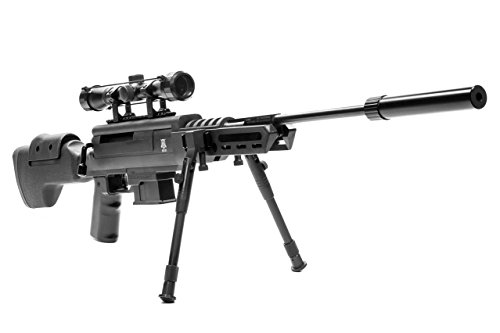
The Black Ops Airgun Sniper Rifle S is a break barrel .22 caliber pellet gun designed for shooters who want a tactical-style air rifle with serious power. It fires pellets up to 1250 feet per second, which puts it in the high-powered category for small game hunting and long-range target shooting. This rifle is best suited for hunters, plinkers, and outdoorsmen who appreciate a gas piston system for smoother cocking and more consistent velocity compared to traditional spring-piston designs.
Real-world performance hinges on the quiet shot cycle and the accuracy potential from the bundled 4x32 scope and bipod. The gas piston reduces vibration and noise, making follow-up shots less disruptive. The trigger pull is described as smooth, which helps with precision. However, at nearly 13 pounds, this is not a lightweight rifle. You will feel the weight during extended carry sessions or when shooting offhand without a support. The break barrel action can also be stiff for some users, especially when new.
Build quality is solid: the barrel and action use blued steel, while the stock is a tough polymer with a comfortable grip. The included scope and bipod add value, but aftermarket upgrades may be needed if you demand exceptional glass. The first 5-50 shots may be louder as the rifle breaks in, according to the product description.
Overall, the Black Ops S is a good option for stationary target practice or hunting from a blind where weight is less of an issue. It offers a lot of features for the price, especially if you want a quiet, high-powered air rifle with a tactical look.
Since this is an air rifle, the term cutting performance refers to its accuracy, power delivery, and consistency on target. The .22 caliber barrel launches pellets at up to 1250 FPS, which provides enough energy for small game like squirrels and rabbits at moderate ranges. The gas piston system helps maintain shot-to-shot consistency because it is less affected by temperature and holds the piston in a neutral position when uncocked.
Accuracy is aided by the 4x32 scope included in the box. The scope gives a clear sight picture for precise shots out to 40-50 yards. The bipod adds stability when shooting from a bench or prone position, which is crucial for precision. The smooth trigger pull reduces the chance of jerking the shot off target.
Control during use is decent thanks to the comfortable grip and the weight of the rifle, which soaks up movement. However, the heavy weight can make offhand shooting less steady. For outdoor tasks like hunting, the quiet operation is a major advantage it won't spook other game in the area. The rifle is not designed for food preparation or wood processing, so those are not applicable here.
The Black Ops S features a blued steel barrel and action, giving it a rugged, corrosion-resistant core that can handle outdoor conditions. The stock is made from a quality polymer with a textured pistol grip and forearm, providing a secure hold even in wet or gloved hands. The overall length is 48 inches, which is typical for a full-size air rifle.
Weight is the main trade-off at 12.94 pounds. This heft makes the rifle stable when shooting from a rest but less portable for hiking. There is no pocket clip or sheath, of course, but the rifle does include an adjustable bipod and a sling mount for carrying. The included scope is a 4x32 unit with covers, which is adequate for general use but not high-end.
Ergonomics are well thought out with a comfortable cheek rest and a reachable trigger. The picatinny rail on the bottom allows you to attach a bipod (included) or other accessories. The integrated suppressor is fixed and reduces muzzle blast significantly. Durability should be good for regular target shooting and hunting, though as with any air rifle, proper maintenance like occasional lubrication and cleaning will extend its life. Overall build quality is solid for the price point.
Humane Airgun Hunting: Energy, Caliber, and Practical Execution
Dispatching small game humanely with an air rifle depends on matching mechanical power to quarry physiology. A rabbit weighs between two and five pounds, featuring a light skeleton but an alert nervous system. Evaluating whether a rifle has sufficient power requires looking past marketing claims to examine delivered terminal energy, trajectory, and projectile construction. When equipped with the right caliber and dense hunting pellets, an air rifle provides a controlled, quiet harvesting method at practical distances.
Minimum Energy Requirements for Ethical Small-Game Hunting
Kinetic energy delivered downrange determines whether a rifle can cleanly dispatch small game. Experienced hunters generally consider twelve foot-pounds of energy (FPE) at the target to be the minimum standard for a rabbit headshot. If taking a heart-lung shot, that requirement increases to fifteen or twenty FPE to ensure adequate internal trauma. Underpowered rifles that merely punch paper will wound game rather than providing an immediate harvest.
Muzzle energy ratings printed on retail packaging rarely tell the complete ballistic story. A pellet sheds a substantial percentage of its initial velocity within twenty yards due to aerodynamic drag. Lightweight alloy pellets fired at extreme speeds lose momentum far faster than heavier lead alternatives. Calculating residual energy at your expected shooting distance ensures the projectile retains sufficient force to penetrate bone.
Penetration depth matters far more than advertised muzzle velocity during field hunting. Low-mass pellets traveling at extreme speeds often fragment or deflect upon striking bone. Conversely, a heavier projectile traveling at moderate velocity maintains forward momentum, creating a clean wound channel to vital structures. Focusing on terminal penetration rather than raw speed guarantees reliable results on live quarry.
Caliber Selection: Comparing .177, .22, and .25 for Rabbits
Caliber choice directly influences energy delivery and wound channel diameter in the field. The .22 caliber pellet remains the premier standard for harvesting rabbits and similar small pests. Its broader surface area and heavier mass deliver substantial knockdown punch upon impact. Additionally, .22 caliber pellets resist wind drift and punch through light vegetation more reliably than smaller alternatives.
The common .177 caliber presents distinct challenges when hunting quarry larger than garden pests or small birds. A lightweight .177 pellet produces a narrow wound channel that can pass through muscle without dropping the animal immediately. The margin for error is narrow, requiring flawless brain shots under field shooting conditions. As a result, most experienced airgun hunters prefer larger calibers for greater forgiveness.
Moving up to .25 caliber provides tremendous terminal authority at the expense of a curvier trajectory. The heavy weight of a .25 pellet transfers massive energy, making it lethal on larger pests around farmsteads. However, in standard spring-piston rifles, the heavier mass leads to significant drop past thirty yards. For shooters working within modest distances, .25 caliber hits hard, but .22 caliber offers the best overall balance.
Pellet Design and Weight: Selecting Hunting Projectiles
The aerodynamic profile and density of an airgun pellet dictate downrange accuracy and terminal performance. Domed round-nosed pellets represent the ideal configuration for small-game hunting due to their high ballistic coefficient. Unlike pointed pellets, which often wobble at higher velocities, domed designs remain stable across longer distances. Their rounded profile penetrates deeply into bone, delivering instant incapacitation.
A prime example of a dependable hunting projectile is the H&N Sport Haendler & Natermann Baracuda Match. Sized in .22 caliber with a substantial 21.14-grain weight, this heavy domed pellet provides exceptional knockdown authority. The snug barrel fit promotes uniform velocity and tight shot groups, even when engaging targets at extended ranges. Its robust construction and protective screw-on container make it an excellent choice for field pest control.
Hollow-point pellets are frequently marketed for pest control, but their performance in air rifles can be erratic. Typical airguns lack the extreme velocity necessary to expand lead hollow points reliably in soft tissue. If the cavity fails to expand, the pellet acts like a blunt cylinder, shedding velocity quickly during flight. Dense domed lead pellets consistently outperform hollow designs in real-world conditions.
Matching pellet mass to your rifle’s specific power plant prevents erratic accuracy and internal wear. Firing a very heavy pellet from an underpowered spring rifle produces a sluggish trajectory and heavy drop. Conversely, shooting an ultra-light pellet from a magnum rifle can break the sound barrier, causing erratic flight turbulence. Testing several quality domed pellets will determine which weight groups tightest in your specific barrel.
Air Rifle Powerplants: Break-Barrel, Gas Piston, and PCP Systems
The powerplant driving your air rifle determines how the gun handles and performs in hunting environments. Break-barrel airguns powered by coiled springs or sealed gas pistons offer self-contained field reliability. They require no external charging cylinders, hand pumps, or disposable gas cartridges. Cocking the barrel compresses the internal piston, priming the rifle for an instant, high-energy shot whenever a target emerges.
Modern gas pistons elevate break-barrel performance to magnum hunting standards. The Gamo Swarm Magnum 10X GEN3i Inertia Fed .22 illustrates these engineering advancements. Driven by an IGT Mach 1 gas piston with a 33mm cylinder, it delivers manufacturer-rated speeds up to 1,300 feet per second. Its horizontal ten-shot inertia magazine cycles pellets automatically upon cocking, while Whisper Fusion dampening keeps acoustic output low.
Another capable option is the Black Ops Airgun Sniper Rifle S .22 Pellet Gun, designed for steady perimeter hunting. Generating manufacturer-listed speeds up to 1,250 feet per second, it features a durable polymer stock and an integrated suppressor. An adjustable bipod and 4×32 scope provide stable resting positions when shooting from blinds or fence borders. The smooth gas-piston action delivers consistent cocking effort across fluctuating temperatures.
While break-barrels provide complete independence, pre-charged pneumatic systems offer virtually recoil-free shooting and fast follow-up shots. Setting up modern hunting PCP air rifles allows hunters to take consecutive shots without shifting shooting positions. However, PCP rifles demand dedicated charging equipment like high-pressure hand pumps or compressed air tanks. For quick backyard pest management, a self-contained gas-piston rifle remains a simpler, highly capable alternative.
Precision Shot Placement and Rabbit Anatomy
Pinpoint shot placement is the single most critical factor in achieving an ethical airgun harvest. Because pellets lack the hydraulic shock of firearm bullets, hunters cannot rely on broad vital margins. A rabbit’s brain is roughly the size of a walnut, demanding careful marksmanship. Striking this compact area destroys the central nervous system instantly, eliminating any chance of the animal escaping underground.
The premier target on a broadside rabbit sits midway between the eye and the base of the ear. This entry point breaches the thinnest section of the skull, delivering energy straight into the cranial cavity. A direct shot between the eyes works equally well if you are elevated above the quarry. If the rabbit faces away, targeting the base of the skull produces the same immediate dispatch.
Body shots directed at the heart and lungs carry substantial risk when using standard airguns. Even with a well-placed thoracic shot, a rabbit frequently retains enough oxygen to sprint twenty yards into thick brush or an inaccessible burrow. Losing an animal down a hole is frustrating for any responsible hunter. Unless operating high-powered PCP platforms, always prioritize brain shots over chest placements.
Assessing animal behavior before triggering the shot prevents errant pellets and wounded game. Rabbits regularly pause and freeze to scan for predators, providing ideal motionless shooting windows. Wait until the animal pauses while feeding or sits upright in broadside profile before taking your shot. Avoid shooting while the animal is hopping, grooming rapidly, or partially shielded by grass stems that can easily deflect pellets.
Understanding Range Limits, Trajectory, and Wind Drift
Defining realistic range limits is essential for consistent accuracy and adequate downrange energy. For most spring and gas-piston air rifles, thirty to thirty-five yards represents the outer limit for ethical rabbit hunting. Beyond thirty yards, pellet trajectory drops steeply, increasing the likelihood of missing the compact vital zone. Restricting your shots to within twenty-five yards guarantees flatter trajectories and maximum terminal impact.
Pellet drop accelerates rapidly once a projectile travels past its primary zero point. Sighting in your air rifle at twenty-five yards establishes a manageable trajectory where elevation holdover remains minimal between fifteen and thirty yards. Past thirty-five yards, minor errors in distance estimation can cause the pellet to strike below the braincase, causing non-lethal injuries. Using a laser rangefinder or pacing out landmarks removes guesswork in the field.
Crosswinds create another significant hazard for lightweight airgun pellets traveling through open spaces. A light breeze of ten miles per hour can drift a .22 pellet an inch off target at thirty yards. In hunting situations, an inch of deflection can turn a perfect headshot into a grazing miss. In gusty conditions, stalk closer to your quarry or align your shooting angle directly with the wind direction.
Hunters who prioritize mechanical consistency often favor fixed-barrel rifles over break-barrel actions. Examining precision underlever air rifles demonstrates how a stationary barrel eliminates pivot-joint movement over thousands of cocking cycles. Because the barrel remains fixed to the cylinder and receiver, scope alignment stays remarkably consistent over time. This structural stability provides shooters with added confidence when attempting precise headshots at extended distances.
Sighting Systems and the Challenge of Airgun Recoil
Optic durability and mount security are critical considerations when outfitting a hunting air rifle. Unlike firearms that push backward, spring-piston and gas-piston airguns generate a sharp two-way recoil cycle. The rifle moves backward as the piston releases, then jerks forward violently when the piston strikes the front chamber wall. This bi-directional impulse can easily shatter internal reticle assemblies on standard firearm scopes.
Always verify that your scope is explicitly rated for airgun recoil and equipped with an etched glass reticle. Dedicated mounts, such as recoil-absorbing rail systems, incorporate polymer cushions to isolate delicate optics from mechanical vibration. Additionally, installing scope rings with integrated stop pins prevents the optic from creeping along the mounting dovetail during strings of shots. Checking ring torque periodically ensures your zero remains locked in.
An adjustable objective or side parallax turret is essential for resolving clear sight pictures at hunting ranges. Standard firearm scopes are often factory-set for parallax at one hundred yards, producing blurred images and reticle drift at twenty yards. An airgun scope focusing down to ten yards delivers razor-sharp clarity on small targets. This crisp focus allows you to detect small twigs or obstructions before pulling the trigger.
Field Safety, Legal Compliance, and Humane Practices
Responsible airgun hunting requires thorough awareness of local wildlife statutes and boundary lines. While airguns face fewer federal restrictions than firearms, many state and regional authorities regulate airgun hunting for game species. Certain jurisdictions require minimum calibers or muzzle velocities for harvesting game, while others restrict airguns to nuisance pest control. Reviewing local hunting regulations before entering the field protects you from citations and ensures lawful operation.
Maintaining a safe, impenetrable backstop is an absolute field rule that must never be neglected. A high-velocity .22 pellet retains enough energy to travel several hundred yards and cause severe injury or property damage. Always ensure your shot trajectory terminates in soft soil, an earthen mound, or a solid tree base. Never shoot toward fence lines, building structures, or animals silhouetted against open skylines.
Practicing from realistic field shooting positions builds the marksmanship discipline needed for humane harvests. Spend time shooting from kneeling, seated, and fence-supported stances rather than shooting solely from a level bench rest. If you cannot place five shots inside the size of a coin at thirty yards, reduce your shooting range accordingly. Honoring the game animal means taking shots only within your proven accuracy envelope.
Practical Summary on Airgun Rabbit Hunting
Modern air rifles provide abundant power to harvest rabbits humanely when operated with proper ammunition and disciplined fieldcraft. Selecting a capable gas-piston or PCP platform in .22 caliber, shooting dense domed lead pellets, and restricting shots to thirty yards ensures reliable, instantaneous harvests. Emphasizing headshots between the eye and ear eliminates suffering and delivers efficient pest management. With proper practice and careful range discipline, an air rifle stands as a quiet, effective tool for small-game hunting.






Write Your Review
No reviews yet. Be the first to share your experience!