


Many airgun enthusiasts appreciate the clean operation and rapid-fire convenience of gas cartridges while wondering how much punch these systems can realistically produce. Pinpointing %what is the most powerful co2 air rifle% requires understanding both standard pellet ballistics and specialty projectile systems like pneumatic arrows. While carbon dioxide has powered target pistols and backyard plinkers for generations, inherent thermodynamic limits dictate how much kinetic energy standard canisters can generate. Shooters weighing downrange energy against filling convenience often compare these platforms with practical value PCP air rifles, yet CO2 remains popular for spontaneous shooting sessions without external pumps or tanks.
Standard lead pellet rifles operating on 12-gram or 88-gram canisters typically deliver between 10 and 14 foot-pounds of energy due to operating pressure caps. In contrast, specialized hybrid platforms such as arrow-launching guns can propel heavier shafts up to 35 foot-pounds of muzzle energy using identical gas sources. Exploring the true performance envelope of CO2 air rifles helps prospective buyers align expectations with their intended shooting disciplines, whether knocking down reactive plinking targets or pursuing lawful pest management. By examining projectile weights, canister capacities, and modern high-pressure cartridge alternatives, you can select an airgun that delivers the impact and reliability you need.

Pros
- Consistent velocity from first to last shot due to CO2 system
- Easy to load and shoot without pumping or complex steps
- Comfortable ergonomic grip with deep checkering for wet or gloved hands
Cons
- CO2 cartridges must be purchased separately and have limited shot count per cartridge
- Not a knife or cutting tool; serves a different purpose for outdoor gear collections
- Limited to 15 shots per magazine; may require frequent reloading during extended sessions
This Crosman Daisy Powerline 426 Air Pistol is a CO2-powered BB pistol designed for recreational target practice and skill development. It is best suited for outdoor enthusiasts, campers, and hunters who want to refine their marksmanship without the cost and noise of live ammunition. While not a knife or cutting tool, it complements an EDC kit by providing a training aid for situational awareness and trigger control.
Real-world performance is straightforward: the semi-auto action allows rapid follow-up shots, and the consistent 430 fps velocity ensures reliable knockdown of tin cans or steel plates. The built-in 15-round magazine simplifies loading, and the molded grip with finger grooves offers a secure hold even in damp conditions. Build quality is typical of Crosman’s air gun lineup—durable polymer frame with steel barrel internals. Portability is good; the pistol is lightweight enough to toss in a range bag or backpack.
A realistic limitation is that CO2 cartridges are consumable and performance drops in cold weather. Also, some users may prefer a single-action trigger for precision work. Overall, this pistol is a practical choice for plinking, target practice, and introducing new shooters to semi-automatic handling. It may not replace a dedicated knife for cutting tasks, but it fills a niche for outdoor fun and training.
While this air pistol does not perform cutting tasks, its shooting performance can be evaluated in terms of accuracy, consistency, and control. The edge sharpness of its performance lies in the consistent muzzle velocity of 430 fps, which remains stable throughout the CO2 cartridge life. This consistency mimics the feel of a fixed-blade knife’s dependable cutting stroke.
Cutting efficiency in this context refers to the pistol’s ability to knock over targets reliably—comparable to a sharp knife’s ability to slice through material with minimal drag. The semi-auto trigger allows rapid follow-up shots, akin to fast deployment in a cutting tool. Lock reliability is replaced by the gas seal of the CO2 system, which holds steady until the cartridge is depleted.
Control during use is enhanced by the molded finger grooves and checkering, similar to a well-textured knife handle. Precision cutting capability translates to the pistol’s ability to hit small targets at typical plinking distances (15-30 feet). For outdoor task suitability, this pistol works well for reactive target practice and can be used for pest control in a pinch. It is not suitable for food prep or wood processing.
The Crosman Daisy Powerline 426 features a polymer frame with a built-in BB magazine, keeping the design simple and lightweight. The blade steel quality is replaced by the steel barrel and internal components, which are durable enough for thousands of shots. The handle material quality is good—the molded grip with deep checkering and finger grooves provides a secure hold, even with sweaty or gloved hands.
Weight and portability are excellent; at under 1 pound, it is easy to carry in a backpack or range bag. There is no pocket clip, but the holster-friendly shape fits standard airsoft holsters. Durability is typical for this price point; the polymer frame resists impacts, and the steel internals withstand normal use. Corrosion resistance is decent—the barrel is blued steel and should be wiped down after use. Carry comfort is not an issue due to its low weight, and storage is simple: keep in a padded case away from moisture.
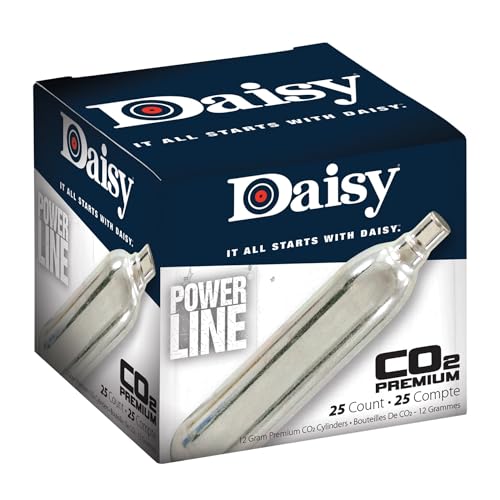
Pros
- Delivers steady pressure for smooth cycling and uniform trajectory
- Universal fit across standard 12-gram CO2 airgun platforms
- Tight manufacturing tolerances protect internal O-rings and piercing pins
- Compact 25-pack box is easy to organize in range bags or gun lockers
Cons
- Ambient cold temperatures can reduce velocity and overall shot count per cylinder
- Single-use non-refillable design requires proper disposal after emptying
- Does not include airgun silicone lubricating oil in the package
The Daisy Powerline 12-Gram CO2 Cylinders come in a practical 25-count pack designed to supply clean, consistent propellant to compatible airguns. Whether running semi-automatic air pistols for tactical drills or sighting in a pellet rifle for backyard target practice, having steady gas flow is essential. These standard 12-gram cartridges serve as the primary power plant for a vast range of target and training airguns, making them a staple accessory for recreational shooters across the country.
This fuel pack is well suited for recreational plinkers, firearms instructors running low-cost trigger control drills, beginners learning fundamental firearm safety, and experienced marksmen keeping their mechanics sharp between range trips. Because airgun training replicates sight alignment, grip, and trigger squeeze without the noise or expense of live centerfire ammunition, these cartridges provide a convenient training tool for home defense owners and sport shooters alike.
Reliable pressure delivery directly influences shot-to-shot consistency and downrange accuracy. According to product specifications, Daisy builds these cylinders to tight tolerances to deliver steady internal pressure throughout the active charge. This consistent pressure allows airgun valves to cycle smoothly, helping preserve a steady muzzle velocity from the first shot through the primary string. As with all CO2 power systems, shooting in rapid succession or colder ambient conditions will naturally cause pressure drops, so pacing shots helps maintain flat trajectories.
Durability and clean neck construction are critical for maintaining the longevity of airgun seals and puncture pins. Daisy crafts these steel cylinders with uniform wall thickness and clean neck profiles that seat cleanly against internal O-rings. A cleanly manufactured tip prevents metal burs from damaging delicate rubber or polyurethane seals, avoiding pesky gas leaks during an active shooting session. Their compact size makes them easy to stow inside shooting range bags, utility boxes, or field packs without adding unnecessary bulk.
Practical safety and maintenance are straightforward with standard 12-gram cylinders. Users should inspect the neck before insertion, seat the cylinder firmly without overtightening the piercing screw, and occasionally place a drop of airgun-rated silicone lubricant on the tip to nourish the internal seals. Storing cartridges in a temperature-controlled space away from direct sunlight preserves pressure integrity and ensures safe handling before every training session.
For sport shooters and plinkers seeking an affordable, dependable propellant for high-volume target practice, the Daisy Powerline 25-pack represents a solid choice. While CO2 platforms carry inherent temperature sensitivity compared to pre-charged pneumatic systems, these cylinders provide the dependable reliability needed for informal plinking, instructional courses, and backyard marksmanship practice.
Daisy Powerline 12-gram cylinders are engineered to standard industry dimensions, ensuring broad compatibility across major airgun brands that accept standard disposable CO2 powerlets. They fit neatly into pistol grips, under-barrel chambers, and rotary magazine air rifles without jamming or binding during insertion.
The uniform neck profile allows clean piercing across various needle mechanisms, from thumb-screw clamps to quick-cam levers. Sport shooters using replica handguns for holster draw practice and trigger reset drills can rely on these cylinders to match the mechanical specifications of their training platforms.
On the firing line, consistent propellant pressure translates directly into predictable group sizes. Daisy Powerline cartridges maintain stable pressure levels during moderate firing tempos, giving shooters reliable cycling in blowback pistols and uniform projectile speeds in target rifles.
For optimal range performance, shooters should allow a few seconds between shots to mitigate the natural cooling effect of expanding gas. Keeping a 25-pack tucked into your gear bag ensures uninterrupted practice during extended plinking afternoons or structured marksmanship training.

Pros
- Delivers high pressure without manual effort or bulky compressors
- Simple to install and replace with clear instructions
- Safe storage design - no leaks or gradual pressure loss when left in the gun
Cons
- Only compatible with N2-designated airguns - not for CO2 or standard PCP models
- 36 cartridges may be expensive for frequent shooters who go through many fills
- Once pierced, the cartridge is single-use and cannot be refilled
The Umarex NitroAir is a prefilled nitrogen cartridge engineered specifically for N2-designated airguns, such as the Umarex Komplete NCR. Unlike traditional PCP airguns that require manual pumping or bulky tanks, these disposable cartridges provide a portable and convenient power source. Each cartridge holds 32 grams of compressed nitrogen at 3600 PSI, delivering consistent shot performance without the need for additional equipment.
This product is best suited for airgun enthusiasts who want a straightforward, high-pressure solution for target shooting, pest control, or recreational plinking. The NitroAir system eliminates the learning curve and physical effort associated with hand pumps or compressors, making it particularly appealing for beginners or those who value simplicity.
In real-world use, the cartridge screws into the N2-designated airgun breech, and once the seal is pierced, a half-turn further ensures a gas-tight connection. According to user feedback, installation is quick and the nitrogen pressure remains stable for multiple shots. The design prevents accidental use in CO2 airguns thanks to a recessed piercing surface, enhancing safety.
Build quality is solid, with a robust metal casing that resists dents and corrosion. The compact size makes it easy to store in a range bag or tackle box. However, the single-use nature means each cartridge is exhausted after filling, and replacement costs add up for high-volume shooters. Also, it only works with airguns bearing the N2 symbol, so compatibility is limited.
Overall, the Umarex NitroAir is a smart choice for N2 airgun owners who prioritize convenience and consistent performance. The two-pack provides a reasonable starting supply, and the hassle-free operation is a genuine advantage over traditional air sources.
While the NitroAir cartridge is not a cutting tool, its performance can be measured in terms of piercing and sealing efficiency. The piercing surface is designed to open cleanly when screwed into the airgun, creating a reliable gas pathway. The half-turn after piercing ensures a proper seal, which is critical for maintaining pressure and preventing leaks.
The 3600 PSI pressure provides consistent shot velocity, which is essential for accuracy in target shooting or pest control. Unlike CO2, which fluctuates with temperature, nitrogen pressure stays stable across a wider temperature range, offering more predictable performance in varying weather.
The cartridge's control during use is straightforward - simply install and it’s ready. No adjustment or fine-tuning required. For airgun tasks like precision plinking or small-game hunting, the consistent pressure helps maintain shot-to-shot consistency.
The design does not support food preparation, wood processing, or other outdoor tasks - it is strictly a power source for airguns. However, within its intended role, the NitroAir cartridge performs reliably and efficiently.
The Umarex NitroAir cartridge is constructed from durable steel, capable of handling 3600 PSI internal pressure without deformation. The exterior has a corrosion-resistant coating, suitable for storage in humid environments like a garage or hunting blind. Each cartridge weighs 32 grams and measures compactly, making it easy to carry in a pocket or pouch.
The patent-pending inset piercing surface is a key design feature: it prevents accidental insertion into CO2 airguns, reducing the risk of damage or injury. The threading is precision-machined for a snug fit into compatible airgun breeches, and the o-ring creates a reliable seal once pierced.
Ergonomics are minimal since the cartridge is entirely functional - no grip or handle required. Portability is excellent; the two-pack fits easily into a small case. Storage is convenient because the cartridge can remain in the airgun without venting or leakage, according to the manufacturer.
Durability is sufficient for occasional field use, though dropping the cartridge on hard surfaces could dent the steel and compromise the seal. Overall, the build quality matches the price point, offering reliability for N2 airgun owners.

Pros
- Quiet operation compared to traditional firearms, ideal for stealth hunting
- Compact and lightweight for transport in a backpack or vehicle
- Easy to use with simple CO2 cartridge insertion and no complex bowstring adjustments
Cons
- CO2 cartridges are not included and require separate purchase; performance may drop in cold weather
- Limited to about 27 effective shots per cartridge, which may be insufficient for extended outings
- Not suitable for large game; best for small game or target practice
The Umarex AirJavelin is not a knife, but it serves a similar role as a compact, precision hunting tool for outdoor enthusiasts. It is best suited for hunters, campers, survivalists, and backpackers who need a quiet, efficient way to take small game or practice target shooting without the noise and bulk of a firearm. Based on user feedback, the AirJavelin delivers reliable performance with its CO2-powered mechanism, shooting up to 300 fps and producing up to 35 fpe energy. That is enough power for squirrels, rabbits, and other small critters.
In real-world use, the gun is easy to load and fire. The included carbon fiber arrows are durable and feature field tips for hunting. The fixed orange fiber optic front sight works well in bright and moderate light. The picatinny rails let you add a red dot scope or a bipod for better accuracy. The all-weather stock and rubber recoil pad make it comfortable to hold, even in wet conditions.
Some drawbacks to consider. CO2 performance drops in cold weather, so it may not be ideal for winter survival use. The 27-shot capacity per cartridge is fine for a day trip but you may want to carry spare cartridges. The gun is not designed for large game. Overall, this is a solid choice for anyone wanting a lightweight, quiet arrow launcher for hunting and survival prep.
While the AirJavelin is not a cutting tool, its arrow performance mimics precision cutting. The arrows fly at up to 300 fps with 35 fpe, delivering enough kinetic energy for clean kills on small game. The 50-grain field tips penetrate well into soft targets. Accuracy is good at typical hunting distances up to 30 yards. The fiber optic front sight helps with quick alignment. For target practice, the arrows group consistently when paired with a stable shooting platform. The included carbon fiber arrows are lightweight and retain their straightness after repeated use.
The Umarex AirJavelin is built around a CO2 reservoir and a composite stock. The all-weather stock is textured for grip, and the rubber recoil pad absorbs some vibration. The picatinny rail on the barrel allows mounting of optics, while the lower rail can hold a bipod or flashlight. The gun weighs 4 pounds, making it easy to carry during hikes. The carbon fiber arrows are robust and resist bending. The CO2 system uses a standard 88-gram cartridge, and the seal is reliable when using Umarex-brand CO2. Overall build quality feels solid for its price range.
Color: Multi
Size: One Size
Dimensions: 2.56 x 32.68 x 10.24 inches
Weight: 4 Pounds
Product Group: Sports
Power: One 88-gram CO2 cartridge (not included)
Muzzle Velocity: Up to 300 fps
Kinetic Energy: Up to 35 fpe
Shots Per Fill: Up to 27
Included Accessories: 3 carbon fiber arrows with 50-grain field tips
Sights: Fixed orange fiber optic front sight
Mounts: Picatinny accessory rails

Pros
- Full-auto mode provides thrilling rapid-fire experience
- Blowback adds realism for training or fun
- Adjustable stock and multiple rails allow customization
- Magazine design simplifies reloading mid-session
Cons
- CO2 cartridges can be expensive for extended shooting sessions
- Full-auto mode drains CO2 quickly, limiting sustained use
- Not suitable for hunting or pest control due to low power and BB ammo
The Crosman CFAR1B Full Auto R1 is a CO2-powered BB air rifle designed for shooters who want a realistic, fast-firing replica experience. Unlike a firearm, it uses compressed CO2 cartridges to propel steel BBs, making it ideal for backyard plinking, target practice, and introducing new shooters to rifle handling.
This air rifle is best suited for casual plinkers, shooters training for firearm handling, and anyone looking for an affordable full-auto experience. The heavy feel and blowback action mimic a real rifle, helping users build familiarity with recoil and follow-up shots.
In real-world use, the R1 excels at rapid-fire fun. Flipping the lever to full auto lets you dump 25 rounds in about a second, which can be a blast for reactive targets. The 6-position stock and four-sided rails allow you to attach red dot sights, flashlights, or grips to match your preferences. The magazine drops out for quick reloads, keeping both BBs and CO2 cartridges together for balance.
Build quality is solid for the price point, though the polymer stock won't feel as premium as real wood. The CO2 system is standard and easy to load. Realistic drawbacks include limited power for anything beyond plinking, and the full-auto mode drains CO2 quickly, meaning you'll go through cartridges fast during extended sessions.
Overall, the Crosman R1 is a fun, training-oriented air rifle that delivers on its full-auto promise. If you want a realistic feel without firearm noise and enjoy rapid-fire plinking, this is a great choice.
While the Crosman R1 is not a cutting tool, its shooting performance deserves evaluation. The CO2 system provides consistent velocity for BBs, allowing for accurate shots at typical backyard ranges of 30-50 feet. The blowback action introduces a mild recoil that helps simulate real firearm handling, aiding in practice.
The full-auto mode delivers a high rate of fire that is impressive for an air rifle, though accuracy suffers during rapid bursts due to recoil and the nature of smoothbore BB barrels. Single-shot mode offers better precision for target practice.
Magazine capacity of 25 rounds allows for sustained shooting before reloads. The drop-out magazine is quick to swap, minimizing downtime. Velocity is moderate, typical for CO2 BB guns, so it is not suitable for hunting or serious pest control. Control during use is helped by the adjustable stock and overall weight, which keeps the rifle steady.
Precision shooting is possible with a red dot sight mounted on the rails. The 4-sided rail system also allows for a bipod for stability. For plinking cans, spinners, and paper targets, the R1 performs admirably. For food preparation or wood processing, it is not intended.
This air rifle is best for recreational shooting and training, not for outdoor tasks requiring cutting.
The Crosman R1 features a black polymer stock with a metal barrel assembly, giving it a weight of 6 pounds that feels substantial. The 6-position adjustable stock allows for length-of-pull customization, accommodating different shooter sizes. The four-sided Picatinny rails on the barrel shroud provide ample mounting options for accessories like red dot sights, flashlights, or foregrips, enhancing versatility.
Ergonomics are decent with a comfortable pistol grip and a cheek rest that works well for cheek weld. The blowback mechanism adds mechanical complexity but delivers satisfying tactile feedback. Durability is typical for Crosman air rifles; the plastic stock may show wear over time but the internal components are standard and replaceable.
Portability is moderate. At 6 pounds, it's not too heavy to carry around the backyard or to a range. The design includes a sling mount (not included) for easier transport. Corrosion resistance is adequate since the barrel is steel and the receiver is mostly polymer. Carry comfort is fine for short sessions, and storage is easy as it fits in a standard gun case or closet.
The drop-out magazine is a highlight, keeping BBs and CO2 cartridges united for rapid reloads. Overall, the build is functional and oriented toward realism and customization rather than premium materials.

Pros
- Easy to use – just insert a nitrogen cartridge and shoot without pumping or charging
- Consistent velocity and energy thanks to the built-in regulator
- Quiet operation helps avoid spooking game or alerting neighbors
- Scope and magazines included – good value for the price
Cons
- Nitrogen cartridges are not included and must be purchased separately (part #2211382)
- Limited to 45 shots per cartridge – not ideal for extended sessions without spares
- Single-use cartridges create ongoing cost and waste compared to refillable tanks
The Umarex Komplete NCR is a .22 caliber pre-charged pneumatic (PCP) air rifle that breaks from tradition by using disposable high-pressure nitrogen cartridges instead of a built-in air tank. This design eliminates the need for an expensive compressor, bulky scuba tank, or strenuous hand pump. Simply insert a NitroAir cartridge (3,600 psi) into the rifle, and the patent-pending piercing mechanism releases nitrogen at a regulated 1,800 psi for consistent shots.
This air rifle is best suited for small game hunters, pest control, and target shooters who value quiet operation and low maintenance. The integrated SilencAir Technology keeps noise levels very low, making it ideal for hunting in suburban areas or where stealth matters. With a velocity of 975 fps using 11.9-grain pellets and 25 ft-lbs of energy, it has enough power for rabbits, squirrels, and similar game.
Build quality is solid for the price point. The synthetic stock is lightweight and features M-LOK slots on the forend for mounting a bipod or accessory rail. The included 4x32 scope and two 10-round magazines add convenience. However, the nitrogen cartridges are single-use and not included, so factor in the ongoing cost. The 45-shot capacity per cartridge is adequate for a hunting session but may require carrying spares for longer outings.
Overall, the Komplete NCR offers a unique entry point into PCP air rifles without the upfront investment in charging equipment. It's a practical choice for hunters who want consistent power and quiet performance in a package that's easy to transport and use.
While not a cutting tool, the Umarex Komplete NCR delivers cutting-edge shooting performance. The regulated nitrogen system ensures each shot is consistent, with minimal velocity variation across the 45-shot string. This translates to tight groups at typical hunting ranges of 30-50 yards.
The .22 caliber is well-suited for small game, offering a balance of energy and trajectory. The 975 fps velocity with 11.9-grain pellets provides a flat enough trajectory for accurate holdover estimation. The internal regulator maintains 1,800 psi, so you don't experience the power drop-off common in unregulated PCPs.
Noise reduction is excellent thanks to the SilencAir Technology. The rifle is noticeably quieter than many spring-piston or CO2 air rifles, which helps in avoiding noise complaints and not alarming game. The trigger pull is crisp out of the box, aiding precision. The scope is basic but functional for getting started.
For hunters, the 10-round magazine allows quick follow-up shots. The M-LOK rail lets you add a bipod for stable shooting positions. Overall, the Komplete NCR performs reliably for its intended use.
The Umarex Komplete NCR features a synthetic stock in grey/black with a textured grip for secure handling. The rifle is lightweight at around 6-7 pounds, making it easy to carry in the field. The Picatinny rail on top accepts the included 4x32 scope, which is mounted with rings and ready to use.
The forend has M-LOK slots on the bottom, allowing you to attach a bipod or accessory rail for lights or lasers. The two 10-round rotary magazines are easy to load and insert. The nitrogen cartridge fits into a compartment under the barrel; the piercing mechanism is simple to operate.
Durability is good for a budget-friendly PCP. The synthetic stock resists weather and impacts. The barrel is rifled steel, and the action is made of metal and polymer. The SilencAir Technology is integrated into the barrel shroud, which also helps protect the barrel. Maintenance is minimal because nitrogen leaves no residue, and there are no seals to wear out from frequent filling.
The rifle is not overly heavy, and the overall design is practical for hunting. The only minor drawback is the need to carry spare nitrogen cartridges, but the system is otherwise straightforward.
Caliber: .22 (5.5mm)
Power Source: Disposable NitroAir N2 cartridge (3,600 psi, regulated to 1,800 psi)
Velocity: 975 fps with 11.9-grain pellets
Energy: 25 ft-lbs
Shots per Cartridge: 45+
Magazine Capacity: 10 rounds (two included)
Scope: 4x32 with rings (included)
Rail: Picatinny for scope, M-LOK on forend
Noise Reduction: Umarex SilencAir Technology
Stock Material: Synthetic (grey/black)
Weight: Approximately 6.5 lbs
Length: Not specified, but typical for a carbine air rifle
Cartridge Part Number: 2211382 (sold separately)
The Komplete NCR comes with two 10-round magazines and a 4x32 scope with rings. Spare magazines are available (part #2251559). You will need to purchase NitroAir cartridges (part #2211382) separately. The M-LOK slots allow adding a bipod or accessory rail for lights or lasers. A good cleaning kit and pellet selection (e.g., JSB, H&N) are recommended for best accuracy.
Output Limits and the Most Powerful CO2 Airgun Platforms
When evaluating what is the most powerful co2 air rifle, shooters must distinguish between raw velocity and downrange kinetic energy. Standard carbon dioxide airguns operate under a strict physical ceiling imposed by the vapor pressure of the liquid gas itself. Because of this mechanical boundary, achieving maximum energy requires rethinking projectile mass and valve efficiency rather than just chasing higher feet per second.
The Kinetic Energy Leader: CO2-Powered Arrow Launchers
The undisputed champion of muzzle energy in the carbon dioxide category is the arrow-launching rifle design, best exemplified by the Umarex AirJavelin CO2 Arrow Gun Air Rifle with 3. Unlike traditional airguns firing lightweight lead pellets or steel BBs, this platform launches custom carbon fiber arrows equipped with 50-grain field tips. Manufacturer specifications indicate that the rifle propels these substantial projectiles at speeds up to 300 feet per second, yielding approximately 34 to 35 foot-pounds of kinetic energy. This energy output is more than triple that of virtually any standard pellet-firing CO2 airgun on the market.
To sustain this level of force, the rifle utilizes an 88-gram CO2 cartridge housed in the forend rather than standard 12-gram cylinders. Manufacturer data indicates that a single 88-gram cartridge provides up to 27 effective shots before pressure drop degrades accuracy. The rifle incorporates an all-weather synthetic stock, Picatinny accessory rails for optics, and an orange fiber optic front sight. Because it shoots full-length arrows with straight flight technology, the platform offers small game capabilities far beyond traditional pellet guns.
The Physics of CO2: Why Conventional Pellets Face an Energy Ceiling
Understanding why standard pellet rifles rarely match arrow launchers requires examining the underlying chemistry of carbon dioxide. Inside any standard powerlet, liquid CO2 exists in constant equilibrium with its gas phase at roughly 850 to 900 pounds per square inch at room temperature. Because the propellant remains liquid until released, internal pressure cannot rise higher without external heat. Unlike pre-charged pneumatic systems operating at several thousand psi, a CO2 rifle must accelerate projectiles using this modest reservoir pressure.
Most standard .177 caliber pellet rifles operating on CO2 max out between 600 and 700 feet per second, yielding roughly 6 to 9 foot-pounds of energy with standard pellets. Stepping up to .22 caliber can raise energy levels to approximately 10 to 14 foot-pounds because the larger base of the pellet offers more surface area for expanding gas. However, pushing past the 15 foot-pound threshold with conventional lead ammunition remains virtually impossible in factory CO2 platforms. Exploring dedicated big bore PCP air rifles highlights the performance gap between standard CO2 output and high-pressure hunting platforms.
Modern Gas Alternatives: High-Pressure Nitrogen Cartridges
Airgun engineers have recently introduced disposable gas cartridges that bypass the inherent pressure limits of carbon dioxide altogether. A primary breakthrough in this category is the Umarex Komplete NCR N2-Powered .22 Caliber PCP Air, an air rifle powered by pre-filled Umarex NitroAir Prefilled Nitrogen Cartridges. While carbon dioxide operates around 850 psi, these disposable NitroAir cylinders contain compressed nitrogen pressurized to 3,600 psi. An internal regulator smoothly releases this volume at a predetermined 1,800 psi, delivering consistent muzzle velocity across 45 or more shots per cartridge.
In terms of ballistic performance, manufacturer specifications indicate that the .22 caliber Komplete NCR propels an 11.9-grain pellet at 975 feet per second. This combination produces 25 foot-pounds of muzzle energy, making it substantially more potent than conventional pellet-firing CO2 rifles. Nitrogen gas also eliminates the dramatic cold-weather performance drops typical of carbon dioxide canisters. The system includes integrated silencing technology, a Picatinny optic rail, two 10-round rotary magazines, and an included 4×32 scope.
Rapid-Fire Action and Steel BB Platforms
Not every shooter prioritizes single-shot energy, as many enthusiasts prefer the rapid cycling and tactical realism that carbon dioxide excels at delivering. Tactical BB rifles such as the Crosman CFAR1B Full Auto R1 CO2-Powered BB Air emphasize cyclical rate and responsive blowback action over raw foot-pound figures. Powered by dual 12-gram CO2 cartridges housed inside a drop-out magazine, this rifle propels steel BBs at advertised velocities reaching 430 feet per second. While a steel BB traveling at this speed produces only 2 to 3 foot-pounds of kinetic energy, the platform offers an adjustable fire selector capable of cycling up to 1,400 rounds per minute.
The R1 features a realistic reciprocating blowback action that provides authentic shoulder feedback with every pull of the trigger. It comes equipped with a six-position adjustable stock and extensive accessory rails on all four sides of the handguard for tactical attachments. However, rapid-fire bursts quickly cool the firing valve, causing gas pressure and projectile velocity to drop noticeably during sustained strings. For recreational plinking on aluminum cans or reactive targets, the modest power level is balanced by rapid-fire excitement.
The Impact of Canister Size: 12-Gram Versus 88-Gram Performance
The physical size of the gas supply plays a critical role in how well any CO2 air rifle maintains its peak energy. Compact target systems and training sidearms like the Crosman Daisy Powerline 426 Air Pistol 15-Count utilize individual cylinders such as Daisy Powerline 12-Gram CO2 Cylinders- 25 Count. These compact canisters are convenient and accessible, but their small thermal mass makes them vulnerable to rapid cooling. When liquid carbon dioxide boils into vapor during discharge, it absorbs heat directly from the metal cylinder and surrounding valve components.
In contrast, large 88-gram canisters provide significantly greater surface area and thermal capacity, dampening the rapid chilling effect during extended shooting strings. Rifles designed around 88-gram bottles retain their optimal working pressure for longer strings of fire before showing noticeable point-of-impact shifts. The trade-off comes in storage flexibility, as leaving a pierced CO2 canister pressurized inside an airgun for weeks can permanently degrade internal rubber seals. With 12-gram setups, shooters can comfortably shoot through a single session and store the gun unpressurized without wasting excess gas.
Temperature Sensitivity and Cold-Weather Power Falloff
Environmental temperature acts as an invisible regulator that directly dictates how much power any CO2 rifle can generate on a given day. On a warm summer afternoon at 85 degrees Fahrenheit, resting cylinder pressure rises toward 1,000 psi, producing crisp valve cycling and maximum advertised velocity. Conversely, shooting in 45-degree conditions drops internal container pressure closer to 600 psi, causing a steep drop in muzzle speed and terminal energy. This thermal dependence explains why velocity ratings on product packaging often reflect ideal warm-weather conditions rather than year-round field performance.
To minimize thermal loss during target practice, experienced shooters avoid firing long continuous strings without pausing between shots. Allowing thirty to forty-five seconds between trigger pulls allows the cylinder to absorb ambient heat and restore optimal vapor pressure. Keeping spare gas canisters in an interior pocket close to body heat before loading can also help maintain performance during cooler mornings. However, never expose CO2 canisters to open flames, direct heaters, or car dashboards, as excessive heat can cause dangerous over-pressurization.
Ethical Use Cases: Matching Power Output to the Target
Because CO2 airguns span a wide spectrum from 2 foot-pounds in BB guns to 35 foot-pounds in arrow launchers, matching the platform to the intended task is vital. Low-energy BB rifles excel at backyard plinking and tactical drills where low noise and safe backstops are the primary concerns. Moderate-power pellet rifles producing 8 to 12 foot-pounds provide excellent precision for paper target matches and reactive silhouette knockdown at distances out to twenty-five yards. If hunting small pests is your main goal, comparing these models with self-contained budget break barrel air rifles provides a useful reference point for mechanical spring power versus gas cartridges.
Arrow-launching platforms occupy an entirely different tier of utility due to their broadhead compatibility and 35 foot-pound output. In jurisdictions where air-powered archery equipment is legally permitted, these platforms can humanely take small game animals and even larger pests at moderate hunting ranges. The broad, razor-sharp cutting surfaces of archery tips do not rely solely on hydraulic shock, allowing them to dispatch targets cleanly despite subsonic velocities. Always verify local fish and game regulations in your specific state or municipality before using any airgun platform for hunting or pest dispatch.
Valve Maintenance and Preserving Factory Velocity
Maintaining peak velocity and consistent shot counts over the lifespan of a CO2 air rifle requires attentive valve care. The sudden release of freezing carbon dioxide gas can dry out internal silicone O-rings, leading to microscopic leaks and reduced muzzle energy. Placing a single drop of specialized airgun silicone oil onto the tip of every third or fourth gas canister lubricates internal seals as the gas circulates through the firing mechanism. Never use petroleum-based lubricants or penetrating oils inside high-pressure airguns, as they can chemically dissolve rubber seals and create safety hazards.
Storage habits also exert a direct influence on the long-term power delivery of your airgun valve. Leaving a punctured 12-gram or 88-gram cartridge clamped tightly inside the gun for extended periods compresses the face seal permanently, reducing its elasticity. Once a seal takes a permanent set, gas escapes around the cartridge neck during firing, reducing the volume pushed down the barrel. Most manufacturers recommend removing used cartridges at the conclusion of a shooting session and easing tension on the piercing screw.
Practical Takeaways and Platform Selection
Answering what is the most powerful CO2 air rifle depends entirely on the projectile configuration you intend to shoot. If maximum kinetic energy is your sole objective, the Umarex AirJavelin CO2 Arrow Gun Air Rifle with 3 stands at the pinnacle of the category with its 35 foot-pound output and 300 fps arrow speed. For traditional lead pellet shooting, physical pressure limits restrict standard CO2 rifles to roughly 10 to 14 foot-pounds, prompting power-focused shooters to explore regulated nitrogen systems like the Umarex Komplete NCR N2-Powered .22 Caliber PCP Air. Meanwhile, platforms like the Crosman R1 prioritize rapid cycling and high magazine capacity over raw terminal energy.
Understanding these mechanical trade-offs ensures you invest in an airgun that matches your practical needs without unexpected performance compromises. Target plinkers can enjoy the fast action and convenience of multi-shot BB rifles, while pest control demands the focused energy of heavy pellets or arrows. Always verify that your chosen ammunition matches the barrel design and manufacturer specifications of your rifle. Proper handling, diligent seal maintenance, and realistic power expectations will keep your gas-powered airgun operating reliably across hundreds of range sessions.



Write Your Review
No reviews yet. Be the first to share your experience!